Pan Am Series – Part XXIX: Technical Assistance Program

Pan American’s Technical Assistance Program

It has long been recognized that Pan American World Airways was an industry leader in the development of flight operations, technology and procedures. What is little known is Pan American’s history of providing technical assistance to fledgling airlines around the world.

As early as 1934, Pan American was already providing technical assistance. From the 1934 Annual Report, the airline boasted of working with the Chinese government in support of China’s aviation programs and highlighted the introduction of “modern flight equipment, new ground radio stations and direction finders.” To be fair, the annual report was a bit ambitious when alluding to the successful cooperation between Pan American and the Chinese. The problem was the weather along the Chinese coastal route of the China National Aviation Corporation. Fog and the wind currents between the mountains and the sea, combined with primitive meteorological support, made flying dangerous and caused two crashes into the hills by the S-38 aircraft sent over from the United States by Pan American. This impaired the airline’s “vaunted reputation for technical skill and concern for safety”, according to Marilyn Bender and Selig Altschul in The Chosen Instrument. Nevertheless, this was one of the earliest instances of Pan American’s technical assistance outside the realm of its operating areas.

In addition, up to and during World War II, Pan American provided significant technical support to its Latin America subsidiaries. These airlines sported similar livery to Pan American’s aircraft and were part of the “Pan American Airways System” that covered nearly all destinations in Latin America. After the war and into the post-war decades, these subsidiaries were eventually sold to local investors or nationalized.

Pan American’s Technical Assistance Program (TAP) formally came into being in 1955 as reported in the annual report for that year:

“Pursuant to the United States policy of furthering the economic development of friendly foreign nations, the International Cooperation Administration (ICA) has commissioned your company to conduct Technical Assistance Programs with the national flag airlines of Pakistan, Turkey and Thailand. Pan American’s mission is to offer technical guidance and personnel training in all aspects of the air transportation industry. Your company is proud to share its 28 years of international airline experience and thus contribute to the improvement of commerce, communications and employment opportunities in these friendly and important nations.”

The next year, Pan American added the national flag airline of Afghanistan, Ariana Afghan Airlines, to its programs. In addition it provided the airline with active management under ICA auspices and also participated as a minority shareholder.

Over the next few years more than 100 skilled Pan American personnel comprised the specialist teams in these programs, and in 1959 key employees of Pakistan International Airlines Corp. and Ariana Afghan Airlines Company Ltd were trained in the United States in the Participant Training Program sponsored by the ICA and the FAA.

In 1965, in cooperation with the US Agency for International Development (USAID), Pan American began providing technical assistance to the national airline of the Republic of Guinea, West Africa. Technical assistance was also provided to Iran and was continued in Afghanistan. Later, the airlines of Vietnam and Ghana were added. By 1967, according to that year’s annual report,“[t]wenty-four airlines in all parts of the world have been assisted by Pan Am over the years”.

Into the 1970s, Pan American continued to provide technical assistance, management and training to various airlines overseas including Ariana, Iran Air, and Air Zaire. The airline also provided airport management under contract at Roberts Field in Liberia and at Muscat and Salalah, Oman.  By 1978, 141 employees were assigned to technical support, mostly overseas. It is not known here when the program was terminated, although no mention is made in annual reports seen subsequent to 1980.

The late John Bigelow, a Pan American Captain, spent a year in Afghanistan as part of the TAP, training pilots of Ariana Afghan Airlines. He wrote a story about his experiences in Pan American World Airways – Aviation History Through the Words of its People. John recently passed away and was well known and respected by his peers, that group of pilots hired in the 1960’s known as the “New Hires”. He will be missed.

“It all started during the Hajj, the annual Muslim pilgrimage to Mecca, for the faithful, a mandatory rite of passage and a passport to heaven and eternity.  For years, Afghan pilgrims had made their way across the deserts and mountains of Afghanistan, Iran, and Saudi Arabia by bus, truck . . . and even camel caravan.  But a visionary King, Mohammed Zahir Shah, with the dream of leading his people into the twentieth century, blessed the conception of the country’s first airline.  In 1957, Ariana Afghan Airlines was born.  At last, pilgrims could fly to Jeddah – the staging point for the pilgrimage to Mecca – in hours rather than days or weeks.

DC-3

“Years later, in early May, 1968, Pan American’s Captain Richard Vinal, Chief Pilot of Latin America, summoned me to his office in Miami.  My reaction was predictable.   Chief Pilots were not in the habit of asking you in to inquire about your health.  I began to formulate complex denials and thought about calling my union representative.  I drove over to the office and sat under the suspicious eye of the Chief Pilot’s secretary who, I was convinced, knew of my misdemeanor, whatever it was.  At last, I was invited in and asked to sit down. The heavy oak door closed behind me, and I noted with some alarm that Captain Vinal and I were alone.

“‘Bigelow, how would you like to go to Afghanistan’?

“I had a vague idea where Afghanistan was – somewhere in Africa, I thought.  Whatever I’d done was about to condemn me to the other side of the world. So I asked my Chief Pilot for some background to his startling question.  A little more kindly now, he explained why we were having this conversation.

“‘Sam Miller, our Vice-President of Flight Operations, called me this morning, wanting to know if I had any young, eager pilots interested in a foreign flight training assignment.  He thinks you might be ready for something like this.

“‘Pan Am owns 49 per cent of Ariana Afghan Airlines and we run a Technical Assistance Program (TAP) with the airline.  Ariana has just acquired a new Boeing 727. Our Project Director out there thinks they need some help training the Afghan pilots.  If you’re interested, I’d like you to go up to New York to talk to Sam Miller.  They need someone out there right away.’

0398-004_album_1200px

“At the time, I’d been with Pan Am for two years and still felt like a new boy.  My wife, Mary Lou, and I talked it over. We discovered Afghanistan was not in Africa but a land-locked kingdom in south-west Asia. To us, it sounded exciting and different, full of adventure and opportunity.

“I bought a paperback copy of James Michener’s Caravans and began reading it on the way to New York.  I was captivated by what I read, spellbound by descriptions of Kandahar, Kabul, and the Hindu Kush.  Suddenly, I was very keen to go there.

?????????????????????????????????????

Ariana 727 over the Hindu Kush

“My interview with the legendary Sam Miller went well.  He had been the commander of the first scheduled commercial flight of a Boeing 707 across the Atlantic in 1958 – a major milestone in Pan Am’s history.  Captain Miller was a gracious, quiet-spoken man and, despite his aura, made me feel at ease.  He was interested in my pre-Pan Am flying experiences in the Canadian Arctic and Middle East.  He had read my personal file and seemed pleased and handed me off to Erskine Rice who headed TAP field operations.

“Rice noted, ‘Were you to accept this assignment, you would be assigned as ‘Advisor’ to the Chief Pilot, Rahim Nowroz.  You would be responsible to him for assessing pilot standards and recommending steps to improve pilot performance.  The Afghan pilots have been trained and released by Boeing instructors, but Charlie Bennett, our project director in Kabul, feels there is a need for ongoing monitoring.

“‘The assignment would be for a year. We need someone out there right away. If you’re interested, I need a decision by the end of the day.’

“I was their man, and I immediately told him so.  He got up smiling, walked around his desk, and we shook hands.  Erskine Rice became more guarded when the discussion turned to Rahim Nowroz – the man I would be advising in Afghanistan.  He said that Nowroz had a reputation for being difficult at times, adding that he was also the King’s personal pilot, and – oh yes – rumored to have a fondness for drink.

“‘John, I’m sure you’ll get along just fine out there.  Go out there and do the best job you know how. I’m sure we’ll all be proud of you.’

“Now I knew I was being conned. No, he wasn’t smiling. He was smirking.

“’What am I getting into?‘”  I thought.

“I was in Kabul when, early in the morning of January 5, 1969, Ariana’s Boeing 727, YA-FAR, crashed three-quarters of a mile short of Runway 27 at London’s Gatwick airport during an instrument approach in a thick, freezing fog.  Our chief of maintenance, Ed Mix, had put his daughter Karen on the flight at Kabul.  With landing gear and flaps extended, the aircraft briefly touched down in a muddy field before becoming airborne again.  The pilot, none other than Captain Nowroz, aware at last that something was wrong, had jammed open the throttles but, seconds before, ten feet of the Boeing’s right wing had been torn away by a large tree.  The aircraft began an uncontrolled, climbing roll to the right, and would have become inverted had not a large two story house stood in its way.  The house and most of the aircraft then exploded in a large ball of burning kerosene.  The cockpit passed inches above the roof and detached itself at the moment of impact, remaining airborne briefly before skidding to a halt in the mud.

“Sixty-nine of the ninety-eight passengers and cabin crew burned to death.  Of those few who survived, most were difficult to recognize as human, even after months of restorative surgery. One of the survivors, a baby girl lying in her bassinette, a toy clutched in her hands, was unharmed in the smoking rubble. Her parents were not so lucky.

“The accident could have been prevented.  But because of a perverse and persistent aspect of human nature, people had to die before anything would change.

“Ed Mix and I traveled to London on Iran Air, a flight that duplicated Pan Am’s flight 115, stopping at Tehran, Beirut, Istanbul, Frankfurt, and London.  Word of the accident had spread to all of Pan Am’s European stations that Ed and I were en route to London.  Ed was well known in Pan Am’s world and well-regarded. At each stop along our way, I deplaned to get an update, leaving Ed in his seat in the cabin, distraught and alone, but grateful for what I was doing.  Pan Am station personnel, waiting for our flight, met me with the latest news:  Few survivors, still no news of Karen. At each stop, as we continued up the line to London, I returned to my seat next to Ed: ‘Nothing yet, no news. But don’t give up. Don’t give up! You hear me?’

“This hard-bitten, cigar-smoking, maintenance manager was now crying.  He reached over to hold my hand. ‘I’m sorry John. I can’t help it. I can’t stop thinking about Karen.  Our beautiful daughter I love so very much . . .’

“On the last leg, from Frankfurt to London, Ed wrote me a note in pencil on an airsick bag. It said: ‘I can’t express myself properly with words at the moment. But I will never forget how important it is that you are here with me, or how grateful I am. Your friend, Ed.’

“I still have the bag.

“We were the first off the airplane at Heathrow.  Pete Dunstan, Pan Am’s maintenance manager in London, and a close friend of Ed’s, waited at the head of the jetway.  He was tight-lipped, a look of infinite sadness on his face.  Ed looked up at him, unable to speak. Pete shook his head and said: ‘I’m sorry, Ed. Karen didn’t make it.’

“Two days later, he and his wife Libby boarded Pan Am’s round-the world flight, ‘Clipper One’ to New York, with their daughter’s remains in the belly of the 707.

“Ed Mix would never return to Afghanistan.

“’You will be leaving us soon, won’t you?’ asked my administrative aide, Captain Gran.

“I answered, ‘It’s time. We both know it.  What can be worse than a guest who overstays his welcome?  My job is done here.  Ariana and its pilots now rank with the best in the world. You don’t need me anymore.’

“He answered, ‘I disagree with you.  We – and I speak for all the pilots – want you to stay.  We will always need you. You are no longer ferangi.  You are part of us; you belong with us.’

I said, ‘Look, Gran. I will always be available, but I must leave Afghanistan. It’s the essence of the program.  From the beginning, I came here to work my way out of this job and train my Afghan replacement – my replacement, not surprisingly, with whom I’m now having lunch.’  Maybe I derailed him with that remark.  When he regained his composure, he said: ‘It is strange how events sometimes unfold, isn’t it? When I look back four years ago, how different things seemed then . . .’

He answered, ‘We were suspicious of you from the start.  I agreed with Rahim – we didn’t need you.  Boeing had trained us, and we knew what we needed to know.  You were yet another example of an unwanted foreign presence. One way or another, the sooner we could get rid of you, the better. 

“’At first we assumed you would just give up and leave like so many others who, for whatever reason, had come to Afghanistan.  But, to Rahim’s frustration and, to a lesser extent, mine, you didn’t.  You were behaving like . . . like an Afghan!  You didn’t give up.  You had the testicles of a goat, and it was driving Rahim crazy!’

“He paused, took a deep breath, and continued.

“This is the part I find most difficult to admit:  I began to see what you were trying to do. But because of my loyalty to Rahim, and because, honestly, I was afraid of him, I did nothing.  If I had cooperated with you then, and you had left, Rahim would have made my life unbearable. We are a small country.  Never forget: Rahim and I are Pashtun, and blood, as they say, runs thicker than water. . . .

“’The accident changed everything.  Captain Rahim Nowroz, my Chief Pilot, I discovered, had committed a dreadful and unforgivable error.  He had killed many people, not the least, the daughter of your friend, Ed Mix.  And of course I knew about his drinking.  I was being split down the middle, in an impossible position.  I will never forget my first meeting with you in London after the crash. I saw myself on a buzkashi field – the calf fought over and pulled apart by opposing chapandaz.  You, Pan Am, and the British on one side, Afghanistan and everything it stands for on the other. I must tell you, John, it was the worst moment of my life.’

He continued, ‘What you did – and this is perhaps the most important aspect of your time with us – was to take our natural inclination to compete and to win at any cost, and to turn this inclination into something positive.  No longer could we buy our way into the seat of an airplane.  No longer was it a question of who we knew or how we were related. Only through training, only through passing through the necessary gates could we expect to succeed. We were all now competing with each other to be the best. . . .

“’We could not figure this out for ourselves; it took a pale-skinned, blue-eyed ferangi to do it for us.’

“I thought about what Gran had said. I was flattered by his words, but it went beyond the apparent success of this Afghan endeavor. For me, from its outset, it had been born out of failure.  In that moment, I saw what I was really doing here: proving to myself I wasn’t quite the hopeless screw-up I’d always seemed to be.  After so many false starts in my life, I’d needed a win.  Maybe, at last, I had one.

“I went on, ignoring him.  

“I said to him, ‘You, my friend, belong in an airplane, not behind a desk.  You know it.  No one ever was killed by paperwork, only inconvenienced. We’ll find someone to fill those administrative duties.  I’m recommending that you be appointed Chief Pilot, Training and Check.  It’s the only reason I can leave Afghanistan and sleep at night’”.

“I still sleep at night; now I am doing the sleeping in Dubai, training pilots at my ripe age of 75. Never will I forget my Afghan Journey, the frustrations and accomplishments. The turbulence and mistrust today, however, cause me to question whether Afghanistan can ever return to the era of serenity and enlightenment which I experienced in the sixties. May peace overcome.”

Arian 707

For additional information about Pan American World Airways:

To learn more about the history of this pioneering airline, click on the title below for preview of

Pan American World Airways – Images of a Great Airline Second Edition

This book is available on eBay .

Another excellent book is Pan Am – Personal Tributes to a Global Aviation Pioneer, which was published to commemorate the 90th Anniversary of Pan Am’s founding. It contains more than 80 stories written by former Pan Am employees and international media friends who had personal experience with many of Pan Am’s key events during its history. It is the perfect companion to Pan American World Airways – Images of a Great Airline Second Edition and can be purchased on Amazon.

Preview Pan American World Airways – Aviation History Through the Words of its People, which is available on Amazon.

For further information about the history of Pan American World Airways, visit: Pan Am Historical Foundation

Pan Am Series – Part XXVIII: Clipper Cargo – 2

Cargo Flights

45-747F

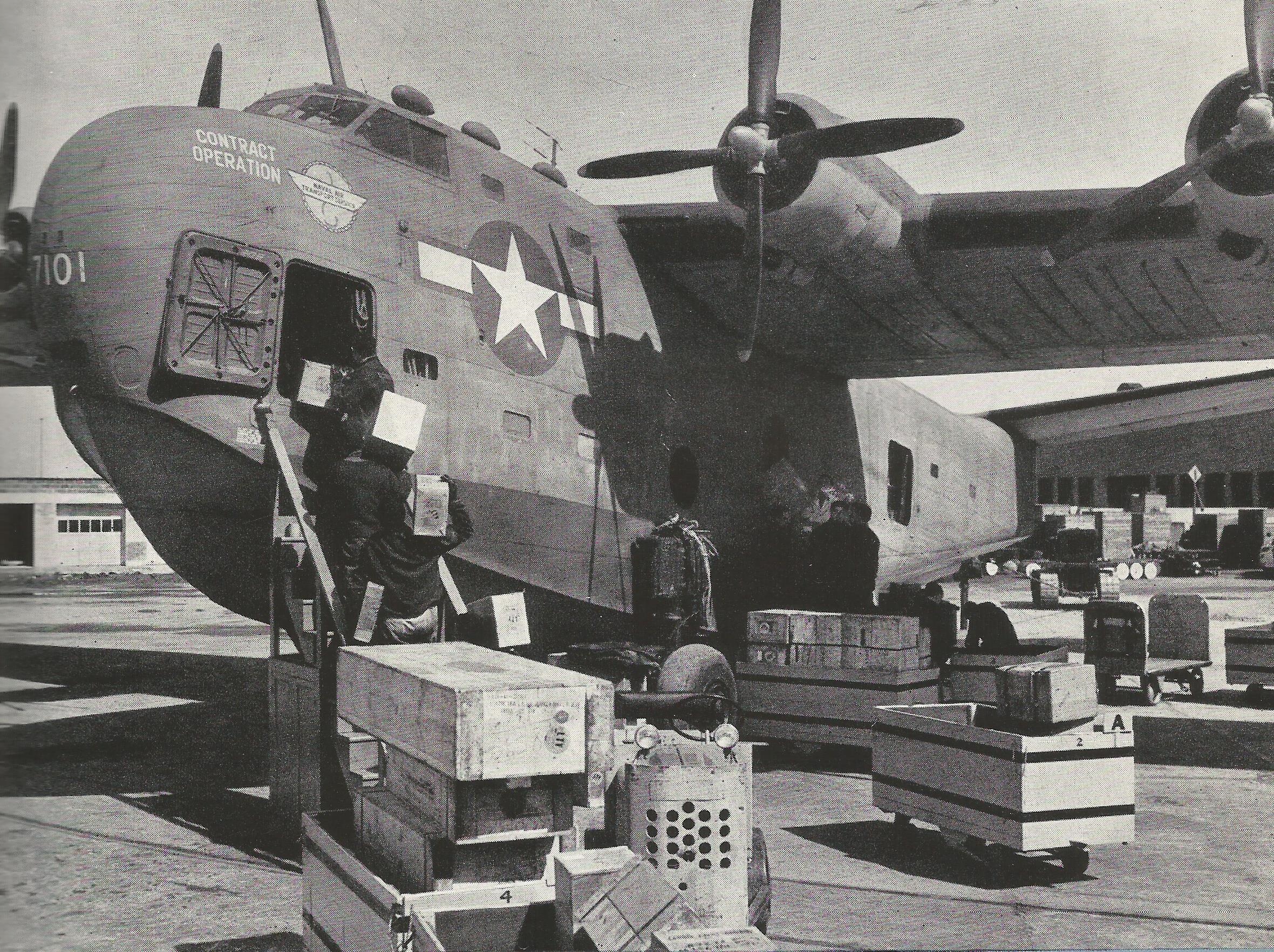
As described in the previous story, Pan American World Airways was an innovator and leader in the early development of the air freight business. Although freight and cargo was nearly always carried on passenger flights, Clipper Cargo was different and was identified with Pan American’s all-freight operation that for all intents and purposes was an airline within an airline. Whilst the all-freighter flights were included in the passenger timetables, as illustrated in the previous story, the flights operated at crazy times , carrying crazy cargoes and sometimes going to crazy places.

Captain John Marshall flew Pan Am Clippers for nearly thirty years and remembers some of his more memorable flights – and cargoes – when assigned to flying the freighters.  “Flying freighters was always an exercise in curiosity – one never knew just what the next load will bring”, he recalls. On one trip out of Anchorage, the load-master presented the Dangerous Goods Notifications Sheet, a document that listed all the hazardous materials loaded. On the list were all manner of flammable liquids, solids, poisons, corrosives and explosives. It turned out the explosives was an elephant tranquilizer gun, prompting the question whether there was an elephant on board. Also on board were five kilos of 24 carat gold in one kilo ingots. On another flight were six thoroughbred race horses bound for stud in Japan from New York. Marshall and his crew took over the trip at Anchorage and was told by the incoming crew that one big grey stallion had “an emphatic dislike for turbulence, and that during some light chop over Canada, they could hear him whinnying and stomping in his stall and when he kicked the sides of his enclosure the whole plane shook”. After take off the crew made contact with a Northwest flight twenty minutes ahead on the same track at the same altitude. The Northwest crew promised to advise them of any turbulence. Fortunately there was none, and the horse slept most of the way.

“We carried all manner of cargo on those flights – loads of over one hundred tons of payload were not uncommon”, says Marshall, “on one flight I was informed that the day’s cargo consisted of 110 head of elk — stags, does and yearlings. They were the entire load; there was no room for anything else. When I boarded there was no question as to the nature of the cargo. The smell was overwhelming. It followed us all the way across the Pacific, and permeated my clothes for weeks afterward.”

Once, when reporting for duty at the cargo hanger one midnight in Los Angeles, “I thought I had stumbled into the private quarters of the Barnum and Bailey Circus. There were cages all around the tarmac, carrying all manner of exotic fauna. One held two Bengal tigers, on the next pallet were half a dozen caged chimpanzees,chattering noisily at the big cats. Ahead of the wing was a portable stall which held four Lilliputian ponies, each so small it looked like a real horse viewed through the wrong end of a telescope.”

One of his oddest experiences in Anchorage was when he was told he and his crew were operating out of the Air Force Base at Elmendorf. No explanation was given and when they got to Elemendorf they soon found “our big 747 freighter sitting lonely and alone on the most remote pad on the base”. They boarded the aircraft and saw pallets of cargo tightly covered with dark green tarpaulin stretching into the darkness all the way aft. The cargo was Patriot missiles bound for Kimhae, at the southern tip of the Korean peninsula. Upon arrival they were met with battalions of huge trucks, along with the usual heavy loaders and forklifts. The plane was unloaded in less than a half an hour.

Jim Duncan, another former Pan American captain who flew the Clippers for over twenty years, had one interesting freighter trip that was then a highly classified Military Airlift Command (MAC) Mission from Little Rock, Arkansas to Mogadishu, Somalia. At the time Duncan was a 747 Check Airman and held the title Manager of Flying of the New York Base at JFK Airport. He wrote about his experience in his story “Night Flight to Mogadishu” in  Pan American World Airways – Aviation History Through the Words of its People. Below are excerpts from his story:

“It began with Bill McCarthy, the Duty Director in Pan American’s Operational Control Unit informing me that a request had come by way of the Dept. of Defense, the State Department, and possibly the CIA, to ferry a 747 Cargo freighter to Little Rock AFB to take on an extensive load of Class A munitions (rocket propelled grenades, .50 caliber bullets and T.O.W. —Tube-launched, Optically Wired controlled missiles), and transport them non-stop to Ramstein  Airbase, Germany with continuation, after a short crew lay-over in Frankfurt, via Cairo for refueling, to Mogadishu, Somalia. Ramstein’s main runway length of 9300 feet would not allow enough fuel, given the heavy cargo load, to make the flight nonstop to Mogadishu.

“My initial call was to my wife who did not take well to the idea.

“’Are you insane?’ she screamed into the phone. ‘Have you forgotten we have small children? Why you?’

“’It’s something I need to do,’ I replied, assuring her that this was not any different than some military missions I had flown in the past. ‘Plus, there will be added life insurance’, I joked.

“[I put together a crew] and [a]t sun-up the following day, the empty, overpowered 747 Cargo Liner lifted off the runway at JFK like a jet fighter and rocketed to our cruise altitude of 39,000 ft in a matter of minutes on its way to Little Rock AFB. Later that day, after arrival and a few hours rest, we closely inspected the Dangerous Goods Manifest. ‘Looks like a mega load of fireworks,’ commented [one of our crew] sarcastically as we checked the secure tie downs of hundreds of boxes in the lower cargo compartment. In addition to the flight plan, weather and wind forecasts, we were handed a special advisory to steer and remain clear of British and Belgian airspace.  European and African countries had allowed ‘only by exception’ the overflight of any aircraft carrying class A explosives.  

“We took off into the evening sky crossing over the Atlantic to overhead at Quimper, France in the early morning hours and continued on a straight path to land at Ramstein AFB in Southwestern Germany.  An Air Force ‘Follow Me’ truck in bright yellow colors guided us to the Dangerous Cargo loading ramp where six Armored Personnel Carriers were added to the upper deck cargo compartment.  

“Over breakfast the following morning, [the crew] and I speculated how we would be routed from Ramstein to Cairo having been denied overflight rights over Austria, Italy, and Switzerland. We were to be picked-up at the hotel at 3 p.m. for a late afternoon departure. However, back in our rooms we were further perplexed by a phone message stating that our departure from the hotel had been moved up by one hour to allow time for a military classified security briefing. The puzzle was solved at Ramstein when we heard the words of the Air Force intelligence officer: ‘From Cairo Southeast bound to Mogadishu you must fly radio silent. Do not answer any transmissions, don’t use your transponder; what’s more important, you will not obtain the usual Air Traffic Control clearance!’

“That was big news to me.

“Despite this unsettling information, we agreed to stick with the plan and take off on our night flight to Mogadishu. Soon we left France behind and looked down on the dark waters of the Mediterranean flying around the boot of Italy southeast to land in Cairo. During refueling we scrutinized our flight plan once more at the operations office. We were to fly a southeasterly track along the center line of the Suez Canal and the Red Sea. The airspace to the east of our course was Saudi Arabia and Yemen, to the west the Sudan, Ethiopia, the disputed territory of Eritrea, and finally Somalia.  At the mouth of the Red Sea, to make it appear on radar that we  were destined somewhere else, we were to fly one hundred nautical miles off-shore, and around the Horn of Africa.

“’We are going to be pretty much on our own for most of the night without any Air traffic Control contact’, I noted. ‘Let’s take on a bit of extra fuel in case we have to divert to Nairobi.’

“The Pan Am freighter lifted off once again into the night sky. The city lights of Cairo gave way to the darkness of the desert below.  Thirty minutes into the flight, 150 miles southeast of Cairo, the heavy plane was still laboring to reach its cruising altitude. The termination of all communications with the Egyptian Air Controllers created an eerie stillness. The only contact we could safely make was an hourly call to contact Pan Am Dispatch via Berna Radio in Switzerland on the high frequency single side band radio: ‘Pan Am Clipper Operations Normal.’

“We continued to monitor the local VHF air traffic control frequencies for information on other air traffic nearby and overhear various aircraft reporting their positions.

“As we approached 200 miles north of the mouth of the Red Sea, we eased the power up to hold Mach .88, cutting our transit time by ten minutes. A blind warning call came over the radio: ‘Aircraft heading 140 degrees at high speed 65 Miles NW of Addis Ababa, identify yourself.’

“With us not responding, the warnings came repeatedly from Addis Ababa and San’a. ‘Strangest flight during my Pan Am career,’ I remarked as a visible shrug of relief is felt by all three of us once the plane has turned further to the East to carry us out over the Indian Ocean and around the Horn of Africa.

“More than four hours after leaving Cairo we made our first radio call to Mogadishu, where we would arrive forty minutes later.

On the ground, and from the ramp we watched the Armored Personnel Carriers being unloaded. ‘Do you think we could take one for a spin around the ramp?’ [a crewman] asked the Somali officer. ‘If you think you know how to drive it, go ahead,’ he answered.

“It was a small reward for the Pan Am family having performed the assigned task. Pan American had supported our nation in the past.  We were merely filling another square.”

Pan American also carried traditional cargo, like the hard drive of the IBM 305 RAMAC computer, launched in 1956, shown below being loaded onto a Clipper freighter. The hard drive weighed over a ton and stored 5 MB of data. To put this into perspective, it would take  3200 of these units to equal the capacity of that little 16-Gig stick plugged into the side of a laptop.

Computer pic

It would not be surprising that every former Pan American pilot or flight engineer who flew the freighters would have similar stories. Hauling cargo may not have been glamorous, but it must have been fun.

For additional information about Pan American World Airways:

To learn more about the history of this pioneering airline, click on the title below for preview of

Pan American World Airways – Images of a Great Airline Second Edition

This book is available on eBay .

Another excellent book is Pan Am – Personal Tributes to a Global Aviation Pioneer, which was published to commemorate the 90th Anniversary of Pan Am’s founding. It contains more than 80 stories written by former Pan Am employees and international media friends who had personal experience with many of Pan Am’s key events during its history. It is the perfect companion to Pan American World Airways – Images of a Great Airline Second Edition and can be purchased on Amazon.

Preview Pan American World Airways – Aviation History Through the Words of its People, which is available on Amazon.

For further information about the history of Pan American World Airways, visit: Pan Am Historical Foundation

Pan Am Series – Part XXVII: Clipper Cargo

Pan American’s All-Cargo Service

Pan American World Airways has always been associated with passenger service, however what is often overlooked is the fact that Pan American was a leader in air cargo and was, in fact, a pioneer in all-cargo flight operations.

The history of Pan American’s all-cargo operations can go as far back as early World War II, when, in 1942, the airline operated international airline service with all-cargo aircraft using DC-4s (Army C-54/Navy R5D) and Coronados (PB2Y). The total cargo carried from 1941 through 1943 rose exponentially from 14,792,441 pounds in 1941 to 84, 545,010 pounds in 1943. In addition, Pan American’s 1943 Annual Report announced:

“The first scheduled all-cargo service was inaugurated . . . between North and South  America. This service to Brazil has provided rapid transit for both war materials and commercial cargoes. Sikorsky Clippers stripped of 2,500 pounds of luxury passenger equipment ns capable of carrying four tons of cargo, are used.”

The Coronado (R5D) (1943 Annual Report)

The Coronado (PB2Y) (1943 Annual Report)

By 1945, Pan American was, according to the annual report of that year, offering “the first commercial transatlantic all-freight service. Regularly scheduled all-cargo Clippers [were] operated by Pan American on several routes.” DC-4s (former Army C-54s) operated on these routes. In 1948, the all-cargo fleet received an influx of ten Curtis C-46 Commandos (the Army C-55) that operated primarily in the Caribbean, although some ventured as far south as Brazil and Argentina. The 1948 annual report noted that Pan American has “[s]ixteen special all-cargo Clippers [to] supplement cargo capacity of the passenger Clippers.”

Curtis C-46 Commando (Ed Coates Collection)

Curtis C-46 Commando (Ed Coates Collection)

Below is illustrated a 1948 advertisement for Clipper Cargo and a page from the 1948 Annual Report showing cargo loading operations on Pan American’s two all-cargo-type aircraft, the DC-4 and C-46. A caption on this page notes that it is cheaper to ship a private aircraft than to fly it to its destination.

The the schedules of all-cargo flights did not appear in any of Pan American’s timetables issued prior to 1950 reviewed for this article. South American all-cargo flight schedules appeared in a 1950 timetable using C-46 aircraft. In a 1952 timetable, the South American flights included the DC-4 as well as the DC-6A. All-cargo flights in other parts of Pan American’s system did not appear in these two timetables.

In a 1956 timetable, transatlantic all-cargo flights were included as well as South American, with the former using DC-4 and DC-6A equipment. In a 1959 timetable, the DC-6A was used on transatlantic flights and the C-54 (DC-4) used primarily on South American routes (page not shown).

By 1961, Boeing 707 passenger jets had been introduced to Pan American’s fleet and because of this, some of the airline’s fleet of DC-7C aircraft were converted to an all-cargo configuration. According to the 1961 Annual Report:

“Conversion of 13 DC-7Cs to all-cargo configuration with 20-ton payload capacity on a transatlantic flight. Each is designed for “’AirPak’ the new cargo loading system developed by Pan American. Using pre-loaded pallets, AirPak reduces aircraft-loading time to less than an hour, provides improved services for shippers and increases utilization of aircraft.”

Utilization of the DC-7CF on transatlantic all-cargo flights were included in the 1961 timetable. The C-54 (DC-4) was deployed in South American operations. In a 1965 timetable, Boeing 707-321C jet freighters had been introduced into service, primarily on the transatlantic routes. Interestingly enough, the South American all-cargo service included not only jet freighters, but DC-7Cs and DC-6As as well. By 1966, the DC-7CFs had dropped off the timetable leaving just a couple of DC-6As on a handful of flights in South America. This marked the end of the piston all-cargo operations.

The 1960s saw a remarkable growth in Pan American’s all-cargo operations, and in the 1967 Annual Report, it was noted that “Pan Am again was the world’s leading air cargo carrier. Pan Am flew 605,500,000 cargo ton-miles, up 15.2 per cent, compared to 1966. * * * In five years, the cost to the average shipper was cut by 25.7 per cent to a new low yield of 20.5 cents per ton-mile.”

Going into the 1970s, cargo growth continued. In the 1972 Annual Report, it was noted that new freighter services were introduced to South America and a South Pacific freighter began new operations providing the only service of this type between the West Coast of the united States and Australia/New Zealand. The report also noted that new cargo centers were opened at off-line stations and new cargo terminal facilities opened in Rome, Lisbon, New Delhi, Osaka and New Orleans. New services were also announced for the next year, 1973, including additional freighter between New York and Latin America, New York and Tokyo and across the Atlantic, and new service between New York and Africa. The report also noted that Pan Am “lead the free world in air cargo tonnage”.

During this period, the 707-321C was the mainstay of Pan American’s jet freighter fleet, operating throughout the world as illustrated in 1971 and 1974 timetables:

In 1977, cargo operations continued to grow, carrying more tons of freight and earning more revenue than ever before. It was also announced in the annual report of that year that Pan Am would develop a Five-Year Plan to improve cargo profits by maximizing utilization of passenger aircraft cargo space and increasing the number of 747 freighters in the fleet. The annual report also noted that Pan Am is “one of the world’s largest and most experienced air freight carriers, . .  [and] [i]ts fleet of  747 freighters  – the largest in the industry – and 707 all-cargo jets, plus the extensive cargo space of its passenger aircraft, give it unmatched capacity. Pan Am’s route system, serving 93 cities in 62 lands, literally covers the world for shippers”.

In 1978, cargo volume and revenue set new records and, according to the 1978 Annual Report, Pan Am regained its position as the “world’s number one carrier of scheduled international air cargo. By the end of 1978, the last of the 707s was retired, making  the Clipper Cargo fleet all wide-body with six 747 freighters. The fleet evolved from seventeen 707s to the six 747s over the decade and this prompted some scheduling and aircraft utilization changes to maximize the economic potential of the 747. This was done through increasing daily utilization, reducing short-haul segments and increasing available capacity.

During this period was the domestic deregulation of the cargo market. This gave Pan American domestic authority in cargo markets, giving the airline new benefits. Thus, for example, adding Chicago to a transcontinental-South Pacific routing would provide additional revenue from the New York-Chicago-San Francisco-Honolulu segments, previously unavailable to Pan American.

Going into the 1980s, Clipper Cargo remained an important part of Pan American’s operations. Freighter service was restructured to improve profitability by emphasizing high volume markets. In addition, the control of containers used on wide-body aircraft for the loading of cargo and baggage was computerized through “Pantrac”, Pan American’s world-wide cargo reservations tracking system. This increased the efficiency of tracking containers, maximizing use and reducing the need to invest in new equipment.

In addition, taking advantage of the deregulation of cargo operations in the United States and the expansion of domestic services, Pan American took the lead, according to its 1979 Annual Report, in introducing the lowest domestic container rates available. Called the “79ers”, these rates made it possible for domestic shippers to ship by air at rates comparable to “LTL” (less than truckload) truck costs. Also introduced was a service for small packages called the “Clipper Package Service”, offering either expedited airport-to-airport or desk-to-desk service at the option of the customer.

Below are timetable pages from 1977 and 1980. Note the extent of world-wide cargo operations in the former. In the latter, the all cargo flights were incorporated into the passenger schedules.

From the cargo perspective, things looked quite encouraging for Pan American at the start of the 1980s. But it was not to be. It is difficult to really explain what happened. Perhaps it was the competition from the likes of Federal Express who revolutionized small package service and eventually flexed its wings overseas. Or perhaps it was the fact that Pan American was losing money and needed cash. During that time, the airline began selling any expendable assets it had. Apparently the 747 freighters fell in that category. In any case, Pan American piece-by-piece reduced its all-cargo operation starting in 1982 when then Pan American CEO C. Edward Acker started selling off the Boeing 747 freighter fleet. The last was sold to Japan Airlines in 1983. Thus came to an end, “Clipper Cargo”.

PanAmCargo

For additional information about Pan American World Airways:

To learn more about the history of this pioneering airline, click on the title below for preview of

Pan American World Airways – Images of a Great Airline Second Edition

This book is available on eBay .

Another excellent book is Pan Am – Personal Tributes to a Global Aviation Pioneer, which was published to commemorate the 90th Anniversary of Pan Am’s founding. It contains more than 80 stories written by former Pan Am employees and international media friends who had personal experience with many of Pan Am’s key events during its history. It is the perfect companion to Pan American World Airways – Images of a Great Airline Second Edition and can be purchased on Amazon.

Preview Pan American World Airways – Aviation History Through the Words of its People, which is available on Amazon.

For further information about the history of Pan American World Airways, visit: Pan Am Historical Foundation

The Pan Am Series – Part XXIV: The Boeing 377

Pan American’s Boeing 377 – The Stratocruiser

Boeing 377 - Clipper America (Mike Machat)

Boeing 377 – Clipper America (Mike Machat)

One of Pan American World Airways’ most iconic airliners was Boeing 377 Stratocruiser. In the post war years and into the 1950s, it epitomized the ultimate in luxury air travel that was unparalleled at the time and probably never will be.

The Stratocruiser was developed from the C-97 Stratofreighter, a military derivative of the B-29 Superfortress. It was Boeing’s first commercial transport since the Boeing 307 Stratoliner and it possessed all the speed and technical improvements available to bombers at the end of the war.

Like the C-97, the Stratocruiser was developed by grafting a large upper fuselage onto the lower fuselage and wings of the B-29, creating an “inverted-figure-8” double deck fuselage. The aircraft had four huge Pratt & Whitney 4360 radial engines with Hamilton Standard propellers.

According to Ron Davies in Pan Am – An Airline and Its Aircraft, the Stratocruiser “looked as ponderous as the Constellation looked graceful. It seemed to bore its way through the air, defying apparent theories of clean aerodynamics. It was, in fact, as fast as the Constellation, and set many point-to-point records.”

The Stratocruiser set a new standard for luxurious air travel with its tastefully decorated extra-wide passenger cabin and gold-appointed dressing rooms. A circular staircase led to a lower-deck beverage lounge, and flight attendants prepared hot meals for 50 to 100 people in a state-of-the-art galley.  As a sleeper, the Stratocruiser was equipped with 28 upper-and-lower bunk units.

Pan American placed the first order for 20 Stratocruisers, worth $24 million, and they began service between San Francisco and Honolulu in 1949. Fifty-six Stratocruisers were built between 1947 and 1950. In addition to Pan American, the Stratocruiser was also operated by American Overseas Airlines (acquired by Pan American in 1950), United Airlines, Northwest Airlines, B.O.A.C. and others.

The Stratocruiser was most remembered for its lower-deck lounge and staterooms. It was used on Pan American’s most prestigious routes and attracted the most discerning of passengers. Although its operating costs were high, they were offset by high revenue.

The Pan American Stratocruisers saw service all over the world. A “Super” Stratocruiser was deployed on the airline’s most prestigious route, the New York-London flight 100/101 and was operated until replaced by the Boeing 707. The “Strat” was also deployed on the New York-Rio “President Special” service but was eventually replaced by the DC-6B, the DC-7B and the Boeing 707. The aircraft also saw extensive usage on Pan American’s Pacific routes as well as the round-the-world service. The timetable images below illustrate these services:

The aircraft was also a favorite of flight crews, not the least for the fact that many celebrities were passengers. Barbara Sharfstein, a former Pan American purser who started working for the airline 1951 and stayed until 1986, when she went to United Airlines with the sale of Pan American’s Pacific routes, said, in a story in Pan American World Airways – Aviation History Through the Words of its People:

“I applied and was hired as a “stewardess” by Pan American World Airways in July, 1951, one month after reaching my 21st birthday and after graduating from college.  About three months later, my friend from home and school, Pat Monahan, joined me and three other new hires in a rented house one block from the Miami Airport.  We started our careers flying to South America and almost all islands in between.  We agreed it was the most amazing, wonderful life imaginable. The types of airplanes we crewed were: Convairs, DC4s, Constellations and our all time favorite, the Boeing- 377 Stratocruiser.  * * *

“[O]ne of the most memorable times in my flying career happened on the Stratocruiser when Louis Armstrong and his band were downstairs in the lounge longing to get to their instruments.   As it happened, there was a door to the cargo compartment right next to the bar.   In fact, the liquor kits were kept in the same compartment as the luggage with only a mesh rope curtain separating us from what they could spot as a few of the instruments.  I can only say it was fortunate for the weight and balance of the airplane that the lounge was centrally located or we might have been in trouble.  Almost all the passengers were in the lounge seats or on steps.  Passengers were helping me serve drinks and neither they nor I will ever forget it.”

Pan American was known for many historic “firsts” in commercial flight and the Stratocruiser was no exception, albeit, in one case, in a most unusual way. On 12 October 1957, Captain Don McLennan and crew started the four engines of Clipper America for a special mission. The story follows from the Pan Am Historical Foundation’s website:

“It was a charter flight for the U.S. Navy. The ultimate destination for the flight was just shy of 10,000 miles away, in the Antarctic at 77 degrees 51 minutes S,166 degrees 40 minutes E – the 6,000 ft. runway at the United States Naval Air Facility, McMurdo Sound; operations base for the Navy’s Operation Deep Freeze III. 

“The passengers included thirty-six Navy personnel, the U.S. Ambassador to New Zealand and a New Zealand cabinet minister, some reporters, but public attention was directed mostly towards the flights’ two Pan Am stewardesses, Ruth Kelly and Pat Hepinstall. The pair were about to become the first women to travel that far south, and although the clipper would be “on the ice” for less than four hours, their arrival caused a big stir at the bottom of the world – and a great news story everywhere else. U.S. Navy Rear Admiral George J. Dufek, the polar veteran in charge of the operation had suggested that such a flight might provide a great PR coup for Pan Am. Operation Deep Freeze would be probing the mysteries of the massive Ross Ice Shelf. The Pan Am flight would mark the first commercial airline flight to the Antarctic. But the admiral was also in for a surprise.

“Three kilometers away from McMurdo was New Zealand’s Scott Base, and as the social calendar was fairly wide open at both facilities, invitations were extended to the Kiwis. Many of the personnel at both bases had been there for months, while some were more recent arrivals – “summer people”. But it seems the arrival of the two young women was apparently not appreciated universally.

“According to an article written by Billy-Ace Baker in the Explorer’s Gazette, official publication of the Old Antarctic Explorer’s Association, in 2001:

“Commenting on the report that there would be no women on the proposed Pan Am flight to McMurdo Sound, Rear Admiral Dufek said: ‘If there are any hostesses they’re going to be men.’

“The Admiral, before the flight anyway, was adamant about not opening the gates to other requests to accommodate women in what was – in 1957 – an exclusive male bastion. But apparently, the stewardesses’ arrival created other conflicts, according to Baker:

“The summer tourists made a big fuss over the girls, but some members of the wintering-over party, who had several more months to spend on the ice, ran away and hid. If you haven’t seen a woman in 12 months, it’s not going to do you much good to look at one who will be gone in a couple of hours. That explains why there were only 50 men in attendance.

“During their brief stay, Kelly and Hepinstall were tasked with judging a beard contest (categories included: longest, blackest, reddest, & sexiest) and were participants in a U.S. v New Zealand dog sled race. The latter event was a failure as far as a picking a winner was concerned, as the stopwatch froze up. So did Pan Am Navigator Earl Lemon’s camera, which also froze after getting one picture.

The event was commemorated in a John T. McCoy watercolor, one of his series of Historic Pan Am Firsts:

Clipper America arriving in Antarctica, 15 October 1957 (John T McCoy watercolor).

Clipper America arriving in Antarctica, 15 October 1957 (John T McCoy watercolor).

During its service for Pan American, the Stratocruiser was dressed in three liveries. The most familiar is pictured above. Below are images of the other two, the first, the original livery upon delivery and the second, the “blue ball”, applied toward the end of its service.

The Stratocruiser played an important role in the phenomenal growth of commercial aviation after World War II and remained a presence on the world’s prestige airline routes up to the beginning of the Jet Age. From Ron Davies:

“While the Constellation is remembered with affection as the epitome of elegance of the piston-engined era, and the DC-6B for its reliability and efficiency, the Stratocruiser was the last to be retired from the world’s prestige routes when, first the turboprop Britannia, and then the Comet and the Boeing 707 jets ushered in a new era that became the Jet Age.”

For additional information about Pan American World Airways:

To learn more about the history of this pioneering airline, click on the title below for preview of

Pan American World Airways – Images of a Great Airline Second Edition

This book is available on eBay .

Another excellent book is Pan Am – Personal Tributes to a Global Aviation Pioneer, which was published to commemorate the 90th Anniversary of Pan Am’s founding. It contains more than 80 stories written by former Pan Am employees and international media friends who had personal experience with many of Pan Am’s key events during its history. It is the perfect companion to Pan American World Airways – Images of a Great Airline Second Edition and can be purchased on Amazon.

Preview Pan American World Airways – Aviation History Through the Words of its People, which is available on Amazon.

For further information about the history of Pan American World Airways, visit: Pan Am Historical Foundation

The Pan Am Series – Part XXII: The Boeing 747

Boeing 747 Machat

Pan American Goes “Top of the World” With the 747

“Would you build it if I bought it?”

“Would you buy it if I built it?”

As legend has it, these were the utterances between Juan Trippe of Pan American and Bill Allen of Boeing while fishing from the Wild Goose in Puget Sound one summer’s day. By the end of their outing, there was, according to Bob Gandt in Skygods – The Fall of Pan Am, a verbal commitment to build an aircraft  what in Trippe’s mind would be a “stopgap airplane” top fill the void between the first generation jets –  the Boeing 707 and the DC-8 – and the yet-to-be-built Supersonic Transport, the SST.

Pan American had been enjoying unprecedented growth during the decade of the 1960s, with traffic, according to R.E.G. Davies in Pan Am – An Airline and Its Aircraft, increasing an average of about 15% per year. Business was booming and it was time to move forward. What was the next step? In Robert Daley’s An American Saga, the next step could have been the Supersonic Transport. At the time, the British and French were planning the Concorde. In the US, there were also plans for an SST, but the costs were beyond what the government could afford. Because of that, President Kennedy was put into a position as to whether to back the US project or not, and before he could decide, asked the then head of the Federal Aviation Administration, Najeeb Halaby (who would later become Pan Am’s Chairman) to ask Juan Trippe not to buy the foreign Concorde. Trippe, however, was aware that Kennedy was wavering and decided to force the President’s hand. He traveled to England and France in May 1963 and , according to Marylin Bender and Selig Altschul in The Chosen Instrument, “took an option on eight planes. . . [and] became the first airline other than Air France and B.O.A.C. to order a supersonic airliner”. This did not go over well with the President.

Shortly thereafter, however, President Kennedy “gave the signal for a commercial supersonic program to proceed and Trippe signed up for fifteen [Boeing] S.S.T.s.”

Unfortunately, the SST would not become operational for another ten years, and something needed to be done with the anticipated increase in airline travel. What would that be? According to Ron Davies, “Trippe had always been bolder than his contemporaries in going for larger aircraft; indeed he seemed to have followed a policy of ordering types which were typically twice the size of the previous generation. * * * [and] [t]he only way to increase capacity, apart from adding frequencies –  another method of coping with increased demand, but which was practically impossible, because of airport and airway congestion –  was to increase the aircraft size.” And that resulted in what Bob Gandt referred to as the “Everyman Airplane”: “The first jets had made world travel available to Everyman, not just the rich and elite. Now they had to build an airplane to satisfy the new yearning to travel – an Everyman airplane.” Thus lay the seeds for the Boeing 747.

By cajoling Bill Allen into such a project, according to Davies, “Juan Trippe went for broke.” To Bender and Altschul, it was a “spectacular gamble”. For Bill Allen of Boeing, according to Gandt, “[i]t would be the perfect swan song if he could step down knowing that he had launched the world’s mightiest ship of the sky. It would secure Boeing’s future well into the century. Or it could ruin Boeing“. The same fate faced Juan Trippe, according to Bender and Altschul, “by placing his company, its employees and its shareholders at enormous risk. If he judged correctly and was lucky to boot, Pan Am’s leadership would be maintained. If he was wrong or fate was cruel, the airline might well go bankrupt.”

On 22 December 1965, Juan Trippe and Bill Allen signed a Letter of Intent for the Boeing 747. On 13 April 1966, Pan American formally ordered twenty-five airplanes. But before the April agreement, a huge obstacle arose: On 30 March, President Johnson invited the Business Council to a dinner. Both Juan Trippe and Bill Allen were in attendance. During the dinner Johnson pleaded for austerity due to economic problems caused by the war in Southeast Asia. This jolted both Trippe and Allen, whose 747 project was not exactly austere. Was the project in jeopardy? After the dinner, Trippe, who had previously no success in having a personal meeting with Johnson, approached him to press his case. Johnson asked Trippe if anyone knew about the project and Trippe said “no, except for Bill Allen”.  Johnson then asked Trippe to be at the White House the next day “to see someone”. The next day Trippe was taken to the Pentagon to discuss the project with the Secretary of Defense Robert McNamara. At the time, another large capacity aircraft, known as the C-5A, was being developed for the Pentagon by Lockheed. McNamara pressed Trippe on the possibility of his waiting for a commercial version of the C-5A. Trippe argued his case for the 747 noting the impracticability of creating a commercial version of the C-5A. McNamara agreed and brought Trippe back to the White House where Johnson ordered that they “work it out”.  Both Trippe and Allen hammered it out with the White House and the Pentagon, and then went for approval from their respective Boards of Directors. With Johnson’s approval, the Pan Am directors were convinced. So convinced, that an option for an additional ten planes was authorized for incorporation into the contract, thus making it, according to Bender and Altschul, “the largest single order for a single aircraft model in the history of commercial aviation”.

Retired Pan American Captain John Marshall, who flew for the airline for years, wrote about the development of the Boeing 747 in an article that appeared in Airways Magazine. Below are excerpts from that article:

“Pan Am’s Juan Trippe was a visionary executive who dreamed in only one dimension: big.  Pan Am was the launch customer for the first successful jet transport, the Boeing 707, and it was Trippe who saw the need for an even larger airplane to keep up with the burgeoning growth in air traffic in the early ’70s.  In the mid-60’s, when the 707 was still a novelty in the world’s skies, Trippe took his ideas to Boeing’s Bill Allen.  He and Allen were alumni of the old school, both of them men of courage and daring, and after many long and sometimes contentious meetings between Pan Am’s planners and Boeing’s engineers, the decision was made to go ahead with the giant aircraft. 

“It was a tremendous gamble.  The 747 would embrace new design and technology that up to then had only existed in the dreams of engineers.  The technical hurdles that had to be cleared were enormous.  The new airplane would carry up to 500 passengers; one of the early questions was, how do you evacuate 500 people from an airplane in just 90 seconds?  The FAA, approached by Boeing to relax its 90-second evacuation criteria, dug in its heels and remained firm.  90 seconds was the limit, or the airplane would not be certified.  Engineers wrestled for days with the problem, and eventually redesigned the interior of the cabin to include not just one center aisle, but two, running the entire length of the airplane, with cross-aisles at each of the four main entry doors (there was an additional over-wing escape exit).  The doors were redesigned to permit egress of a staggered two-abreast.

“Perhaps the biggest obstacle to the aircraft’s designers was that of the engines.  While Pratt & Whitney was working on the prototype of the huge JT-9D engine, it had yet to be tested, and it was far from certain that it would be ready in time to mate with the 747.  Boeing had bitter memories of the B-29 bomber and its star-crossed marriage with the Wright Cyclone engines, which had a nasty habit of catching fire and burning off the wing.  The giant JT-9D engine would be the first jet engine mated to an airframe that had not earned its stripes on the wing of a military airplane.  It was an enormous gamble.

“The initial design specifications of the new airplane had the takeoff gross weight pegged at 550,000 pounds.  As the 747 design grew and matured, it put on weight, the bane of every aeronautical engineer.  A massive effort was directed at slimming-down the airplane, and eventually an all-up weight of 710,000 pounds became the final design target.  Four engines, each producing 41,000 pounds of thrust, would be required to get the 747 airborne, and as the airframe design came closer to being finalized, Pratt was way behind the power curve.  Engine development and production proceeded so slowly that the entire project threatened to sink under its own weight.  At one point there were so many engine-less airframes sitting on the ramp at the Everett production facility that their cost exceeded the net worth of the Boeing company.

“The early JT-9D-3 engines that powered the early model 747s were fraught with problems; they suffered from frequent compressor stalls, and would overtemp at the drop of a hat.  It quickly became a procedure that once the engines were running, while the airplane was on the ground at least one of the three cockpit crewmembers had to constantly monitor the engine temperatures for overheat.  Even the first scheduled passenger flight of the giant airplane was delayed several hours because of engine problems, severe enough to force an ignominious change to a backup aircraft.  The sheer weight of the engine and nacelle resulted in a new, heretofore unknown phenomenon, the “ovalizing” of the engine itself.  Its weight was literally pulling the engine out of round.  One of Boeing’s engineers put the situation into cleverly-phrased perspective.  “We have an unround situation,” he said.

“Engineers devised a unique, space-age solution.  It required that the largest amount of weight be placed in the smallest package, in the cowling of the engine itself.  The result was the use of one of the densest metals known, spent uranium, which was embedded in the engine cowl.  It solved the problem

“Trippe envisioned the 747 as a bridge aircraft which would carry the airlines through the adolescent years of the jet age until the supersonic transports, or SSTs, came along.  He insisted on the double deck design for the jumbo, with the flight deck perched high above the main level, so that when the airplane had outlived its passenger-carrying days, it could readily be converted into a very economic cargo carrier.  The nose cone would swing upward to reveal a nearly 200-foot straight-in main deck, accommodating cargo of a size and weight that would have been unthinkable just a few years earlier.

747 Cargo

“Here the visionary pioneer made a major miscalculation.  The SST would be personified only by the Anglo-French Concorde, and even then only a few would be built.  Esthetic and graceful, it was nearly an economic disaster.  Designed when jet fuel was literally pennies per gallon, by the time it had completed what was then the most exhaustive test program ever devised, the oil crisis of the early ’70s had made the airplane almost prohibitively expensive to operate.  It soon became obvious that there would not be squadrons of supersonic transports gracing the skies, criss-crossing the oceans and continents to the world’s capitals, slicing flying times from hours and hours to hours and minutes.  The United State’s answer to the Angle-French Concorde, Boeing’s 2707, was slain by the stroke of a Congressional pen.  The B-747 would have to carry the transoceanic burden, at least for the foreseeable future.

“The introduction of the Boeing 747 represented a quantum leap in air transport technology and design.  Twice as big as its predecessor the 707, the Jumbo not only dwarfed anything it might encounter on the world’s airport ramps, but provided wonderful grist for anecdotal tales that were told among the airlines that were fortunate to have been at the head of the line to fly her.  Untold numbers of photos were snapped of comely stewardesses (still so-called in the early ’70s) standing in the cowling of the huge Pratt JT-9 engines, surrounded by the great shroud that enclosed the big fans.  “Artist’s renderings” was a fanciful term applied to the surrealistic drawings of the new 747 that appeared in promotional material.  The airplane was parked at a futuristic terminal, with a jetway conveniently nestled against each of her eight main entry doors.  There were piano bars (an innovation that briefly came to pass with at least one jumbo operator) and movie amphitheaters, a Radio City in the sky.  Passengers would be able to pass to and fro, as though attending a wonderful, celestial cocktail party. 

Pan American’s 1967 Annual Report noted that its order for the Boeing 747 “led the airline industry to a new generation of heavy duty transports. . .[and that] new standards of passenger comfort and convenience will be introduced. Simplified ticketing, computerized check-in and automated baggage handling will be provided. Pan Am’s 747s will have two aisles and seat 366 passengers.” In the 1968 Annual Report, Pan American noted that the “year 1969 will mark the beginning of the second stage of the jet age – the time of the Boeing 747 and other wide-bodied, advance-technology jet transports. Pan Am again is the leader. * * * Pan Am will be the first to put it into service to the major world markets we serve. Pan Am’s fleet of thirty-three 747s will be the largest. * * * Pan Am’s operating and marketing plans for the 747 program have already been formulated. Ground facilities are also being prepared. The men and women of Pan Am at home and abroad will be ready to put the plane in service”.

Development of the Boeing 747 as described above, was not without other challenges affecting performance and costs – the addition of a spiral staircase, for example. Building the massive aircraft also required a larger  assembly plant. That was achieved by construction of a new plant at Everett, Washington, near Paine Field.  In addition, Pan Am built a maintenance facility and extended the Pan American terminal to accommodate the big jetliners.

The illustrations below were taken from Pan American’s 1968 annual report.

The first 747 was delivered on time and was christened by the First Lady Pat Nixon on 15 January 1970. Six days later, on 21 January, the first commercial flight of a wide-body jet, Pan American flight 2, was scheduled for departure at 1900 hours for London. Clipper Young America was assigned the duty. Unfortunately, an overheating engine delayed the departure and also required a substitute aircraft, Clipper Constitution.  Never-the-less, at 0152 hours on 22 January, the 747 departed New York and arrived later that morning in London, completing an historic flight, opening the door to new era of commercial airline operations and making the Boeing 747 one of the most recognizable aircraft in the world.

In preparing this article, the following sources were used: John Marshall’s article in Airways Magazine, “The Big Jumbo”; The Chosen Instrument by Marylin Bender and Selig Altschul; An American Saga –  Juan Trippe and His Pan Am Empire, by Robert Daley; Pan Am – An Airline and Its Aircraft, by Ron Davies; and Skygods – The Fall of Pan Am, by Robert Gandt; and Pan American’s 1967 and 1968 annual reports.

On interesting side-note:  Pan Am’s order for twenty-five 747s and an option for ten more in 1966 was the biggest ever at the time. In November 2013 Emirates airline rewrote all records in civil aviation with an order for 150 Boeing 777X, comprising 35 Boeing 777-8Xs and 115 Boeing 777-9Xs, plus 50 purchase rights; and an additional 50 Airbus A380 aircraft.

For additional information about Pan American World Airways:

To learn more about the history of this pioneering airline, click on the title below for preview of

Pan American World Airways – Images of a Great Airline Second Edition

This book is available on eBay .

Another excellent book is Pan Am – Personal Tributes to a Global Aviation Pioneer, which was published to commemorate the 90th Anniversary of Pan Am’s founding. It contains more than 80 stories written by former Pan Am employees and international media friends who had personal experience with many of Pan Am’s key events during its history. It is the perfect companion to Pan American World Airways – Images of a Great Airline Second Edition and can be purchased on Amazon.

Preview Pan American World Airways – Aviation History Through the Words of its People, which is available on Amazon.

For further information about the history of Pan American World Airways, visit: Pan Am Historical Foundation


The Pan Am Series – Part XIV: Crossing the Pacific

Crossing the Pacific – The “Unsung Hero”

On the date 22 November, Pan American World Airways was part of two historic events. The first, in 1935, was the inauguration of trans-Pacific airline service, and the second, in 1963, was the assassination of President John F. Kennedy. In this installment is the story of the China Clipper, which crossed the Pacific Ocean in 1935; in the next will be the story of Pan Am’s part in the tragic events in Dallas, Texas in 1963.

Whenever there is reference to the first airliner crossing of the Pacific Ocean, invariably it is the Martin M-130 China Clipper that comes to mind. This, event, according to Ron Davies in Pan Am – An Airline and its Aircraft, was “one of the most noteworthy and historic dates in the history of transport”. The Clipper, commanded by Edwin C. Musick, departed San Francisco Friday afternoon, 22 November 1935 and arrived in Manila, Philippines Friday afternoon, 29 November, having stopped in Honolulu, Midway Island, Wake Island and Guam along the way. The 8210 mile trip took 59 hours and 48 minutes flying time.

In addition to its historic importance, the event was one of the most publicized ever. Described in detail by Robert Daley in An American Saga – Juan Trippe and His Pan Am Empire, the celebration included lunches, speeches by VIPs and “crowds on the docks, crowds on the rooftops and crowds aboard the extra ferries that had been added on”. In addition the inaugural ceremony was broadcast both in the USA as well as in Europe, South America and the Orient and included speeches by Postmaster General James Farley and Juan Trippe. Trippe concluded matters with the command, “Captain Musick, you have your sailing orders. Cast off and depart for Manila in accordance therewith”. Receptions greeted the Clipper in Honolulu and upon arrival in Manila between two and three hundred thousand Filipinos jammed together along a jetty to welcome the ship. In addition was an enclosure with two thousand prominent guests as well as people in the streets and on rooftops. A flotilla of military fighter planes flew out to escort the Clipper through its splashdown and landing. There followed a reception, banquet and parade. Later, Captain Musick presented a letter from US President Roosevelt to Philippine President Quezon commemorating the flight. It was indeed an important event in aviation history.

The Atlantic

Crossing the Pacific, however, was not the original intent of Juan Trippe in his desire to cross an ocean. It was the Atlantic. However the geopolitical situation coupled with technological limitations made that option impossible. The details are spelled out with precision in Marylin Bender and Selig Altschul’s The Chosen instrument. In a nutshell, the path to Europe was through Newfoundland. Unfortunately, negotiations between Juan Trippe, Britain, Canada and Newfoundland in 1932 did not provide the access desired, although some understanding was achieved between Pan American and Britain’s Imperial Airways with regard to traffic rights. Because Newfoundland appeared to be in doubt, Trippe looked south. Unfortunately, the political situation in Portugal made it difficult for Pan American to negotiate for traffic rights there as well. In addition, a survey trip made by Charles Lindbergh in the summer of 1933 brought into question the feasibility of using flying boats for regularly scheduled trans-Atlantic service.

What is interesting here, with respect to the negotiations over Newfoundland, is that it was not the American government doing Pan American’s bidding. It was Juan Trippe. And it was Juan Trippe who personally dealt with the governments of Britain, Canada and Newfoundland, following a pattern used when he negotiated traffic rights to countries in Latin America.

The Pacific

Any hope for trans-Atlantic operations, however, was dashed when, in April 1934, the British government demanded reciprocity with the United States over traffic rights.  According to Bender and Altschul, the British “[g]overnment pulled the strings for Imperial, and if it viewed Pan American Airways as a similar instrument of national policy, then it would want to settle matters with the United States government.” Juan Trippe had overestimated his diplomatic skills and his “go-it-alone diplomacy” was not working. He admitted that he did not see much future for Pan American in the North Atlantic. In addition, as pointed out by Bob Gandt in China Clipper – The Age of the Great Flying Boats, “[t]he British, in 1934, had nothing like the S-42 or the coming M-130. Until Imperial Airways . . . possessed an airplane that could commence scheduled flights from Britain to the United States, Pan American would find itself blocked from the British crown colonies”.

One point of interest here is that during this time the state-owned flag carriers of several European nations were establishing routes to their own colonies in Asia, Africa and the Indian Sub-Continent, all without the need to obtain traffic rights. Privately owned Pan American did not have this luxury in that part of the world.

The focus thus switched to the Pacific. After a “great circle” trans-Pacific route through the north was ruled out due to issues between the United States and the Soviet Union, it was decided to take the route that represented the longest distance between the United States and the Orient: the mid-Pacific.

Here, the issue of traffic rights was not a problem for Pan American. The route involved stops at Honolulu, Midway, Wake and Guam, terminating in Manila, all of which were under U.S. jurisdiction. At Guam and the Philippines, the U.S. Navy had established bases on the pretext of potential confrontation with Japan. Midway was being used by the Navy for war games staged in the area. This left Wake, a tiny island, discovered by Juan Trippe in the New York Public Library, and, according to Daley, “[f]or a brief time – only the blink of an eye as history is measured – it was one of the most famous places in the world”.

Wake Island

The tiny island of Wake, an uninhabited coral atoll, was to become one of the most important way points on the route west to the Orient. It lay over 4000 miles from the U.S. mainland in the middle of the Pacific Ocean and was a minor trophy of the Spanish-American War. Inside was a lagoon with surface water smooth enough to handle landings of flying boats, but the presence of coral heads made landings impossible. Its location, however, made it a critical point for the trans-Pacific flight. Juan Trippe eventually got permission to use the island as a base, and on 27 March 1935, the S.S. North Haven, a cargo ship, sailed west with provisions to set up bases for Pan American at Midway and Wake. At Wake, an entire village was built, including a hotel for passengers en-route to or from the Orient. Everything used in building the base was shipped from the mainland. In addition, a swimmer from Columbia University, Bill Mullahey, who boarded the ship in Honolulu in a swimsuit, straw hat and a surfboard over his shoulder, was brought on board as the one man demolition expert to clear the lagoon for landings. Wherever there was a coral head in the lagoon, he would dive down and place dynamite sticks in holes in the coral heads and attach detonator wires to them. After he surfaced the dynamite was blasted, and afterward he would go down to inspect. The channel to be cleared was one mile long and three hundred yards wide and it took months to clear the channel of several hundred coral heads. His only gear was a pair of marine goggles; fins, face-masks, snorkels and scuba tanks had not yet been invented.

The below illustrations of Wake Island are from Robert Daley’s An American Saga. Shown is the treacherous surf outside the lagoon the workers bringing in gear had to brave, the village and the hotel’s lobby. Because there was no anchorage, the North Haven anchored offshore.

 The Aircraft

On 1 October 1932, Pan American placed an order for three Sikorsky S-42s, The aircraft was a product of the joint oversight of Pan American’s Chief Engineer Andre Priester and Charles Lindbergh. What was unique about this aircraft, according to Bob Gandt, was the design of the wing, which gave it greater range and the ability to bear a greater load. By the time Pan American accepted delivery of its first S-42, the aircraft had set several aviation records that made it probably the most advanced airliner in the world. Unfortunately, it was primarily designed for service in Latin America and was not suitable for trans-oceanic passenger operations. The aircraft could only carry six or eight passengers with the required fuel. In Latin American operations, passenger capacity was up two thirty-two.

At the same time, the Martin M-130, a larger aircraft capable of trans-oceanic flight, was on the drawing board. A more advanced airliner than the S-42, Juan Trippe also placed an order for three.

Survey Flights

The M-130 was the intended aircraft for the new trans-Pacific route, however it was not due for delivery until the end of 1935. Survey flights were needed and Juan Trippe would not wait. The West Indies Clipper, an S-42 then being used in Latin America, was selected for the duty. It was renamed the Pan American Clipper and was stripped of all passenger accommodation and fitted with extra fuel tanks, giving it an endurance of 21 1/2 hours and a range of 3000 miles. The key, and most important flight segment of the trans-Pacific trip was California-Honolulu. The ability to fly this critical segment meant there would be no barrier to the eventual establishment of trans-oceanic flight. That was achieved. The Pan American Clipper departed San Francisco on 16 April 1935 for Honolulu and returned on 22 April. On 12 June it surveyed the Honolulu-Midway segment; on 9 August, Midway-Wake; and on 5 October, Wake-Guam. On 24 October, the U.S. Post Office awarded Pan American the trans-Pacific mail contract, the day the  Pan American Clipper arrived back in San Francisco from its survey flights across the Pacific.

The two illustrations below are from different sources: On the left is a picture of an S-42 departing San Francisco, presumably on one of the survey flights. It was provided by the late Marcel “Skip” Conrad, Esq., who was an attorney for Oakland International Airport. The picture was on one of the walls in his office. The picture on the right is the S-42 upon arrival in Honolulu on its first survey flight. This was an illustration in Robert Daley’s An American Saga.

China Clipper

The first Martin M-130, China Clipper, was delivered 9 October 1935. On 22 November, China Clipper inaugurated trans-Pacific airline service. The planning and preparation for this service was typical of the efficient organization nurtured by Pan American, and was a manifestation of the high standards demanded of the flying crews. As described by Ron Davies, “… there was a certain inevitability about the event. . . .the planning which went into the preparation for the historic event left no stone unturned, or to be exact, no potentially damaging piece of coral reef unmoved. * * * Pan American Clippers had cut the trans-Pacific travel time from a matter of weeks to a matter of days. The world’s biggest ocean had been conquered. A new age had begun.”

Below is illustrated the cover and the inside page (showing the route map and flight schedules) of Pan Am’s June-August 1940 timetable. Note the flight numbers were 800 and 801 and the aircraft used were either the M-130 or the Boeing 314. Until the sale of its Pacific routes to United in 1986, all Pan Am flight numbers in the Pacific were numbered in the 800’s.

The Unsung Hero

The "Unsung Hero" of Pan American's historic crossing of the Pacific, Bill Mullahey. Without his bravery in blasting out each coral head in the lagoon of Wake Island, the flying boats could never have landed. (Daley, An American Saga)

The “Unsung Hero” of Pan American’s historic crossing of the Pacific, Bill Mullahey. Without his bravery in blasting out each coral head in the lagoon of Wake Island, the flying boats could never have landed. He had another role in a later Pan American historic event that occurred after the bombing of Pearl Harbor. (Daley, An American Saga)

On 22 November 1985, commemorating the 50th Anniversary of the historic flight of the China Clipper, Pan American re-enacted the event with a Boeing 747-212B, named China Clipper II. Ann Whyte, who was Manager, Public Relations at the time, was a participant. She tells about her experiences of that flight in the book, Pan American World Airways – Aviation History Through the Words of its People. Below is an excerpt from her story:

“The 1935 China Clipper, piloted by Captain Edwin Musick, departed from Alameda and stopped in Honolulu, Midway Island, Wake Island and Guam before finally landing in Manila.  * * * Our 747 would follow the exact route. The revenue passengers, in addition to many VIPs, were composed of members of our frequent flyers program, others who yearned to be a part of aviation history, and those who wanted a package tour to the Pacific. 

China Clipper II (Don Boyd photo, airliners.net)

China Clipper II (Don Boyd photo, airliners.net)

“Excitement and expectancy were evident at our airport ceremony that included music and speeches. The son of James A. Farley, Postmaster General in 1935, was there.  His father had delivered a message from President Franklin Roosevelt, who said, ‘Even at this distance, I thrill to the wonder of it all.’  San Francisco Postmaster Mrs. Mary Brown told us that a special China Clipper international 44-cent stamp had been issued at Treasure Island in February 1985 and that the original flight carried 100,000 letters to the Philippines.  Also, 5,000 envelopes which had received philatelic treatment were on board our flight and would get special cancellations at each stop.  Flight attendants paraded in the various styles of uniform worn since the early days.  We cheered members of our flight crew when they were introduced.   It was a festive atmosphere.

51-Comm Envelope

“For the 1935 flight, the San Francisco to Hawaii leg was the most dangerous.  It took 21 hours for the seaplane to fly over the 2,397 miles of open water.  There was no radar, no voice communication.  The flight navigator had to climb out of a hatch several times at night to take star sightings with a sextant.  Harry R. Canaday, a pioneer captain on board our flight, remembered that in the early days, even with the best equipment available, it was what they called ‘flying by the seat of your pants.’  Shure V.  Sigfred, another pioneer captain on board, was astounded by the amount of people and cargo carried on our modern 747.  ‘We loaded the ship according to the weather and weighed every ounce,’ he reminisced.

“But on our flight there was a party atmosphere.  It took just five hours for us to reach Honolulu.  I was eager to see each island for a different reason.  I had had the opportunity to look at photographs and read accounts of those early days in the archives.  What I saw were pictures of enthusiastic crowds, flowers, song and dance waiting to greet the M-130 crew in Hawaii 50 years ago.

“I could feel the hospitality as soon as we landed.  To me, Hawaii signifies music, dancing, singing, fragrant blossoms, romance and exotic fruit.  We received a warm Aloha welcome of leis, song and dance.   Next we were whisked away to Pearl Harbor where we were honored with a ceremony to dedicate a plaque commemorating 50 years of commercial air service at the location where the original China Clipper landed, Middle Loch, Pearl City Peninsula.  That evening, it was thrilling to be part of the reception, testimonial dinner and entertainment at the Royal Hawaiian Hotel where our pioneers were recognized and applauded.”

At the other end of the trip, Cass Myers, Regional Director for Sales based in Hong Kong, was involved with the re-enactment of the China Clipper’s historic flight as well. His memories are also included in the above book, and are excerpted below:

“The seats on the flight were marketed commercially and there were many celebrities participating, including author James Michener, an astronaut, and other dignitaries such as Charles Lindbergh’s four grand-sons.  The Manila Hotel on Manila Bay was also nearly taken over for the group where two days of fun was planned.

“Two outside factors made this flight re-enactment especially interesting:  (1) United Airlines had already purchased Pan Am’s Pacific Division and was scheduled to take over flight operations as United Airlines in early February 1986; and (2) the President and First lady of the Philippines, Ferdinand and Imelda Marcos, were on their last legs as rulers, both  literally and figuratively.  In a couple months, the world would know that Imelda Marcos owned 2,000 pairs of shoes.     

“Being based at the Pan Am Regional Office in Hong Kong, I was fortunate to be one of the people responsible for the setup on the ground in Manila for the arrival, greeting and hotel transfer for the passengers and all the ceremonies and entertainment that followed. 

“The event itself was what was expected and more!   The arrival went without a hitch. The Pan Am Country Manager,  the late Joe Basso, even managed to locate the same bugler who in 1935 was a Boy Scout and then (at 58 years of age) still had the same bugle and played for the arrival. Needless to say, a great time was had by all but it was, in a way, bittersweet as Pan Am’s presence in the Pacific was rapidly coming to an end.”

To learn more about the history of this pioneering airline, click on the title below for preview of

Pan American World Airways – Images of a Great Airline Second Edition

This book is available on eBay .

Another excellent book is Pan Am – Personal Tributes to a Global Aviation Pioneer, which was published to commemorate the 90th Anniversary of Pan Am’s founding. It contains more than 80 stories written by former Pan Am employees and international media friends who had personal experience with many of Pan Am’s key events during its history. It is the perfect companion to Pan American World Airways – Images of a Great Airline Second Edition and can be purchased on Amazon.

Preview Pan American World Airways – Aviation History Through the Words of its People, which is available on Amazon.

For further information about the history of Pan American World Airways, visit: Pan Am Historical Foundation
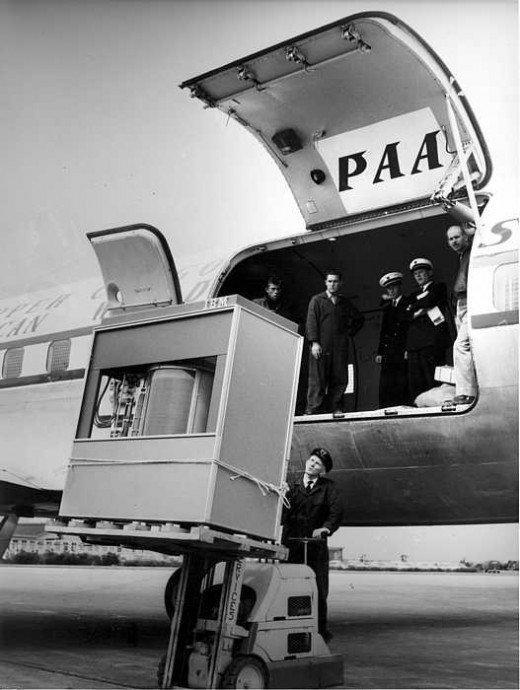
The writer of this article gratefully acknowledges the four sources liberally used in its preparation:

Marylin Bender and Selig Altschul, The Chosen instrument

Robert Daley, An American Saga – Juan Trippe and His Pan Am Empire

Ron Davies, Pan Am – An Airline and its Aircraft

Robert Gandt, China Clipper – The Age of the Great Flying Boats

The Pan Am Series – Part I: The Book

Boeing 747-121 at Los Angeles International Airport circa 1969

Boeing 747-121 at Los Angeles International Airport circa 1969

I am launching a new series of postings about Pan American World Airways to be called “The Pan Am Series”.  My aim is to share the memories of this iconic airline that played such an important role in the development of civil aviation.  Pan Am’s first revenue flight was a Fokker F-VII between Key West and Havana on 28 October 1927.  The last revenue flights were a 747 from New York Kennedy to São Paulo, Brazil on 3 December 1991 and a 727 from New York to Barbados on 4 December 1991.  Pan Am officially ceased operations at 9:00 a.m., 4 December 1991.  The 747 crew was resting in São Paulo awaiting their return flight that evening when the news broke.  The captain of the 727 received the news upon arrival in Barbados. Both their stories will be published in future postings.

I have been a fan of Pan Am all my life, starting as a boy when I watched a Boeing 377 Stratocruiser arrive at its gate at Los Angeles International Airport (LAX) after a flight from the Far East with my grandfather on board.

Pan Am's Boeing 377 - the Stratocruiser

Pan Am’s Boeing 377 – the Stratocruiser

My father did a lot of international travel as well and we would meet him at LAX when he arrived on DC-6Bs of Pan Am from South America.

Pan American World Airways DC-6B, the "Super 6", Clipper Midnight Sun.

Pan American World Airways DC-6B, the “Super 6”, Clipper Midnight Sun.

During our childhoods growing up in Los Angeles, our parents often took my sisters and me to LAX to visit the terminals and watch airplanes land over Sepulveda Boulevard.   During that time I developed an interest in collecting airline brochures, timetables and baggage tags.  For some reason, I developed a keen interest in the baggage tags and amassed a large collection over the years.  I leaned heavily in Pan Am’s favor because I thought it was the “best airline” and because the baggage tags were more colorful than other airlines.  I also liked the Pan Am timetables because the route map seemingly covered every corner of the globe!

Eventually, our family went on a trip to South America, and we flew on Pan Am!  I remember that day in 1957.  We flew from Los Angeles to Guatemala on a DC-6B, Flight 515.   That was the beginning of my traveling on many more Pan Am flights over the next decades, including on some its most prestigious routes.

As I grew up, I studied the history of Pan Am, and learned a lot of geography from the route maps and flight schedules in its timetables.  I even learned about time zones and the 24-hour clock!   As a college student, I managed to work Pan Am into my studies as an International Relations major, focusing on the international airline system and international politics.  Later, I went to law school to become an airline lawyer.

I continued collecting and over a period of 50 years, managed to keep much of the material, supplemented by purchases from similar collectors on eBay.

Recently, while teaching in the College of Business at Embry-Riddle Aeronautical University in Daytona Beach, I often mentioned Pan Am, but to my surprise most of my students were not familiar with the aviation pioneer.  At the same time, I was in the process of preserving my Pan Am collection by scanning the brochures, timetables and tags and putting them into a digital “scrapbook”.  It dawned on me that it would be a nice idea to use the digital scrapbook to create a book about Pan Am’s history through images of the material I had scanned and use it to tell the Pan Am story to students and those who were not around during Pan Am’s glory years.  Thus was born my book, Pan American World Airways – Images of a Great Airline, now in its Second Edition.

front-and-back


From the Preface to the Second Edition:

In the first edition of this book, published in 2011, I set out to list the “firsts”, along with significant events, of the life of Pan American World Airways, and present them in chronological order divided into six sections representing key eras: (1) Beginnings (1927-1939); (2) The War Years (1940-1945); (3) The Piston Era (1946-1957); (4) The Jet Age (1958-1969); (5) Top of the World – Boeing 747 (1970-1979); and (6) End of an American Icon (1980-1991). The firsts and significant events were listed at the beginning of each section followed by illustrations from that era, including covers of annual reports, covers of timetables (along with a page of flight schedules and route map), baggage strap tags, safety information cards and pictures of aircraft.

This formula is largely preserved in this Second Edition, which features more images of aircraft and enhanced images of timetable pages and maps. Covers of annual reports are still included but the safety information cards have been removed.

A major addition to this edition, however, are narratives on certain pieces of Pan American’s history. These were originally published as posts in my blog, “The Pan Am Series”, in jpbtransconsulting.com. The narratives I selected to include in this book cover the development and launch of key aircraft operated by Pan American and key routes the airline operated from its beginnings to the end. The routes featured include Latin America, the first trans-Pacific flight, crossing the Atlantic and Pan American’s famous round-the-world service operated by flights 1 and 2. The narratives are populated with images illustrating the story being told.

As written in the preface to the first edition of this book, probably no airline in the history of aviation has attracted more attention and has been more written about than Pan American World Airways, for decades the symbol of airline superiority world-wide. This is the airline that pioneered air navigation and communications. It introduced international and over-ocean flights. It set the standard for in-flight service and brought air travel to the masses through the introduction of “Tourist” class. It brought the industry into the jet age and eventually the era of the wide-body jet. To thousands of Americans living and working overseas, Pan American meant home. Pan American served the United States and never failed to answer the call of the country. For many, Pan American was the symbol of the United States around the world.

Pan American shut down on 4 December 1991. However, the legacy lives on and the airline still has influence in the industry as recently exemplified by Emirates Airline’s highlighting Pan American’s in-flight meal service as the standard for theirs. And, as is pointed out in the narrative on the “Nautical Airline”, the pilot-in-command is still known as the “Captain”.

The people of Pan American World Airways and its friends and fans have a unique loyalty to their airline that has manifested itself through the social media as well as at numerous gatherings around the world. This loyalty continues even though the company has been gone for over twenty years. Recently, an additional group of “loyalists” have emerged, and they are the children and grandchildren of those who worked for the airline in the past decades. They, too, want to preserve the rich history of the once great airline.

Since the publication of the first edition of this book, numerous books have been published, many by former Pan Amers sharing their experiences with the rest of the world. One book, which I, along with Pan American’s former Vice President for Corporate Communications Jeff Kriendler put together, Pan Am – Personal Tributes to a Global Aviation Pioneer, can be considered the seminal book about the airline. Its purpose is to preserve the legacy of an aviation giant. This second edition is aimed to complement that book and fulfills my goal in keeping the Pan American story alive.

Comments about the first edition of the book:

From Captain Bill Nash, who flew for Pan Am August 1942 – June 1977

“As a Pan Am pilot for 35 years (34 yrs as Captain) I thoroughly enjoyed your presentation and the way you did it with items familiar to me, such as varied baggage strap tags, articles, routes, schedules, annual reports, progressive aircraft photos (external and internal), lists of Pan Am “firsts”, and operation advances.”

From Captain Bob Gandt, who flew for Pan Am 1965-1991 and author, Skygods: The Fall of Pan Am

“Jamie Baldwin has given us a treasure trove of Pan Am lore. Here is something for everyone — a concise history of the pioneering airline, a rich potpourri of Pan Am memorabilia, and, best of all, a nostalgic journey back to an age when the mighty Pan American ruled the skies.”

From Susanne (Strickland) Malm, Flight Attendant, 1968-1978

“…a carefully constructed timeline of Pan Am’s incredible record of firsts and aviation achievements… chock full of rare and nostalgic collector’s memorabilia… a veritable time capsule into which any reader may be gently transported…back to a time when flying was gracious, glamorous and eagerly anticipated by passengers and crew alike!”

From Pete Runnette, President, Pan Am Historical Foundation

“…a fine chronology of Pan Am’s pioneering history, with wonderful pictures to match – valuable to student or aviation aficionado alike, and browsing will bring back fond memories for employees or passengers, of air travel Pan Am style…”

From Carol and Fred Tomlinson, Pan Am Staff

“We would like to thank you for doing a marvelous job on the book, and for portraying Pan Am as the great airline that it was!  We are all extremely proud of its history and professionalism, and your book brought back many happy memories!”

From Barry Humphreys, Chairman, British Air Transport Association and former Director, Virgin Atlantic Airways

“No history of international aviation can be complete without including the amazing story of Pan American Airways. Pan Am was without doubt the industry’s leader for several decades; more than just another airline. Jamie Baldwin’s fascinating collection of photographs and chronology captures the story of Pan Am brilliantly, from the early days, thru the glory years to the sad end. It is a story well worth telling.”

To learn more about this book and the history of this pioneering airline, click on the title below for preview of

Pan American World Airways – Images of a Great Airline Second Edition

This book is available on eBay .

Another excellent book is Pan Am – Personal Tributes to a Global Aviation Pioneer, which was published to commemorate the 90th Anniversary of Pan Am’s founding. It contains more than 80 stories written by former Pan Am employees and international media friends who had personal experience with many of Pan Am’s key events during its history. It is the perfect companion to Pan American World Airways – Images of a Great Airline Second Edition and can be purchased on Amazon.

For further information about the history of Pan American World Airways, visit: Pan Am Historical Foundation