Kindle Edition Now Available!
27 October 2013 Leave a comment
Now Available in Kindle!

A Kindle Edition of Pan American World Airways – Aviation History Through the Words of its People is now available!
Click here for more information.
The Blog and Website of James Patrick Baldwin
27 October 2013 Leave a comment
Click here for more information.
26 October 2013 2 Comments

THE LAST WEEK OF OCTOBER IS SIGNIFICANT IN THE HISTORY OF Pan American World Airways. Looking at the last six days of the month, the first Amazon route service was established on the 25th in 1933. On the 26th was the first service to Buenos Aires in 1931. On the 28th was Pan Am’s first scheduled flight in 1927. And on the 29th was the first operation at Pan American Field in Miami in 1928. There were two more recent events: On the 26th was the inauguration of the first scheduled trans-Atlantic service with an American-built jet, a Boeing 707-121 in 1958, the subject of this article, and on the 28th was the record-breaking Pole-to-Pole round-the-world flight with a Boeing 747SP in 1977, commemorating the fiftieth anniversary of Pan Am’s first scheduled flight, to be covered next week.
During World War II, Pan Am President Juan Trippe, Charles Lindbergh and Pan Am Chief Engineer Andre Priester explored the idea of jet propulsion. However, the idea that jets would eventually become commercially viable did not have its genesis until the early 1950’s. Then, there was no jet airliner even in the design stage in the United States. Britain had been developing the “Comet” jet, but it lacked range. Boeing was developing a bomber, called the B-47, but its design did not lend itself to commercial flight. In December 1951, BOAC (predecessor to British Airways) took delivery of its first Comet, notwithstanding its poor economy and range. What Pan Am wanted was a plane that could carry at least 65 passengers from New York to London at 500 miles-per-hour. In mid-1952 Pan Am engineers Priester and John Borger made the rounds to Boeing, Douglas and Lockheed. What was seen was disappointing. The manufacturers, however, soon began focusing on a commercial jet because by September 1952, jet airliners had become inevitable. Boeing developed the Boeing 707 prototype and Douglas was working on its DC-8 project. At the same time, the turboprop engine had been developed and airlines were lining up for the likes of the Lockheed Electras and British Viscounts. Pan Am was not in the line because its engineers were of the opinion that propellers were the cause of most mechanical breakdowns.
BOAC indicated its intent to start trans-Atlantic operations with the Comet jet, even though its range required two stops westbound and one stop eastbound. Despite that, it was still 3-5 hours faster than the comfortable Startocruiser that Pan Am was using on its trans-Atlantic routes. To play it safe, Pan Am ordered three Comets although doubtful they would ever be delivered. They were not. After a number of accidents it was determined the Comet had a design flaw that required its grounding.
Other problems had to be dealt with, most foremost were the lack of airports that could handle jets, lack of fuel to “feed them”, lack of tugs to tow them, lack of suitable stairways and lack of adequate hangers to overhaul their engines. Other issues included the engine to be used, the size of the aircraft and its range, and its economics, pitting the air-frame manufacturers, the engine manufacturers and Pan Am on seemingly a collision course, given the different needs of each group.
After hard negotiations, Pan Am got what it wanted: The Boeing 707 and the DC-8. And on 13 October 1955, Juan Trippe made the announcement that he had just bought 45 jetliners. According to R.E.G. Davies, in Pan Am – An Airline and Its Aircraft:
“Each [jet] had twice the capacity of all but the largest piston airliner, had the potential for trans-Atlantic nonstop range, and was twice as fast. In economic terms this multiplied to about four or five times the productivity of the DC-7Cs . . . . and furthermore the reliability of the engines and airframes held out the prospect of far higher levels of annual utilization. “
While the 707 got all the attention given it was the first to be delivered, the jet aircraft order was for 20 Boeing and 25 Douglas machines. The fact that Pan Am ordered more DC-8’s suggests, according to Davies, that “Pan Am was prepared to support the company which had supplied it with so many reliable aircraft during the postwar years, but was also warning it that its product had to be good and that tradition and sentiment would not guarantee a continued market.” In fact, the Douglas jets were bigger and had better range than its Boeing counterparts, and because Boeing feared the foreign airlines going to Douglas, Boeing and Pan Am renegotiated the order for a bigger 707. Pan Am did take delivery of six smaller 707s in order to open service in the north-Atlantic before anyone else did (BOAC, however, did beat Pan Am, operating the first jet service to New York from London on 4 October 1958, although not daily). Boeing took Pan Am’s warning to heart. It assembled a production and marketing team that, according to Davies, “out-produced and out sold the experienced Douglas. More important, Pan American switched to Boeing as its main supplier. * * * [And] when Pan American sneezed, the rest of the aviation world felt a severe [draft] and most of it caught [a] cold or worse.”

DC-8 and Boeing 707-121 (photo by R A Scholefield)
The issue of economics of the jets was a major consideration during the transition from prop to jet. There was the belief that the jet would be a “rich man’s airplane” – “extra speed at extra prices. . . a “super-first class premium ride” for well-heeled patrons, according to Robert Daley, in An American Saga – Juan Trippe and His Pan Am Empire. Pan Am took the opposite view. Daley notes that Pan Am saw the jet as a way to keep costs down as the tourist fare had just been introduced with great success resulting in increased trans-Atlantic travel 30% over the previous year. Once the jets were in service, Pan Am’s position was clear, as shown in the 1958 Annual Report to shareholders:
“In April, 1958, Pan American inaugurated transatlantic Economy class service offering fast, comfortable transportation at a greatly reduced fare. Whereas the roundtrip fare between New York and London was $783.00 First class, and $567.00 Tourist class, the new Economy class fare was $453.00.
“Economy class service increases aircraft seating capacity by use of close seat spacing required for that new class…Luxury services are curtailed. Economy class service, sponsored by your company, again emphasizes the leadership in expanding air travel by bringing it within the budgets of more and more people who heretofore could not afford to travel abroad.
“Over 100 transatlantic Clipper flights per week are scheduled during the 1959 season, all offering Economy class service. Jet Clippers will operate 50 of these flights with the remainder being flown with long-range Super-7 Clippers”.

This page from a 1959 timetable (above) demonstrates the extent of Economy (“Clipper Thrift”) class service on trans-Atlantic flights. Every flight offered it. Tourist (“Rainbow”) service was only available on a handful of flights. It should be noted, however, that Rainbow (and not Economy) service was available on all flights beyond the UK and European gateway cities, probably due to limitations in the bilateral agreements between the US and the countries concerned. Deluxe “President Special” service was only available on jets. The other aircraft used on the trans-Atlantic routes was the DC-7C with a change of gauge to DC-6Bs once “over the pond”. One interesting note is that some flights offered three-class service: First, Tourist and Economy.
Pan Am’s first scheduled jet flight was No. 114 from New York to Paris on 26 October 1958. The flight was operated with the smaller 707-121 and required a fuel stop in Gander along the way.


Former Pan Am purser Jay Koren was a flight attendant on the first trans-Atlantic jet flight. His story about his experiences on that flight is featured in the book Pan American World Airways – Aviation history Through the Words of its People published by BlueWaterPress. Below are excerpts from his story:
“Pan American flight 114 to Paris, slated to depart New York on October 26th, would not only mark America’s entry into the Jet Age, it would mark the inauguration of the world’s first daily trans-Atlantic jet service. * * *
“Crew rosters had been posted weeks earlier and the lucky chosen few notified of their assignment to the first fights. Four days before the inauguration, my supervisor called. “We’ve decided to add a seventh flight attendant to the inaugural, Jay, and you’ve been selected.” I couldn’t have been more excited if I were being sent to the moon. Day before our departure, we were given an extensive briefing. * * * First Class on the Boeing 707s, with seats and aisles wider than any pre-jet aircraft, was designated Deluxe Class and Pan Am’s President Special dining service would be featured. * * *
:On the eve of participating in this historic event, although supercharged with anticipation, we all confessed to a sense of apprehension. We were about to zap across the Atlantic at more than eighty percent of the speed of sound—nearly twice as fast as any of us had ever flown before—at an altitude nearly twice as high, and in an aircraft capable of carrying double the load of our old, familiar, piston-engine airplanes. * * *
Until boarding began we were busy checking out our new workplace: its closets and cabinets, galleys and equipment, food and bar provisioning. * * * [Captain Miller announced], ‘Ladies and gentlemen, we have reached the runway. Flight Service, prepare for take-off’. * * * As we began our roll down the runway and Captain Miller opened the throttles to full thrust, the powerful force of our rapid acceleration pressed our backs into the thinly-padded bulkhead behind us. Even more startling was the unexpected vibration and violent roar of the jet engines as we gathered speed for our leap up into the night. We grasped hands and stared wide-eyed at one another in disbelief. Where is that vibration-free, quiet-as-a-whisper ambiance the airline ads have been touting? We discovered why the first-class section is now located in the front. Just opposite to piston-engine aircraft—where the cabin becomes quieter toward the rear—we were seated in the noisiest spot in a jet. * * *
“Also unlike conventional airplanes that lift off the runway in a horizontal attitude, jets do it nose up. No one has given us prior warning of this characteristic either. As we attain take-off speed approaching 200 mph, Captain Miller rotates the nose of the Clipper sharply upward. This causes us, seated in the very tail of the jet, to drop sharply downward—a sensation I would never become totally comfortable with. We are airborne!
“In half the time required of the “pre-jets,” we reached cruising altitude. The vibration disappeared completely and the engine roar subsided to little more than a gentle hum.”

John T. McCoy watercolor of the takeoff of Flight 114.


Arrival in Paris
The introduction of jet service changed the travel industry forever. Slowly, trans-Atlantic travel by passenger steamship as a mode of transportation (as opposed to cruising or pleasure) disappeared. Similarly did long-haul rail service in the United States. Because of the jet, more places are available to more people than anytime in history. What Juan Trippe envisioned some 80 years ago not only has become a reality, but also a part of the life we live today.
To learn more about the history of this pioneering airline, click on the title below for preview of
Pan American World Airways – Images of a Great Airline Second Edition.
This book is available on eBay .
Another excellent book is Pan Am – Personal Tributes to a Global Aviation Pioneer, which was published to commemorate the 90th Anniversary of Pan Am’s founding. It contains more than 80 stories written by former Pan Am employees and international media friends who had personal experience with many of Pan Am’s key events during its history. It is the perfect companion to Pan American World Airways – Images of a Great Airline Second Edition and can be purchased on Amazon.
Preview Pan American World Airways – Aviation History Through the Words of its People, which is available on Amazon.
For further information about the history of Pan American World Airways, visit: Pan Am Historical Foundation
19 October 2013 Leave a comment

PROBABLY THE MOST IMPORTANT, COMPETITIVE AND DENSE INTERNATIONAL ROUTE in any form of transportation is the North Atlantic. Today, hundreds of flights make the crossing daily between the major cities of the United States and those of Europe. However, it was not always that way. For most of the 19th and 20th centuries, the principal market was between New York and London. These two cities for all intents and purposes were the main gateways to the United States and Europe respectively, and more passengers and cargo passed through these cities than any others. This article will focus on that market and highlight a major player in it, Pan American World Airways and its signature flight, Clipper 100, one of the most prestigious of airline lore.
But first, a little history. In the 18th and early 19th centuries, crossing the Atlantic was by sail, and the trip was often perilous and time-consuming, often several months. With the advent of the steamship, travel times were greatly reduced and safety and reliability noticeably improved. The Cunard and White Star Lines pioneered these routes and developed the great ocean liners that were national and company symbols. The “grand” ocean liner became a staple in the North Atlantic passenger trade at the beginning of the 20th Century as the technology improved to allow construction of mammoth (at the time) ships with large passenger capacity. The liners competed in the luxury market offering opulent accommodations designed to please the most discerning of passengers. They also competed in speed and comfort. Until the jet age, the liners were the transportation of choice for many a trans-Atlantic passenger. In the US-UK market, the names are legendary: Acquitania, Mauretania, Queen Mary, Queen Elizabeth and United States, to name just a few.
(Note: To enlarge any of the images below, simply click on it)


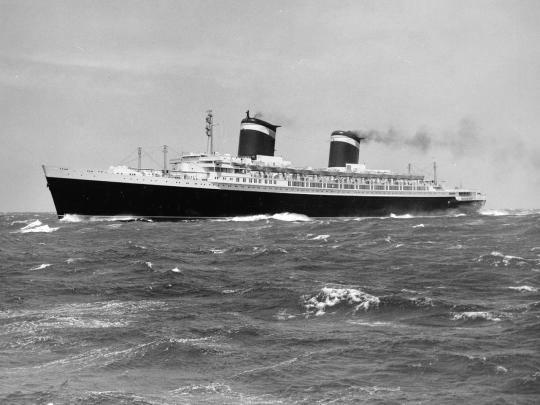
SS United States
Commercial travel by air in the trans-Atlantic market did not really play a role in transAtlantic commerce until after World War II. The first commercial flights were pioneered by Pan Am. In 20 May 1939 the first transAtlantic mail service was inaugurated when the Yankee Clipper, a Boeing 314 flying boat, flew from New York to Marseilles, France via Horta, Azores and Lisbon, Portugal. About a month later, on 24 June 1939, the Yankee Clipper established the first airmail service from New York to Southampton, England. In June 1939, the Dixie Clipper, also a Boeing 314, inaugurated passenger service between New York and Marseilles, and in July, passenger service was inaugurated between New York and Southampton. These services were suspended during World War II and it was not until 1945 that passenger service resumed.
As best can be determined, flights were not numbered in the timetables until the ending of the War. In the October 1945 Pan Am timetable, flights were numbered and the flight between New York and the United Kingdom was identified as “Flight 100”, a Boeing 314. It departed New York’s La Guardia Airport on Sundays, Wednesdays and Fridays at 5 a.m. for Foynes, Ireland with stops in Shediac, Canada and Botwood, Newfoundland. At Foynes, passengers connected with a BOAC DC-3 for London (Croydon), arriving at 3 p.m. the next day. By the October 1948 timetable, the equipment had been changed to a Lockheed Constellation and offered a daily non-stop service departing La Guardia at 4 p.m. and arriving at London Airport at 11 a.m. the next day.


October 1945 Timetable


October 1948 Timetable


In the 1950’s Flight 100 switched to the Boeing 377. In the June 1954 timetable, the flight departed New York’s Idlewild daily at 4 p.m. arriving London at 9:30 a.m. the next day. On Fridays “The President Special” service was available, which, according to the timetable, was “the ultimate in luxury service”, featuring “Sleeperette” chairs that provided “bed-length sleeping comfort”. Also included was special food service and extra cabin attendants. “President Staterooms” with berths were also a feature of the service. In the October 1957 timetable, the equipment was upgraded to a specially configured Boeing 377 designated a “Super Stratocruiser”. “The President Special” was offered on Fridays. By 1959, a Boeing 707 was operating the service and in the April 1959 timetable, a 707 departed daily at 8 p.m., arriving London at 7:35 a.m. the following day. “The President Special” service was offered daily. It should be noted that in the timetable effective 26 October 1958, which included the first jet service, Flight 100 had a 10 a.m. departure from New York, arriving in London at 9:35 p.m. The service was started on 16 November. On 15 November, the all-First class Super Stratocruiser service was discontinued. The new jet service was later changed to the evening departure.


June 1954 Timetable


October 1957 Timetable


Page from 26 October timetable (above) showing the start of jet service. For the first time, flight 100 included two-class service, Deluxe President Special and Economy.

April 1959 Timetable


By the 1960’s, Flight 100 was a daylight flight departing New York at 10 a.m. and arriving at London at 9:45 p.m., as shown in the September 1961 timetable. In the 1970’s, the Boeing 747 was introduced to the route, as shown in the January/February 1971 timetable, and continued operating the same daylight flight through the decade as shown in the Summer 1978 timetable.


September 1961 Timetable


January/February 1971 Timetable


Summer 1978 Timetable
With the merger of Pan Am and National in 1980, Flight 100 was discontinued as shown in the Spring/Summer 1980 timetable. All New York-London services were overnight flights and none were numbered “100”. In the timetable that became effective 24 April 1983, Flight 100 returned, operating a daytime flight with a Boeing 747SP. The flight offered 3-class service with “Clipper Class” in a separate cabin, departing at 10 a.m. and arriving in London at 9:40 p.m. Interestingly enough, the timetable announced it as a “New Daily Daylight Service”.
After the sale of Pan Am’s Pacific routes, which included the 747SP fleet, the equipment was changed back to a 747. In the timetable effective 26 October 1986 the 10 a.m. departure was changed to 9 a.m., with an 8:40 p.m. arrival. With the sale of the London Heathrow routes to United, Flight 100 came off the timetable. In addition, as shown in the May 1991 timetable, Pan Am no longer operated the New York-London route. Ironically, the cover of that timetable boasted “More Nonstops Across The Atlantic Than Any Other Airline!”. Little did anyone know that six months later, Pan Am would have no transAtlantic routes except for a 3-times weekly Miami-Paris flight.


Spring/Summer 1980 Timetable


April 24, 1983 Timetable

Boeing 747SP (photo by John Wegg, Airways Magazine)


October 1986 Timetable

Clipper Pride of the Ocean at London Heathrow


May 1991 Timetable

Clipper Belle of the Sky at London Heathrow
It is not unreasonable to believe that Flight 100 was Pan Am’s premier passenger flight. Although Pan Am had several lucrative routes in its system, it is fair to say that the New York-London route was the most important. Not only was it Pan Am’s most prestigious route, it could arguably be called its Signature Route. Pan Am put its best foot forward with equipment, in-flight service and scheduling. Nothing was overlooked and as a result, it attracted the passengers who demanded that type of service. According to Carla Marshall, a former Pan Am Purser, “it certainly was our most popular businessman’s flight (few women then). Always top executives of major companies, both American and European. Nelson Doubleday was a frequent traveler, as was IBM Chairman Thomas Watson. Also NATO General Alexander Haig was often on the 707 flights as was Elizabeth Taylor.”
For Bronwen Roberts, a young flight attendant (then Stewardess) for Pan Am, a very special passenger on Flight 100 was one of the highlights of her 31 year career with Pan Am.
Below is an excerpt from her story about this special passenger in the book, Pan American World Airways – Aviation History Through the Words of its People:
“When I was hired by Pan Am in February 1958, one of 11 from 5,000 applicants, I could not in my wildest dreams have imagined the exciting life I would lead and the fascinating people I would encounter during my 31 year career.
“In the 1960’s Pan Am was the airline of choice for the rich and famous. Among the celebrities I had on board were the legendary Charles Lindbergh, films stars Robert Taylor, Warren Beatty, Susan Hayward, Sophia Loren and her husband Carlo Ponti, Audrey Hepburn and her husband Mel Ferrer.
“However my most memorable flight occurred early in my career. As a child I had been subjected to the terror of air raids over Britain during World War Two and I remember listening to the inspiring speeches given over the radio by our then Prime Minister, Winston Churchill. How could I possibly have known then that on April 14th.1961 I would be serving the great man on a Pan Am Clipper flight. To my everlasting gratitude and indeed to my amazement I was selected to serve Sir Winston on flight 100 from New York along with another British flight attendant, Valerie Wilton, and American purser, Mickey Deangelis.
“The flight was uneventful and very pleasant with cocktail service followed by a leisurely lunch, with the regular President Special menu consisting of Hors D’oeuvres, including caviar, Terrapin or cream of mushroom soup; entrees, including Lobster Thermidor, Filet of Sole, Himalayan Partridge Sweetbread Financieres, stuffed Rock Cornish game hen, double lamb chops or Prime Rib of beef, choice of vegetables, salad; and a selection of continental cheeses, desserts and fresh fruit items. Colmans mustard and horseradish, Stilton cheese, imported teas and crumpets were added.
“After the excitement of the arrival I was taken to be interviewed by the British press and that is how my parents learned in the following morning newspapers that their daughter had had the privilege and honour of serving one of their heroes, something neither I nor they could have ever imagined so many years earlier.”
From the flight deck, Flight 100 was just a regular flight, according to former Pan Am Captain John Marshall, “from the flight deck perspective Clipper 100 was pretty much like any other, except that the scheduling showed us arriving at the hotel downtown around 9 PM, with just time enough to change and get to the pub before last call. We usually operated flight 101 back the following day departing LHR at 1100. A very civilized schedule, which is why most of us liked it.”
Because of the attractive scheduling, the most senior and experienced pilots were likely in the cockpit. Thus Flight 100 not only provided the best in the cabin, but in the flight deck as well.
It is fair to say that Pan Am’s Flight 100 set the standard for the ultimate in first class travel. Over the years Pan Am had multiple daily flights between New York and London, but Flight 100 was singled out as the way to travel between the two cities. At that level, the only real competition was the Concorde.
Today, notwithstanding the multiple US cities that have non-stop service to London, New York is still the major departure city from the US to London. Indeed, between New York Kennedy Airport and Newark Airport, there are upwards of 25 daily flights between the two cities. However, credit has to be given to Pan Am for setting the high standards that today’s carriers strive for in that market. Pan Am may be gone, but its not forgotten.
To learn more about the history of this pioneering airline, click on the title below for preview of
Pan American World Airways – Images of a Great Airline Second Edition.
This book is available on eBay .
Another excellent book is Pan Am – Personal Tributes to a Global Aviation Pioneer, which was published to commemorate the 90th Anniversary of Pan Am’s founding. It contains more than 80 stories written by former Pan Am employees and international media friends who had personal experience with many of Pan Am’s key events during its history. It is the perfect companion to Pan American World Airways – Images of a Great Airline Second Edition and can be purchased on Amazon.
Preview Pan American World Airways – Aviation History Through the Words of its People, which is available on Amazon.
For further information about the history of Pan American World Airways, visit: Pan Am Historical Foundation


13 October 2013 Leave a comment
On 16 October 1956, Pan American World Airways flight 6 (sometimes referred to as flight 943) with 24 passengers and seven crew ditched in the Pacific Ocean after two of its four engines failed. The aircraft, Clipper Sovereign of the Skies, a Boeing 377 bearing the registration N90943 (hence the flight 943 designation), was operating the last sector of an around-the-world flight and had departed Honolulu the previous evening.

Boeing 377 Stratocruiser
According to the April 1956 and July 1956 timetables (the only two available for this article), flight 6 was part of Pan Am’s round-the-world service operating on Thursdays and Fridays as flights 70/6 (all-Tourist Class) and 100/6 (all-First Class) and on Fridays as 64/6 (combined First and Tourist). Flights 64 and 70 were operated with DC-7B or DC-7C equipment and flight 100 was operated with a Boeing 377 Super Stratocruiser. Flights 70 and 100 operated from New York to London where flight 6 took over with DC-6B equipment offering “Sleeperette” service. Flight 64 operated from New York to Beirut via Shannon (April 1956 only), Paris and Rome. In Beirut, the trip connected with flight 6 from London with a stop in Frankfurt. From Beirut flight 6 continued to Karachi, Rangoon, Bangkok, Hong Kong and Tokyo, where the equipment was changed to a Boeing 377 “Strato” Clipper. The flight then continued to Wake Island and Honolulu before terminating in San Francisco.


Captain John Marshall, who flew Pan Am Clippers for many years, wrote about flight 6 (flight 943) in an article that appeared in Airways Magazine. Below are excerpts from his article:
“It was a gentler time. A journey aboard a modern airliner, especially a trans-oceanic one, was an incredibly romantic adventure, and the passengers preparing to board Pan American’s flight 943 (flight 6) from Honolulu to San Francisco on that balmy October evening in 1956 were excited. Purser Pat Reynolds stood at the top of the stairs at Honolulu Airport and greeted the 24 boarding passengers that were going to be in her charge for the next ten hours. Their chariot that night was a Boeing 377, at the time the largest airliner in the sky. She was powered by four huge Pratt & Whitney 4360 engines and pulled by Hamilton Standard propellers.
The Stratocruiser was the state-of-the-art airline transport; there was no more luxurious airliner anywhere. She had recently arrived from the Orient and around the world, and was finally headed back to her home base at San Francisco. Her flight crew that night consisted of veteran Pan Am skipper Dick Ogg, First Officer George Lee Haaker, Navigator Dick Brown, and Flight Engineer Frank Garcia.
“The passengers were a mixed bag. There were the Gordons, a young couple traveling with their two tow-headed twin girls, barely three years old, a French physician and two middle-aged California ladies traveling alone. Businessmen, holiday vacationers, young marrieds, they were typical of those that flew across oceans in 1956. What was not typical was the adventure that was to befall the crew and passengers of the Sovereign of the Skies during the next few hours.
“At 26 minutes past eight o’clock, Honolulu time, the big Boeing lifted from the runway at Honolulu Airport. Captain Ogg pointed her bulbous nose out past Diamond Head and into the darkening eastern sky, and took up a heading for California. The flight plan called for a flight of 8 hours and 54 minutes, leveling off initially at 13,000 feet, and then, just prior to the equal time point, climbing to 21,000 for the remainder of the trip. The big Pratts rumbled their song as they settled down into the cruise portion of the flight. The weather was good and the air smooth. Dick Brown would have no problems locating his favorite stars to navigate by on this evening. Flight Engineer Garcia carefully leaned the engines and set the spark advance, keeping close track of the fuel they were burning. In the cabin Pat Reynolds and her colleagues, Mary Ellen Daniel and Katherine Araki set about serving a light supper to the passengers. Soon the lights were dimmed and the passengers settled in for the night. Pillows and blankets appeared, and they slept.
“Flight 943 (flight 6) cruised into the night at 13,000 feet until close to the midpoint of their Pacific crossing, when their clearance to the final level, 21,000 feet, was approved by ATC. Garcia set the engines at climb power, and she climbed easily upward to the new level. In a few moments they leveled off, and the crew once more allowed the aircraft to increase speed, settling into the routine for the final pull to San Francisco. Stewardess Mary Ellen Daniel had just stepped onto the flight deck to take coffee orders from the crew. Lee Haaker, who was doing the flying, had just called for cruise power, and Frank Garcia began easing the throttles back from the climb setting.
“Suddenly, in an instant, the placid atmosphere of the flight deck was shattered, and everything changed. The soothing beat of the engines was interrupted by a shrill high-pitched whine; the airplane lurched, Mary Ellen staggered, and almost fell. The propeller noise increased quickly, and First Officer Lee Haaker, who was flying the airplane, felt the controls vibrate. A quick glance at the engine instruments told the crew the bad news: the prop on the number 1 engine was running away. Haaker saw that the RPM was rapidly approaching the upper limit; it was over 2900 on the gauge, and he quickly pushed the feathering button to bring it under control. At the same time he slowed the huge Boeing and lowered 30 degrees of flaps. This was the ‘book’ solution to the problem; at the lower speed the propeller would be easier to control. Frank Garcia, meanwhile, pulled the mixture to cutoff to shut off the fuel to the number 1 engine, and pulled back the throttles on the other three to help slow the airplane. Unfortunately, nothing seemed to help. The needle on the number 1 tachometer hit the upper limit of the gauge and stayed there. They had a true runaway.
“Captain Ogg had been sitting at the navigator’s station, and he quickly regained the left seat. He had some rapid decisions to make. His first action was to make a radio transmission to Ocean Station Vessel ‘November’, a Coast Guard cutter named Ponchartrain, that was permanently stationed midway between Hawaii and the mainland. She was there to provide navigational assistance as well as to render whatever other help might be required by an airplane flying over that loneliest stretch of the Pacific. Incredibly, flight 943 (flight 6) was less than 40 miles from the ship, and Ogg motioned to Haaker to pick up the bearing to the cutter.
“An uncontrollable runaway prop presented a considerable problem. Unlike a damaged engine which could be stopped and the propeller feathered into a minimum drag configuration, a runaway acted like a flat plate disk out there in the slipstream, creating terrible drag. Ogg knew that if they were unsuccessful in controlling the number 1 prop, they could well be faced with the ultimate horror of ocean flying: a ditching at sea.
“The aircraft had been in a slow descent as they headed toward the Ponchartrain, the crew trying several times to unsuccessfully feather the uncooperative prop on the number 1 engine. Ogg finally told Garcia to cut off the oil to the engine in hopes that it would eventually seize, stopping the prop. A few minutes later there was a momentary decrease in the prop speed, followed by a heavy thud, and an increase again in the RPM. They had been successful in freezing the engine, but now the prop was just windmilling in the airstream.
“At 5,000 feet they added power to level off, and received another surprise, one that effectively sealed the fate of the unlucky Stratocruiser. The number 4, the outboard engine on the opposite wing, was not responding; it would only run at about half power. The vital signs were all pretty close to normal, it just wouldn’t produce the power. The crew discovered that they could keep the airplane in the air with rated power on the inboards, and partial power on number 4. They also found that if they slowed to 140 knots the problem prop out there on number 1 was just barely controllable at the upper limit of the tach, but 140 was about twenty knots below efficient two engine cruise speed.
“It wasn’t long before the crew sighted the Ponchartrain, it was a bright clear night and visibility was good. Some quick calculations revealed what they already knew to be true. With only two good engines trying to pull their reluctant brethren as well as sixty-five tons of airplane, they only had fuel for 750 miles. It was over 1,000 miles to the nearest dry land, be it San Francisco or Hawaii. There was a finality to it now; they were committed to a landing in the Pacific. In a way, however, they were incredibly lucky. There was fuel enough to loiter over the cutter until sunup, when they would be able to accomplish the ditching in full daylight. Also they wouldn’t have to wait long to be rescued; their rescuers were already alerted and waiting, 5,000 feet below. They set up a large orbit over the Ponchartrain and awaited the morning.
“Dick Ogg and Frank Garcia turned the controls over to Lee Haaker and went aft to see to the preparations in the cabin. Pat Reynolds and her crew had already gone through the aisle and briefed their charges; Ogg and Haaker wanted to be sure that everyone knew how to handle the over-wing exits and the escape lines. Ogg later remarked on how calm everyone was, it was almost becoming a non-event. One concern that the captain had was the placement of the passengers in seats over the wings; he was afraid that when they struck the water the spinning prop on number 1 would dig into the sea, spin the aircraft around and break the tail off.
“When he returned to the flight deck Ogg had time to really think about the landing he was about to make; the last landing that the Sovereign of the Skies would ever make. It was difficult to imagine that everything that they looked at and touched in the spacious cockpit would soon be at the bottom of the sea. The book said to land the airplane parallel to the major swells and across the secondary swell. Ocean pilots often mused about how one would ever accomplish such a thing at night, or in a storm-tossed sea. Dick Ogg and his crew were lucky; it would be daylight, and the sea below was glass calm. He would fly her down as slow as possible, with the gear up and full flaps, and the nose slightly raised so that the huge flaps took the brunt of the initial impact.
“Soon the sky paled in the east, and the sharpening horizon took on more definition. Below were the comforting lights of the Ponchartrain. It was a beautiful morning, just right for a ditching, Ogg thought. He made one last orbit and picked up the PA mike. ‘There is absolutely nothing to worry about,’ he said. ‘Things couldn’t be better. I’ll give you a ten minute warning, and then at one minute to touchdown I’ll tell you, this is it.’”
At 0540 Captain Ogg notified Pontchartrain that he was preparing to ditch. The cutter laid out a foam path for a best ditch heading of 315 degrees to help the captain to judge height above the water. After a dry run the plane touched down at 0615, at 90 knots with full flaps and landing gear retracted, in sight of the Pontchartrain at 30°01.5’N. 140°09’W. One wing hit a swell, causing the plane to rotate, damaging the nose section and breaking off the tail.


From Captain Marshall’s article:
“Frank Garcia remembers: ‘At touchdown I didn’t feel the initial contact of the wing flaps as Dick and Lee did on the control columns…I saw the water spray over the windshield then felt a force pulling me into the seat and noticed the first officer’s control column going back and forth. After that I saw nothing but water covering the windshield, and as soon as it started to recede I knew we were OK. After opening the cockpit door I got a shock when all I saw at the back of the aircraft was the Pacific Ocean.'”
All 31 on board survived the ditching. Three life rafts were deployed by the crew and passengers that had been previously assigned to help. One raft failed to inflate properly, but rescue boats from the cutter were able to promptly transfer the passengers from that raft. All were rescued by the Coast Guard before the last pieces of wreckage sank at 6:35 a.m.


From Captain Marshall:
“The rest of the saga was an anticlimax. The flight deck crew quickly abandoned the cockpit and went aft to assist the passengers. The stewardesses had already opened the emergency exits, and the orderly egress had already begun. The only raft that was unusable was the one launched from the main cabin door that got trapped between the tail and the fuselage. It was a remarkable feat of airmanship and skill that Dick Ogg was able to accomplish a water landing in the open sea with a large airliner, not only with no loss of life, but without serious injury. Only five passengers were injured, and they only slightly. The airplane floated for twenty minutes; plenty of time to get the 31 occupants to safety. In fact even the dry and bureaucratic Civil Aeronautics Board (CAB), the body responsible for aircraft accident investigation in 1956, stated in their official report of the accident, ‘The Board highly commends the crew members for their ability in recognizing the malfunctions and taking correct emergency actions consistent with known procedures.'”
At the end of Captain Marshall’s story, there was an interesting sidelight: When the cutter was en-route to San Francisco, Frank Garcia was told by a senior chief petty officer on board that Pan Am “was going to have his [behind] because the airplane had been dispatched with enough fuel to make it from the most critical point of the flight to go ahead or return with two engines out. Of course we could have made it, if we’d been able to feather both of them.”
Many thanks for Captain John Marshall for his contribution to this story. He has written a large number of stories covering his career with Pan Am, many having appeared in Airliners Magazine. He also contributed a story, “Desert Storm”, describing his involvement in the airlift supporting Operation Desert Storm in the first Gulf War, to Pan American World Airways – Aviation History Through the Words of its People, published by BlueWaterPress. This book contains 71 stories written by people of Pan Am who played important roles in many of the important events in Pan Am’s history.
To learn more about the history of this pioneering airline, click on the title below for preview of
Pan American World Airways – Images of a Great Airline Second Edition.
This book is available on eBay .
Another excellent book is Pan Am – Personal Tributes to a Global Aviation Pioneer, which was published to commemorate the 90th Anniversary of Pan Am’s founding. It contains more than 80 stories written by former Pan Am employees and international media friends who had personal experience with many of Pan Am’s key events during its history. It is the perfect companion to Pan American World Airways – Images of a Great Airline Second Edition and can be purchased on Amazon.
Preview Pan American World Airways – Aviation History Through the Words of its People, which is available on Amazon.
For further information about the history of Pan American World Airways, visit: Pan Am Historical Foundation
Below is an US Coast Guard film about the ditching of Pan Am flight 6:
11 October 2013 Leave a comment
Every year with the arrival of Fall comes for many the end of the golf season (except in Florida, when it begins). For those who have put away their golf clubs, staying connected with the game they love becomes difficult as the days get shorter and the weather colder. There are remedies to this problem, however: First is the Golf Channel with its comprehensive lineup of interview and golf news shows, lessons and clinics, tournaments from around the world and the Big Break. Then there are the many golf magazines that include articles like “Add 20 yards to your Drive”, “Making the Perfect Bump and Run” or “Never Three Putt Again”. And, of course, are the hundreds of “how to” books and memoirs by the great professional players of yesterday and today. As to the latter, it is not surprising that many golfers have a good number of these books stacked nicely in their library for reading by the fireside during a cold winter evening. This leads to another aspect of golf that makes it unique from other sports: Its relationship with the arts.
Ever since the first ball was stricken somewhere in the wilds of Scotland, the game of golf has lent itself to the arts, both literary and visual. Books have been written about golf. Many a notable quote has been made by the famous and infamous about golf. The words of golfers and non-golfers alike about golf can lend credence to the notion that “golf is the microcosm of life”. And this could lead to spirited debate. But its not only words. The beauty of the golf course, with its surroundings created by nature, lends itself to visual presentation, and many a painting or photograph has featured the quiet solitude of a fairway or the lonely golfer agonizing over a shot.
Unfortunately, however, while the literature of golf is well represented, not so much with the visual arts. Until now.
Bradford G.Wheler has just added a new book to his BookCollaborative.com “Wit & Wisdom Series” with Golf Sayings: wit and wisdom of a good walk spoiled just published by BookCollaborative.com.

This new book brings together both the literary and visual sides of the arts as they relate to the game of golf. From the BookCollaborative.com website:
“GOLF SAYINGS: wit & wisdom of a good walk spoiled is an exciting and vibrant collection of golf art and text designed to celebrate golf and the people that love the game.
“This golf art book showcases artwork along with quotations about golf that covers topics including sportsmanship, golf humor, the pros, Scotland, and even presidential golf. This collaborative publication has two goals in mind: first, to honor and highlight the great game of golf though text and artwork, and secondly, to showcase the talents of new and emerging artists who focus on creating golf art.”
Author Wheler achieves these two goals with great success. First, the quotes selected were carefully chosen and skillfully presented within the book’s ten chapters. From the first quote in chapter one, “That’s Golf”, Wheler kicks off with one of the most famous of all golf quotes, “Golf is a good walk spoiled” by Mark Twain. It gets better. And as the reader becomes immersed in the words he or she can pause and admire the artwork that appears on nearly every page of each chapter.
The second chapter entertains the reader with quotes from professional golfers followed by a chapter on golf humor, always a favorite. Chapter four, “Winning & Losing” ends with an interesting quote from Dave Williams,”If you want to beat someone out on the golf course,just get him mad.” Chapters five and six deal with the two biggest elements of the game, Sportsmanship and Frustration, with the latter something experienced by nearly all golfers during every round they play. The artwork in these chapters compliment and cleverly illustrate the sayings quoted.
Chapters seven and eight deal with things close to the heart of golf: Scotland and Presidential. Every golfer knows the home of golf is Scotland and a trip to St Andrews is prominent on the bucket list of any golfer. The illustrations capture the essence of St Andrews. Presidential golf is uniquely American. The relationship between golf and the President probably had its genesis with Dwight Eisenhower, who was often seen on television. But probably most famous was President Gerald Ford, whose misadventures made headlines. His quote in chapter eight summed it up: “I know I’m getting better at golf because I’m hitting fewer spectators. Either that, or fewer people are watching me play.”
Chapters nine and ten ends the book with quotes from four of the greatest golfers, Hogan, Jones, Nelson and Snead in chapter nine and finally “The Back Nine” in chapter ten. For many golfers, even one good shot on the back nine is enough to bring one back to golf, inspite of the horrible front nine.
The sayings in Wheler’s book are classic. So, too, is the artwork.
One of the goals of Wheler’s series of books is the promotion of the visual arts. In his earlier books this was a prominent feature. In Golf Sayings, it continues with relish.
Among selected artists whose works are featured in “GOLF SAYINGS” are Christine LaGrow from Southern California who’s captivating landscapes add so much to the book, and Lesley Giles an artist from England who has “walked inside the ropes” with top golfers including Tiger Woods.
Christine got her inspiration from living in the Lake Tahoe area and the Napa Valley wine country of California.
Lesley is primarily a landscape painter inspired by solitary places and isolated objects. She was encouraged in golf art by her husband (an avid golfer) who could see a potential for her to make paintings of golf courses, which, to her, are very strange but tantalizing landscapes! Her work appears throughout the book, including paintings of Tom Watson and Tiger Woods, as well as famous golf courses such as Augusta National and St Andrews.
Below are two examples of Lesley’s work appearing in the book:


This book is a valuable addition to the golf literature and will fit well in any golfer’s library. The artwork included is an extra treat that is a unique and welcome feature. Enjoy!
The book is now available and Lesley is offering exclusive signed copies here.
10 October 2013 9 Comments

Snow Leopard “blocking” at Delhi
The Story of Snow Leopard from the beginning was the story of a revolutionary idea that should have been hugely successful. Unfortunately the fates would not allow that and countless hours of devotion to a noble project went to waste. If there is blame, it is not worth dwelling on. Everyone wanted the right outcome. Unfortunately, it was not to be.
Nevertheless, the London staff, pilots and cabin crew worked their mightiest to make this project work, using initiative and self-sacrifice to get over what eventually became an insurmountable problem.
Once the regular schedule was established and operating, the flights still presented a challenge to everyone involved and it goes without saying they were up to it. The Pan Am culture in which the pilots and flight attendants grew up lent itself to innovation and decisiveness in dealing with the everyday issues they confronted while operating Snow Leopard. A case in point is the first trip of Captain Sherman Carr, who encountered his share of challenges during his first trip as Pilot-in-Command on Snow Leopard.
Flying Snow Leopard to Delhi and Back
Captain Carr, who flew the acceptance flight, arrived in London for his first revenue trip and met with the rest of the flight crews at his hotel who briefed him on the operation. He also learned that the flights for the next two months were full, “which was a relief to me as I was anxious for my new employers to succeed”. That evening, he reported with his crew to London’s Heathrow Airport for his trip to Delhi with a short stop in Dushanbe. While completing pre-flight, which included verifying the flight plan, the weather, the fuel load, the passenger load, weight and balance and reviewing the current Notice to Airmen, he learned that the flight was being handled by United Airlines Dispatch in Chicago.
From Captain Carr:
“I reported to the aircraft with my crew and was greeted warmly by the Tajik Air Station Manager and his wife. I briefed the flight service team about our flight time (6 1/2 hours to Dushanbe; 2 1/2 hours to Delhi) and conducted a review of emergency procedures. I checked with catering and baggage handling to ensure things were progressing for an on time departure. All was well. So far.
“The cockpit of a 747 is on the top deck making it difficult to observe the loading progress. So one relies on clues such as all doors closing but one, or the tug getting ready for push-back. As our departure time neared, these things weren’t happening. I could see through the window into the boarding area and saw a huddle of ground personnel talking on cell phones. I contacted flight-ops by radio and found that the United Airlines Dispatch Center had not sent the final weight and balance figures. I said: ‘So what. We have the figures here, we can finish it.’ ‘That’s not the way we do it’, said the United London ops man. We waited at the gate 45 minutes until someone in Chicago sent us our final weight and balance based on the numbers we sent them. I said ‘hmmnnn’ and made a couple of notes.”
The flight was finally cleared and took off for Dushanbe. For Captain Carr, it was “great to be flying again”. The route took Snow Leopard over Belgium, Germany, and Czechoslovakia and across the former Soviet Union. In the flight deck, the pilots were busy with position reports, weather updates and programming the way-points on the route into the Inertial Navigation Systems (INS) on the aircraft. This system directs the flight as it moves along its route. Connected to autopilot, it makes piloting the flight effortless. Except in the former Soviet Union.
From Captain Carr:
“The airways in the USSR were established when airplanes flew about 100 mph with reporting points very close together and in zig zag courses that were established by radio beacons installed along winding roads or rivers that were only accessible by mule or boat. The result was that we found ourselves barely able to stay ahead of the aircraft progress while loading the many way points. We asked the Russian ground controllers if we could fly a straighter route and report every hundred miles or so but this was 1993 and they were still very strict about enforcing their old ways.“
The flight, however, made good progress and was on its way for an on-time arrival. Then there was a problem: Fluid loss in one of the hydraulic systems that required an alternative procedure to lower the landing gear and made the nose wheel steering inoperative. This was “no big whoop” to Captain Carr. These were things pilots were trained to deal with. The landing in Dushanbe was routine and Captain Carr requested a tug to tow the aircraft to the gate.
From Captain Carr:
“’What tug?’ the tower responded. It turns out there was no tug at Dushanbe capable of moving a 747. The book says you can’t taxi a 747 without the # 1 hydraulic system which is the one we lost, but, as an old Navy Pilot used to a carrier aircraft that didn’t have nose wheel steering anyway, we just went back to basics. Using differential brakes and forward thrust on one side and idle reverse on the other we swung right around and taxied up to the terminal. ‘Kharasho’ (‘no problem’). The Dushanbe passengers deplaned and we asked everyone else to stay on board while we examined the situation.”
After examining the landing gear, the source of the leak was identified and capped. Repairs would be done in Delhi. The crew determined that the aircraft could continue to Delhi with the landing gear locked down adding about 45 minutes to the flight plan, arriving in Delhi a little late. Communications in Dushanbe, however, was quite primitive, and after several unsuccessful attempts by the operations office to contact London and Chicago, Captain Carr finally reached Chicago by HF frequency from the aircraft. He explained the situation and got his first taste of United Corporate Culture.
From Captain Carr:
“‘You can’t do that,’ said the United dispatcher in Chicago. ‘We don’t have any such procedure for gear down flights with passengers.’ I explained we had such procedures and that our operating certificate was based on using Pan Am manuals, flight procedures and techniques and the manuals permitted safe operation with the gear down. We had been doing it since the introduction of the first 747. I asked him: ‘Don’t you realize that every flight operates with the gear down at the beginning and end? We were just going to have it down longer.’ He said he didn’t care, he had checked with his bosses and if we attempted to fly with the gear down, they would repossess the aircraft. I had to give the bad news to the local Tajik Air people and two managers from London who were with us. We had to come up with plan B”.
The next problem for Captain Carr was dealing with the passengers still on board going to Delhi. There were no hotels available to put them up overnight. Also, the aircraft heating and electricity was being powered by an on-board auxiliary power unit (APU) that used up fuel and there was no fuel available in Dushanbe. If the APU was kept running, there would not be enough fuel for the flight to Delhi. In addition, the airport was closing and airport personnel were going home.
From Captain Carr:
“The local Tajik Air managers came up with the idea of using one of their Tupolev 154s, which could carry our passengers but not their luggage. The Tupolev crew was called to the airport, their airplane readied, and I was told all we had to do was transfer our passengers to the other aircraft. I learned that wasn’t going to be so easy.
“In London, the BBC had been reporting on the theft of airline baggage. Most of the passengers were Indian Nationals, many of whom carrying as many VCRs, portable TVs and other small appliances as their luggage would bear. When I told them that they would be continuing to Delhi on the Tupolev, but could not take their luggage, there was a near riot. A few began wagging their fingers in my face. I asked the Hindi speaking members of our crew to translate for me so there would be no misunderstanding. I explained there were no hotel rooms, that we had to shut down our aircraft and if they tried to stay, they would freeze to death. I told them we had made arrangements to get them to their destination and their luggage would be arriving the next morning. Their response was underwhelming. To emphasize our security arrangements, I had our guards come aboard the airplane and hold their Kalishnikov machine guns over their heads to show our passengers that their luggage would be well protected. These were not ordinary airport security guards but members of the élite Russian Spetsnaz. I was very glad to see them providing security. And having them behind me to back up my promise to protect the passengers luggage worked very well. Also, no one else wagged a finger in my face.
The Tupolev was brought along side and the passengers began filing from one aircraft to the other in the dark. Once the transfer was complete I went to the Tupolev to meet the cockpit crew and wish our passengers a bon voyage. I introduced myself to the Captain and his crew. We chatted a bit and their Captain smiled and said: ‘Don’t worry Captain, we’ll take good care of your passengers and crew.’ I was grateful for his recognizing my concern and addressing it. I was very impressed. I thanked him, and went though the cabin thanking all the passengers for their cooperation. I also thanked all our flight service team for all their hard work during a difficult time. They were terrific.”
After spending the night at a hotel in Dushanbe, Captain Carr and his crew returned to Dushanbe Airport to find a “pile of papers that truly impressed me” and that “United in Chicago. . .had come to the conclusion” that he was right and released the aircraft for a ferry flight to Delhi with gear down.
From Captain Carr:
“We boarded the airplane and took off. It was a beautiful day and even with the gear down the SP climbed easily to cross the Hindu Kush and surrounding peaks that rose to about 24,000 feet. We were enjoying the scenery as we cruised at 29,000 feet entering Pakistan. We made our position report to the Pakistan air controller who asked us to confirm our country of registration. No one could believe that Tajikistan had a 747. He asked us for our overflight permit number. Before take-off we had received our en-route clearance but no one had said anything about an overflight permit number. I hadn’t heard of this before and in my years of flying with Pan Am, had never been asked for one. The three of us in the cockpit began searching through the paper work. I began reading the controller numbers we found but they were not the number he wanted. He sounded very unhappy and eventually his supervisor radioed: ‘Tajik Air 801, you have entered Pakistani airspace illegally and are directed to land at Lahore Airport immediately.’ I explained that we were a ferry flight because of a mechanical difficulty and that it would be dangerous to divert and could not comply. He said: ‘You must land immediately.’ I again explained that I am using my authority as Captain for the safety of my aircraft and crew to proceed. We only had about 5 more minutes until we were out of Pakistan Airspace. I pushed the throttles up as much as I dared and we kept looking out both sides and hoped that if they scrambled fighters, that they would at least do one fly-by before shooting at us. We reached the Indian/Pakistan border and I thanked the Pakistan air controller for his ‘cooperation’.
“We landed at Delhi and taxied to the gate where I could see the smiling passengers looking out the big windows as they waited to get their luggage. Entering the terminal, I spoke with our Senior Purser and mentioned again how glad I was to have thought of the idea of having the Spetsnaz show off their weapons to assure the passengers that their belongings would be well protected. She said: ‘Oh no Captain. They didn’t get off the plane because they thought your were protecting their luggage. They got off because they thought you were going to shoot them.’ I had wondered why the passengers moved so quickly out of my way as I walked down the ramp.”


Pamir Mountains as seen from Snow Leopard.
Captain Carr and his crew stayed in Delhi for a three day layover, during which Snow Leopard made a London-Karachi rotation through Dushanbe. When Snow Leopard returned to Delhi, he and his crew would take it back to London. At Delhi Airport, he learned that the weather in Dushanbe was “iffy”, adding the requirement of planning a fuel load so that they would be light enough to land in Dushanbe yet have enough to make it to London if they had to bypass Tajikistan. This was resolved by using a “re-dispatch” flight plan that provided for a fuel stop at an alternative airport if necessary.
From Captain Carr:
“We took off on schedule with a full load of passengers, fortunately none bound for Tajikistan, because as we approached Dushanbe, we learned that it was snowing heavily and the runway could not be cleared. We were then informed that we had to deviate north of Azerbaijan due to ‘military activities’. All I could think of was, ‘uh-oh, there goes our fuel and our on-time arrival in London’. The distance from Delhi to London is normally not a problem for a 747SP, but, because we had to limit the amount of fuel we could carry, we had the minimum amount to make it to London and now had to worry about using up our reserves. However, our calculations indicated that we would still have the proper amount of reserve fuel.
“As we progressed west, the weather reports for London kept getting worse. We were advised by Maastricht Control,(Netherlands), that there were delays for aircraft inbound to Heathrow. We had now been airborne for almost nine hours and were getting close to the minimum fuel that would let us safely proceed to our alternate airport. We were told to enter the holding pattern at Lamborne, less than 20 miles from London’s Heathrow Airport. I knew it could take up to an hour or more to cover those last 20 miles. We were flying in ovals on a specific flight path at a specific altitude separated by 1000 feet from the aircraft above and below. We were still at 16,000 feet and since the approach normally is not begun until we have worked our way down through the “stack” to 8,000 feet I knew we were going to be doing this for a while and it was quite possible that we would reach our “bingo” fuel, the minimum amount left for us to proceed to our alternate airport. I excused myself and went aft for a stretch and briefed the senior purser that we might have to divert to Stansted Airport.
“When I returned to the cockpit I was glad to see we had worked our way down to 12,000 feet. We had also been in continuous contact with our Flight Ops to check on Stansted weather. It was okay and the winds were favorable to get there. Nevertheless, I had to tell London Control that we could only make two more turns in the pattern and would then have to divert. At the very last moment, we had worked our way down and were cleared for an approach. The weather had gotten worse and we were faced with zero ceiling and zero visibility, called a ‘zero-zero landing’.
“A 747 can make zero-zero landing if the aircraft and airport are properly equipped, which they were. We committed to making a zero-zero landing, requiring an instrument approach. The aircraft flies where you want it to go with just a caress of the controls. For this landing I decided to make a ‘coupled approach’, on the auto pilot. Even though the autopilot is flying the airplane, the pilot still must follow all the instruments as though flying manually and keep hands on the controls to override just in case. I let the autopilot make the actual touch down and apply the brakes.
“One strange thing about a zero-zero landing is that after you land is when it gets dicey. The trick is to slow the aircraft and keep it on the runway that still can’t be seen. Fortunately, on the runway are ‘center line lights’ embedded in the concrete. But though they are very bright, in low visibility, one can only see a couple at a time and the trick is to run over them with the nose wheel. Otherwise, if one loses sight of the lights, there is no way to tell if the aircraft is to the right or left, other than instinct, until it runs off the runway.
“Once the aircraft was slow enough, we used the “lead-in lights” to our gate. Following the green lights embedded in the taxi ways and stopping when they turn red is all there is to it. Just before the last red stop light, we saw the bricks of the terminal. We had arrived.”
Dushanbe Airport
The flight attendants also had interesting experiences. Vince Rossi recalls making “care” packages from the inbound catering overages for the pilots laying over in Dushanbe. The flight attendants would also set up a buffet for the ground staff and soldiers there. It was a big event whenever Snow Leopard arrived at Dushanbe. According to Rossi, “in spite of the bitter winter cold, there were often people watching from the terminal and nearby the airport”.
There were other interesting aspects of operating through Dushanbe Airport. Capitalism flourished! At the time of the Snow Leopard operation, ground handling was handled by individual “small businesses”, each performing a single function. Thus the baggage handling was a “small business” and the worker was paid directly for his services. This was also the case for the passenger stairs, blocking, fueling, cleaning the aircraft and other air-side activities. One interesting observation was the snow removal operation as described by former Pan Am Purser Gunilla Crawford:
“It was becoming cold and one of our concerns was the lack of de-icing equipment. We were the biggest plane they had ever seen in Dushanbe, and all they had was a three rung ladder and a mop!!!! We questioned the contents of the bucket, and decided it was probably Vodka. The wings they could reach from the left and right “3” doors inside the plane, but the tail was another issue. It was just way too high.”
Soon, a cherry-picker appeared to take care of the tail, and it, too, was a small business that was paid directly for its services.


Snowbound Dushanbe Airport
Layovers in Exotic Places
One of the attractions of working for an international airline is the opportunity to visit countries all over the world and explore them during layovers. Layovers are necessary to ensure flight crew members are not “timed out” and are well rested for their next segment.
In the case of Tajik Air, most layovers were in Delhi, where the hotels were plentiful and there were places to visit. Except, of course, when there is a major holiday and the hotels are fully booked. This happened to Gunilla Crawford and her crew:
“We got to Delhi and decided to go to a hotel in the airport area, but every hotel was full. We agreed that we had indeed a hotel at the airport ourselves, our plane. 9 bathrooms, 3 galleys and plenty of seats, [and] in First Class the seats reclined pretty flat. For three days we stayed, parked in this cargo area, ordered food, walked on the tarmac for exercise and read books. “
Dushanbe was not considered a layover city, but there were times that a layover was necessary due to operational circumstances. For the most part, due to the political situation in Tajikistan, the flight attendants kindly declined the opportunity to sample Dushanbe. The pilots, however, did. Captain Carr’s first layover was the over-nighter, caused by the landing gear problem. This was his first experience in a former Soviet Republic.
From Captain Carr:
“We watched the Tupolev taxi out and take off, secured our plane, set our departure for about 10 a.m. the next morning, waved goodbye to the guards and got on our bus to the hotel. As tired as I was, I was now looking forward to actually being in Dushanbe. Some of the Spetsnaz came with us on the bus and explained that we would be traveling after curfew and the roads were not necessarily free of problems. Problems? I didn’t ask what problems. I was cool. Speaking of cool, the bus was very similar to an American school bus circa 1950 and if it was +10 F outside the bus, it was -10 inside. We finally made it to the hotel and I was greatly relieved to see that it looked very nice. This was my first USSR hotel. We were greeted by a giant fellow in a caftan of sorts wearing a beautifully decorated hat that was a cross between a fez and a skull-cap. I didn’t know whether to bow to him or shake his hand but he resolved this by taking our luggage. He was the combination bell man , guard and lobby bouncer. We were told the hotel was full but they would make some rooms available for us. I have never liked giving up my passport at a hotel desk but even though we were crew-members and accompanied by the Tajik Air Dushanbe Station Manager, we were told: ‘no passport, no room.’ I gave up my passport. I asked if we could get something to eat. ‘Breakfast’ was the answer. ‘Now?’ I asked, ‘Morning. No food now.’ We received keys to our rooms and proceeded up in an elevator to our floor. I mentioned that the hotel looked nice from the outside. My first impression was that it may have also looked nice on the inside but I wasn’t absolutely sure because it was so dark.”
The next time Captain Carr visited Dushanbe, he had a chance to have a better view of Dushanbe. This was a city that was affected by the then ongoing civil war and things were quite unstable. The country was struggling and its economy was to say the least, precarious.
From Captain Carr:
“My next layover in Dushanbe gave me another jolt of realism. We made arrangements with the Station Manager to take a tour of the Dushanbe area. He was able to provide the same bus that took us to and from the hotel. We drove through some areas with some very grand government buildings with surprisingly attractive architecture. We stopped at a beautiful park with some magnificent statuary. It didn’t take us too long to realize though that something was wrong. No people on the streets. No cars on the roads. The only other humans we saw on our drive were local policemen who stopped our bus, asked for our identification, and extracted a small ‘toll’ for passing through their section of road. I don’t believe they received much else in the way of pay. We headed back to the area of our hotel and stopped at a ‘super market.’ It was quite a large store, larger than most in the U.S. but dramatically different. The shelves were all bare except for one corner of the store where a man dispensed potatoes into burlap bags with a shovel. This was the government store. We did finally find a ‘people’s market’ with fresh vegetables and other marketable foods and goods. We were able to buy some tasty snacks and food to carry us through the evening curfew. I also made my one big purchase of a local item that is my one souvenir of my Tajikistan experience.


“On flights, we were all wearing our old Pan Am uniforms without the Pan Am insignia or hats. I thought it would be nice to have a hat with an emblem indicative of Tajikistan. I found the perfect thing on a peddlers cart. It was a pin-on gold medallion of a beautifully crafted snow leopard. I happily purchased it, stuck it on my beret, and it was my contribution to uniform design and a personal trademark thereafter. I took a little kidding at first but then all the other crew-members wanted one as well.
“The next day, the Engineer, First Officer and I decided to walk over to explore another hotel that we had noticed not too far away. The hotel seemed very attractive from the outside. The lobby was very dark and deserted but after we rang a little bell on the main desk, a clerk eventually appeared. I asked if we could look around and see their rooms. ‘Da’. He pointed to a doorway with a flight of stairs. We went up and came to what appeared to be an airport style security check point with a walk-through metal detector and guards with Kalishnikov machine guns. After we got through we ran into a fellow on the upper landing that seemed to be an American. He asked if he could help us and I explained that we were looking for a better hotel and were hoping to see what the rooms were like here. He said: ‘Sure.’ He told us his name was Stan and we followed him into what appeared to be a suite of 10 or 12 rooms that had its own pantry and kitchen. He invited us to the suite’s lounge and offered chips, dip, and sodas. We explained that we were the crew for the new Tajik airline’s 747. As we were sitting in the lounge, I finally noticed a big emblem on the wall that read ‘U.S. Embassy’. I asked,’Is this the U. S. Embassy?’ ‘Yes.’ ‘Do you work here?’ ‘Yes.’ ‘What do you do?’ ‘I’m the Ambassador.’ Stan, the Ambassador, and his charming wife entertained us for the next hour or so as we swapped stories and local intelligence. I asked him about the information I had gotten about local war lords and border positions. He confirmed most of it. The border fighting that was supposedly 150 miles away was now only 80 miles from the city. He explained that he kept a C-130 Hercules airplane on standby 24 hours a day in case it became necessary to evacuate the embassy staff.

The hotel where the U.S. Embassy was located.
“That night, the aircraft we were scheduled to fly to Karachi and back overflew Dushanbe because of bad weather. The weather stayed bad and it overflew us again on the way back to London. We were stuck here for another 48 hours. My most immediate concern was to call my wife Mary because she was going to meet me in London. Since I obviously wasn’t going to be back in London in time to meet her, I put in the two-hour-to-wait call through Moscow and was relieved when I finally got through and told her to wait two days and come on the next Tajik Air flight out of London. She would then spend one day with me in Dushanbe and we would continue together to New Delhi, Agra and the Taj Mahal.
“Two things I hadn’t counted on happened. The airplane had to overfly one more time and there was a fire fight near our hotel between Russian tanks and rebels with Kalishnikovs and mortars. The rapid fire of modern machine guns is really something. The Russians were using the most modern Gatling gun type that sounded more like an air hose used to clean machine parts except instead of air, it was putting out steel projectiles at a ‘zillion’ per second. Everything was snow covered so the sounds of the skirmish were eerily muffled. The rebels would fire their Kalishnikovs, and the Russians would answer. I called Mary and told her to stay home.”
The Last Layover
As the flights continued it was quickly becoming clear that the operation was encountering some severe financial problems and getting the flight successfully off was becoming a day-to-day affair. In addition, there was a mechanical problem with one of the aircraft’s engines and it was taken out of service. Eventually Snow Leopard was repossessed by United Airlines. Gunilla Crawford and her crew were on the last rotation. They were in Delhi when the aircraft was repossessed.
From Gunilla Crawford:
“We arrived in New Delhi on a regular flight, and checked in at the Sheraton where we stayed as Pan Am crew. A couple of days later as we are getting ready to take the inbound flight back to London, our Captain informed us that there is a delay. I believe the message read ‘buy more beer’ or something to that effect.
“We sat by the pool and eventually it became clear that the plane had been impounded and our adventure probably over. It had lasted a little over 4 months. Our Station Manager was stuck with some 500-700 hundred passengers who had booked flights to London. He counted on the crew as pawns for money from London, as we could not leave and our crew visas would run out. We knew how to quietly go to the authorities and extend the visas without his knowledge. The Station Manager’s assistant was helpful. We did not want the hotel to know the dilemma, after all the company was to pay for our rooms. We asked Vince who was in London to fax an explanation to our situation, in Spanish, so the hotel would not find out. They didn’t and we got the information we wanted. Time to plan our ‘escape’.


The crew waiting in Delhi.
“The problem was to book a flight, we had to buy the tickets right away and not at the airport when we left. Through a friend in Miami, who was a travel agent and who made a few phone calls, we were booked on Air France to Paris with a connection to London and we were able to pay the morning of the departure. Our Captain footed the bill on his credit card!! An incredible man! On the morning we left we all came down to the lobby, paid our incidentals and went to the airport. We felt an urge to quickly get through security and immigration, and I remember looking around, like the others, to see if the Station Manager would come running to stop us. He didn’t, and we were back in London several hours later.”
Vince Rossi was in London at the time of the repossession of Snow Leopard. He wanted to provide as much information as possible to the Delhi crew without compromising them given the financial situation. He did this by sending information by fax, written in Spanish. In addition, there were Tajik flight attendants laying over in London. They were faced with a different problem.
From Vince Rossi:
“The Tajik crew laying over in LHR had purchased MANY frozen chickens to bring home. When it became clear we were not flying that night and it was likely we would not ever fly again, the Tajik flight attendants approached me and expressed concern about the chickens defrosting. It is highly unlikely that the front desk manager from the Sheraton Skyline had ever received the request I was to make. I approached the front desk and asked for a substantial space in the hotel’s kitchen freezer to store quite a large number of frozen chickens. The chickens remained there frozen until the Embassy of Tajikistan arranged for transport of the Tajik crews and the frozen chickens back to Dushanbe some time later.”
Gunilla Crawford remained in London for a short while, hoping that the affair was “just a hiccup, and all would be solved in due time.” After a few days the sad truth settled in that it was all over and “maybe it had never meant to be more than what it was.”
Who would have thought that a remote country in the former Soviet Union would have a Boeing 747 operation linking it with the West? It actually happened – and it could have continued but for fate. The timing was just not perfect for starting such an operation. The infrastructure within Tajikistan’s Civil Aviation Authority had not matured enough to take on the financial and political burden of a complex Sixth Freedom operation, requiring bilateral agreements not only with the United Kingdom, but with India and Pakistan as well. Thanks to the London management, the UK agreement and slots at Heathrow were secured. Unfortunately, the negotiations to secure the agreements with India were still incomplete when the operation started and that presented barriers and resultant revenue losses. Had the start of the operation been delayed until the negotiations were completed there might have been a different result. That will never be known. However, the Snow Leopard operation proved that it could be done, and for four short months, Snow Leopard proudly flew the skies between London, Dushanbe and Delhi/Karachi.
The gold Snow Leopard medallion is still proudly mounted on Captain Carr’s beret.

THE END
Writing this story would not have been possible without the contributions of those Pan Am pilots and flight attendants who were so willing to share their experiences. I would like to personally thank former Pan Am Captain Sherman Carr whose story about his experiences with Snow Leopard played a major part in this story (and the operation) and also former Pan Am Pursers Gunilla Crawford and Vince Rossi. I would also like to thank Ben Daneshmand with whom I worked in London and also for his recollections of the story he shared with me.
5 October 2013 3 Comments


The Pan Am Shuttle was inaugurated on 1 October 1986 in direct competition with the legendary Eastern Shuttle that had been in operation since 30 April 1961. The Eastern Shuttle began with the Lockheed 1049 Constellation and operated between New York LaGuardia , Washington National and Boston Logan every two hours between 8 a.m. and 10 p.m. The service later became hourly from 7 a.m. to 10 p.m. The shuttle required no reservations, there were no seat assignments, no check in was required and no boarding passes were issued. In other words, a passenger simply went to the airport and boarded the aircraft. Tickets were purchased on board after takeoff and there were no drinks or meal service.
The Constellation was eventually replaced by the Lockheed Electra, which was replaced by the DC-9, which was replaced by the Boeing 727-200, pictured above at its LaGuardia gate (left).

Lockheed Electra (photo by Piergiuliano Chesi)
One feature of the Eastern Shuttle was that every passenger was guaranteed a seat. If a flight was full, a back-up aircraft was ready to go. As legend has it, there was once a single passenger who arrived for a flight on time and as it was full, was accommodated by a back-up aircraft.
Eastern Airlines and the Eastern Shuttle were acquired by Texas Air Corporation in 1986. In June of 1989, the Eastern Shuttle was acquired by Donald Trump and operated as the Trump Shuttle. Henry Harteveldt was Director of Marketing for Trump Shuttle at the time. Below are his recollections of the operation:
“When we took over the Eastern Shuttle, Eastern had 14% market share. Within 6 months, we’d increased that to about 48%-49%. Eastern lost market share due to the airline’s labor problems. The day after we started to operate as Trump, we started to see market share — led by key corporate clients — return, because they saw management stability and, importantly, a commitment to operational reliability and maintenance/safety (Eastern never compromised on Maintenance/safety, but corporate clients, travel agents, and the public had their concerns). Pan Am was a sharp competitor, and did some excellent marketing (their “corporate jet” advertising campaign was smart and clever). After we’d been in operation for several months, what we learned was that about 40% of the market was ‘loyal’ to Trump, 40% to Pan Am, and the remaining 20% looked at their watches and went to the airline that had the first departure.”

Trump Shuttle 727 (photo by Felix Goetting)
Later, the USAir Group acquired 40% of the operation with an agreement to manage it and also an option to eventually acquire the entire entity. In April 1992, the Trump Shuttle ceased to exist when it was merged into a new corporation, Shuttle, Inc., and began operating as the USAir Shuttle. In 1997 US Airways purchased the remainder of Shuttle, Inc., and began operation of the US Airways Shuttle, that continues to today.
The story of the Pan Am Shuttle had its roots shortly after the US airlines were deregulated when, in 1980, the Frank Lorenzo-owned Texas Air Corporation formed start-up, non-union New York Air to compete with the Eastern Shuttle. The new airline used DC-9-30s and later MD-80s on the Boston-New York-Washington shuttle route and also offered popular in-flight snack bags called “The Flying Nosh”.

New York Air DC-9. (photo by Ed Marmet)
As part of the previously mentioned Texas Air Corporation acquisition of Eastern Airlines and the Eastern Shuttle in 1986, the government required as a condition of the purchase that Texas Air Corporation divest itself of the New York Air shuttle operation. Pan Am, in its attempt to gain a presence in the Washington–New York–Boston air corridor purchased it for $100 million. Pan Am also acquired Ransome Airlines (which later became the Pan Am Express). The purchase of the shuttle operation enabled Pan Am to offer a high-frequency service for business travelers in direct competition with the Eastern Air Lines Shuttle.
Pan Am’s shuttle operation was different and unique. First, it operated on the half-hour, rather than on the hour. It offered in-flight snacks and beverages and featured Samuel Adams Beer. Pan Am went on a marketing blitz when the service was introduced, and differentiated itself from Eastern’s product by emphasizing “Pan Am Service”, recalling the glory days of Pan Am’s world renowned in-flight service. Ticketing was not done on board, rather with ticketing machines located in its terminals at Washington National, New York LaGuardia and at Boston Logan. No reservations were required. The passenger simply showed up at the terminal, purchased the ticket at a ticketing machine, and boarded the aircraft. The passenger also had the option of checking baggage before boarding, although this had to be done at a regular check-in desk. One unique and highly touted feature was that the New York terminal would be the renovated and rejuvenated Marine Air Terminal from where the Boeing 314 flying boats once departed.

Marine Air Terminal at LaGuardia Airport.
The aircraft used were Boeing 727-200s (pictured at the top of this story, right, photo by Andy Martin), acquired from the defunct Peoples Express and from Lufthansa and were in an all-economy configuration. Pan Am also offered a guaranteed seat. In one advertisement, called “No Shutouts”, it was proclaimed: “If a flight is full, out comes a second plane to pick up the slack. No bench warmers; everybody gets in the game.” In addition, as its first flight was at 6:30 a.m., beating Eastern’s first shuttle at 7 a.m., the Pan Am Shuttle called itself “The first choice”. Also, to attract the high-yield business traffic, the shuttle was called “The Corporate Jet” and advertisements promoted in-seat telephones for use by passengers to “make connections in high places”. And in one of the best deals of all, members of Pan Am’s WorldPass frequent flyer program earned 2000 miles for every sector flown on the shuttle. A passenger could accumulate a total of 8000 miles on a round trip between Washington and Boston!

Kelly Cusack was involved with Pan Am’s shuttle operation in New York from its inception. Below are excerpts from his story about his experiences that appears in Pan American World Airways – Aviation History Through the Words of Its People, published by BlueWatePress:
“The Pan Am Shuttle was launched in the Fall of 1986 from the Marine Air Terminal which had been built by Pan Am in 1940 for Trans-Atlantic flying boat operations. An extension was added on to the original terminal allowing it to accommodate up to 5 jets and hourly service (on the half hour) to Boston and Washington, DC was offered from 6:30am to 8:30pm (Washington), 9:30pm (Boston).
Pan Am Shuttle Boeing 727-200s at the Marine Air Terminal, LaGuardia Airport, New York. (photo by George Hamlin)
“Pan Am’s goal was to compete with service and not price, offering leather seats and in-flight beverages and snacks. In order to allow customers to enjoy the in-flight perks Pan Am offered advance ticketing unlike the Eastern Shuttle that only ticketed in-flight. Another unique amenity of the Pan Am Shuttle was the Pan Am Water Shuttle, a ferry service from a pier at the Marine Air Terminal to Pier 11 serving Wall St in Manhattan. Because of the layout of LaGuardia Eastern could not match this service. The Water Shuttle reduced travel times significantly from LaGuardia to lower Manhattan during rush hours. Pan Am also introduced a “Business Center” in the modified Marine Air Terminal with fax and copier service. Within the terminal Pan Am offered a wide range of complimentary newspapers and magazines conveniently placed so customers could grab them as they dashed to catch a flight.”
The operation was staffed by New York-based personnel, although in an interesting twist, Pan Am staff from Honolulu also made up the work force. According to Cusack:
“The Pan Am Shuttle had an unusually high percentage of Hawaiian Employees working in Passenger Service. With the sale of the Pacific routes to United in March of 1986 there was a surplus of agents in Honolulu. These agents used their union “bumping” rights to secure positions at the Shuttle. There were 8 transfers from Honolulu. They shared a house and a car. They worked shifts for each other allowing each of them to get home to Hawaii about once a month for a week or more. They were lovely, warm people and their presence at the Shuttle was uniquely Pan Am.”
Kelly Cusack (center) with Hawaiian staff. (photo courtesy of Kelly Cusack)
The Pan Am Shuttle was a wonderful operation that was very popular and profitable for Pan Am. Unfortunately, with the sale of Pan Am’s remaining European routes and Frankfurt hub to Delta, the Shuttle was part of the deal, and Delta took over operations on 1 September 1991.
To learn more about the history of this pioneering airline, click on the title below for preview of
Pan American World Airways – Images of a Great Airline Second Edition.
This book is available on eBay .
Another excellent book is Pan Am – Personal Tributes to a Global Aviation Pioneer, which was published to commemorate the 90th Anniversary of Pan Am’s founding. It contains more than 80 stories written by former Pan Am employees and international media friends who had personal experience with many of Pan Am’s key events during its history. It is the perfect companion to Pan American World Airways – Images of a Great Airline Second Edition and can be purchased on Amazon.
Preview Pan American World Airways – Aviation History Through the Words of its People, which is available on Amazon.
For further information about the history of Pan American World Airways, visit: Pan Am Historical Foundation
27 September 2013 Leave a comment


Pan American World Airways’ Role in Aviation History
During the next three months, anniversaries of many “firsts” and significant events in the history of Pan American World Airways will be observed. There are quite a few particularly noteworthy events. Suffice to say, below is a list:
October: Launch of the Pan Am Shuttle on 1 October 1986; first to order American-built jet transports from Boeing on 13 October 1955; ditching of flight 943, a Boeing 377, in the Pacific on 15 October 1956; first airliner trip to McMurdo Sound, Antarctica on 15 October 1957; first flight on 19 October 1927 (chartered from West Indian Aerial Express); first trans-Pacific passenger service on 21 October 1936; first flight to Hong Kong on 23 October 1936; first Amazon route service on 25 October 1933, first trans-Atlantic service with the Boeing 707 on 26 October 1958; first scheduled Pan Am flight on 28 October 1927 and first to make a round-the-world flight via the North and South Poles on the same date in 1977, marking the 50th anniversary of the airline.
November: First delivery of the Douglas DC-4 on 3 November 1945; first service to Fiji on 5 November 1941; first service to Barcelona on 8 November 1948; first Great Circle route to Tokyo on 17 November 1959; first “Clipper” flight on 19 November 1931 and the first trans-Pacific flight (mail) by the China Clipper a Martin M-130 on 22 November 1935.
December: First service to Bolama (West Africa) on 1 December 1940; runway overrun by flight 812, a Boeing 707, after an aborted takeoff caused by bird strikes and a related engine failure in Sydney on 1 December 1969; first to open the largest single air terminal in the world at New York Kennedy Airport on 5 December 1973; first service to Leopoldville on 6 December 1941; first delivery of the wide-body Boeing 747 on 12 December 1969; first jet service to Sydney on 15 December 1959; first delivery of the Ford Tri-Motor on 28 December 1928 and first delivery of the Fokker F-10-A on 31 December 1928.
On a sadder note, during this same period will be the anniversaries of Lockerbie on 21 December 1988, the last trans-Atlantic flight from Frankfurt on 1 November 1991 and finally, the cessation of all operations on 4 December 1991.
It has been suggested that the history of Pan Am could be considered the history of international commercial air transportation. The above events, plus the geographic location of the US and the events of World War II, lend a lot of validity to this assertion. At the time of Pan Am’s founding, the notion of using air carriers for shipping the mail was gaining in viability, and getting mail to the countries of Latin America by air became an attractive idea. A special inter-departmental committee called by then Secretary of Commerce Herbert Hoover reported its recommendations just about one month after Pan Am successfully delivered its first load of mail to Cuba. This committee was headed by Undersecretary of State Francis White, a Yale alumnus known to Pan Am’s founder Juan Trippe, and a supporter of the new airline. The committee included representatives from the Commerce, War, and Navy Departments, as well as the Post Office – several being Yale grads and known to Trippe. Their conclusions, among other things, included the suggestion that foreign airmail contracts be let to the bidder that in the judgment of the Postmaster General, would best serve the interests of the United States, which was a critical distinction, freeing the Post Office from selections based solely on low bids. They also suggested development of two routes south from Florida, both of which had been suggested by Trippe. It was this meeting that for all practical purposes crowned Pan American Airways as America’s chosen instrument for developing international air routes.
Operating authority to these countries, however, needed to be secured and at the time there was no framework within the US government to accomplish that. Trippe, was able to do it. He carried out then, what the US Departments of State and Transportation do today with respect to foreign routes. But to realize his vision, Trippe needed the U.S. government’s cooperation and as a result, Pan Am worked closely with a small group of influential and informed government officials to create and exploit the opportunity that would permit Pan Am to flourish and grow.
Another factor was that the US had virtually no colonial empire as compared to its European counterparts. The “foreign routes” of European airlines, for the most part government-owned (unlike the privately owned US carriers), were largely made up of routes to their colonies in Africa and Asia. There was no need to obtain operating rights. Pan Am, however, was required to obtain rights to operate not only to the European countries, but to their colonies as well. This was basically the situation at the beginning of World War II.
During World War II, because of the nature of the war in the Pacific, the US faced a need to develop large, long-range aircraft, in transports (the C-54) and bombers. These aircraft featured large fuselages, a wide wingspan and big capacity. Translated to a peace environment, these would convert to large passenger aircraft that would give the US a decided advantage in long-haul, intercontinental commercial airline operations. Because of this and other factors, the Chicago Conference was called in 1944 to deal with such issues that many anticipated would arise at the end of the war. What emerged from that conference was the International Civil Aviation Organization, the Freedoms of the Air and the framework for traffic rights between countries through Bilateral Agreements.
At the end of the war, with the benefit of conversion of wartime aircraft to large passenger aircraft, Pan Am emerged as a truly global airline, culminating in the operation of the first commercial round-the world-flight in 1947. The war also caused the development of a mighty U.S. based aircraft industry, capable and ready to beat the proverbial sword into plows to supply newly-developed aircraft to both U.S. and foreign airlines.


John T. McCoy’s watercolor of Pan Am’s first round-the-world flight (left) and the “converted bomber” (right) .
The people of Pan Am have been in the forefront of the airline’s glorious history. And probably no other airline chief ever received the loyalty that Juan Trippe earned, carrying on through decades long after he stepped down as Pan Am’s Chairman, his passing and finally the passing of the airline he founded. Many of the Pan Am family played major roles in Pan Am’s history and have had the selflessness to share their recollections with us.
In Pan American World Airways – Aviation History Through the Words of Its People, published by BlueWaterPress, seventy-one such Pan Amers did just that, giving us 71 stories about their part in some of Pan Am’s history-making events.
Here are some of the writers:


Left to right: Kathleen Clair, writes about her experiences as Juan Trippe’s personal assistant; Jay Koren (2nd from right in picture) writes about the first 707 flight; Kari Mette Pigman remembers November 22, 1963 in Dallas; and Gillian Kellogg L’Eplattenier tells about the excitement of flying the Beatles to New York.


Left to right: Bob Gandt tells of his experiences flying with the “Skygods”; Helen Davey recalls the R&R flights during Viet Nam; John Bigelow brings back memories helping Ariana Afghan Airlines; and John McGhee recounts the evacuation of Vietnamese orphans.



Left to Right: Allan Topping recollects his role in Pan Am’s last flight out of Saigon; Dorothy Kelly recalls the horrors of Tenerife; Ron Marasco tells us about Pan Am’s special relationship with Mother Teresa; and George Doubleday brings back memories of resuming service to China.


Left to right: Harvey Benefield recalls evacuating Pan Am employees from Tehran; Mike Clark remembers his role in the merger with National Airlines; Merle Richman tells about Pan Am’s last round-the-world flight; and Diane Vander-Zanden recollects the sale of Pan Am’s venerable Pacific routes.


Left to right: Kelly Cusack writes about starting the Pan Am Shuttle; Arnie Reiner recalls the initial investigation of the Lockerbie tragedy; Don Cooper tells about the Internal German Service out of Berlin; Nancy Scully recollects her experiences working Pan Am’s White House Press Charters; and Mark Pyle remembers piloting the Last Clipper to Miami.
From the preface:
“On December 11, 1934, Pan Am’s founder, Juan T. Trippe in a New York City speech stated:
‘By each successive step, aviation is advancing to that potential ideal of a universal service for humanity. By overcoming artificial barriers, aviation can weave together, in closer understanding, the nations of the world, and lift for the peoples of the world those horizons which have too long limited the prospective of those who live upon this earth.’
“These words are fulfilled in this book, an anthology of stories written by the people of Pan Am. They were there at the important and news-making events that shaped the airline’s life. Many of these events made headlines around the world, such as the carnage at Tenerife or the Lockerbie bombing. And, with the recent fall of Muammar Ghaddafi, the name Pan American is still commanding space in news publications today. Other events, among so many, might have just been a small item in the local newspaper or were never reported at all.
“There were those employees who went beyond the call of duty; others were simply doing their job and in some cases there was loss of life of their dear friends. The bottom line, big or small, heroic or otherwise, is that the events were important to the airline and its people. This is the story we have to tell: The historic achievements of Pan Am as experienced and lived by its greatest resource – its people.”
Below are some comments:
From Michael Manning, Broadcast Journalist and Media Consultant,
“[The book takes the] reader ‘inside Pan Am’ relative to its achievements and tragedies from a first-person perspective. * * * [O]ver 70 first-hand accounts . . . that lend authenticity to the human experience shared by employees at all levels of the company. By the conclusion of the book, what becomes evident is that this unique US institution—long admired as ‘the American Flag’ by many foreign countries—has also come to represent a piece of the USA that has been sadly lost. This wonderful presentation of Pan Am revealed without barriers allows the reader to ponder a company that was only as great as the people who made it ‘The World’s Most Experienced Airline’”.
From Bobby Booth, long time airline consultant and aficionado,
“The stories in this book make up what is essentially one important story – a story of dedication, heroism, and sacrifice – by an airline and its people during an important period of aviation history. It is a story that needs to be preserved in history for future generations. This book is an important step in that direction.”
From Edward S. Trippe, Chairman, Pan Am Historical Foundation,
” . . . is a tribute to the legacy of one of the world’s great airlines and the men and women who for six decades were the soul of the company. * * * [This is] a compelling book, which through the words of its contributors captures much of the joy, adventure and spirit which was Pan Am.”
From Readers,
“This is a superb collection of very short tales by a wide range of former employees ranging from flight crew to “ground pounders.” Taken together they provide an accurate, intimate view of what made this airline great.”
“Pan Am – nostalgia – memories – incredible stories. A must read if you enjoy air travel and get to wondering just what kind of lives did – and do – airline personnel live.”
“A nice compiling of stories by former Pan Am employees. Well worth the read for any fan of Pan Am or airlines in general. Pan Am was the pioneer and the stories in the book prove it!”
From Sir Richard Branson, Chairman, Virgin Group,
“Fathered by the legendary Juan Trippe, Pan American was the leader in international aviation exploration and development. A relentless risk-taker, Trippe was an innovator and ultimate entrepreneur……………and this book captures many of Pan Am’s most memorable events from personal accounts of the employees who were there.”
Preview Pan American World Airways – Aviation History Through the Words of its People, which is available on Amazon.
To learn more about the history of this pioneering airline, click on the title below for preview of
Pan American World Airways – Images of a Great Airline Second Edition.
This book is available on eBay .
Another excellent book is Pan Am – Personal Tributes to a Global Aviation Pioneer, which was published to commemorate the 90th Anniversary of Pan Am’s founding. It contains more than 80 stories written by former Pan Am employees and international media friends who had personal experience with many of Pan Am’s key events during its history. It is the perfect companion to Pan American World Airways – Images of a Great Airline Second Edition and can be purchased on Amazon.
For further information about the history of Pan American World Airways, visit: Pan Am Historical Foundation
21 September 2013 3 Comments

The S-38 pioneered Pan Am’s expansion in the Caribbean and Central America.

A Boeing 747 at Rio de Janeiro – the mainstay of Pan Am’s South American operations until the end.
Pan Am, from the beginning has been identified with Latin America. Perhaps it is the name, “Pan American Airways”, which founder Juan Trippe finally settled on when told that “pan” meant all and that is what the airline was: it served all the Americas.
The airline’s first scheduled mail (28 October 1927) and passenger (16 January 1928) flights were from Key West to Havana, and on 29 October 1928, Miami was added to the route system. During the late 1920’s and early 1930’s Pan Am’s network extended through all of Central and South America. Pan Am also purchased a number of ailing or defunct airlines in Central and South America and negotiated with postal officials to win most of the US government’s airmail contracts to the region. In September 1929 Trippe toured Latin America with Charles Lindbergh to negotiate landing rights in a number of countries, including SCADTA’s home turf in Colombia, and Venezuela. By the end of the year, Pan Am offered flights along the west coast of South America to Peru. The following year, Pan Am purchased the New York, Rio and Buenos Aires Line (NYRBA), giving it a seaplane route along the east coast of South America to Buenos Aires, Argentina, and westbound to Santiago, Chile. Pan Am also partnered with W. R. Grace & Company in 1929 to form Pan American-Grace Airways (Panagra).

Front and back cover of Pan Am’s first timetable. Reproduction of the original eight page folder.
The Sikorsky S-38 was the workhorse of the period and was used in survey flights and scheduled service as Pan Am extended its route system in the Caribbean. On 6 February 1929, this aircraft made the first airmail flight to the Canal Zone with Charles Lindbergh in command and John A. Hambleton, one of the airline’s co-founders, as co-pilot.

Timetable cover circa early 1930s.
Captain John Marshall piloted Pan Am’s Latin America routes for years on many of the airline’s aircraft. He wrote about Pan Am in Latin America along with memories about his first flight to Rio in a piece that appeared in Airways Magazine. Here are excerpts from his article, “Flying to Rio”:
“Pan American Airways (the ’World’ did not come until after the war, when the airline really did fly all over the world) from the beginning had a Latin flavor. Its very first flight was from Key West to Havana, and the early days were marked by exploration and new service to the Caribbean, Central America, and down to the huge southern half of the hemisphere. One of founder Juan Trippe’s early moves was the purchase of the New York, Rio, and Buenos Aires Line (NYRBA). The routes from this purchase formed the backbone of the South American route system that would be a mainstay of the company until its very last days. Included in the deal was a fleet of Consolidated Commodores.”

“Much of the early route exploration done during 1929 was accomplished with the Sikorsky S-38 seaplane with Charles Lindbergh at the controls, along with wife Anne and the Trippes, Juan and his wife Betty. Together they pioneered these first routes that connected Miami with Cuba and Central America. Later on that year they explored another air mail route that took them through Puerto Rico and as far south as Paramaribo in Dutch Guiana (now Surinam).
“The fledgling airline’s fleet of Consolidated Commodore and the venerable S-38 formed the backbone of Pan Am’s South American operation until the arrival of the four-engine Sikorsky S-42.
“The Commodore could cover the journey from Miami to Rio in an astounding five days. It could fly nearly 900 miles without refueling, and carry a load of 32 passengers, plus cargo – a truly staggering achievement! Crossing the equator vested one with a rare and unique badge of honor, and properly engraved certificates were solemnly presented to each passenger. When the ‘Line’ was crossed, the captain pulled back on the yoke and then pushed abruptly forward, performing a swooping, stomach-dropping maneuver that was proof that the flight had indeed crossed the Equator and entered the southern hemisphere.
“It was about this time that Pan Am began building a series of guest houses along the long route to South America in order to provide suitable accommodations for over-night passengers. These guest houses would remain in use until well after the war.
Flight 201
Pan Am’s flight 201 could be considered a Pan Am “signature” flight that operated on its prestige routes. It originally operated between Miami and Buenos Aires and eventually between New York and Buenos Aires. The flight also included a stop in Rio de Janeiro. Just when the flight was designated “201” is difficult to determine. The flight number appears in the December 1939 timetable but does not in the April 1939 timetable. Timetables from earlier years had no flight numbers.
In 1939, flight 201 operated six days a week with an S-42, and the journey took 6 days. Below is the schedule of flight 201 from the December 1939 timetable. Note the overnight stops.


The Sikorsky S-42
In 1940 the flight was operated with a Boeing 307 “Strato Clipper” and in 1943, a DC-3 was operated on the route. Presumably this continued during the war wartime restrictions prevented publication of public timetables.


Douglas DC-3
As the war was winding down, Pan Am began transition from wartime to peacetime operations and the focus was on Latin America. The October 1945 time table advertised a 21 hour trip between New York and Buenos Aires with “huge new 100 and 200-passenger Clippers”. However, until the these new Clippers were available, the route to Buenos Aires continued to be operated with a DC-3 from Miami with overnight stops in Port of Spain, Belem and Rio de Janeiro.


From Captain Marshall:
“In July, 1948, just three years after the end of the war, Pan Am advertised daily single plane service between New York and Rio. The flight number was 201, as it would remain until the last day of the airline, and it left every night for Brazil. The aircraft was a Douglas DC-4 the unpressurized successor to the C-54, the military workhorse whose fame extended to the Berlin Airlift in the same year. Flight 201 left New York La Guardia (New York Idlewild, later JFK, would not come into general use until years later) at 2315 hours, according to the timetable, which was 11:15 p.m. to the civilian populace. Ten hours later it landed at San Juan, where it spent an hour’s layover before departing on the next leg, to Port-of-Spain, the capital of Trinidad, touching down three and a half hours later. Passengers had the option of breaking their journey at Pan Am’s Piarco Guest House in Port of Spain and continuing on the same flight the next day or waiting to take flight 203, another DC-4 that operated on Wednesdays and Saturdays to Georgetown, British Guinea, Paramaribo, Surinam, and Cayenne, French Guinea. That flight departed Port of Spain at 2:00 a.m. and passengers spent the rest of the long night boring through the South American skies to those exotic ports of call. Those continuing on flight 201 departed for Belem, Brazil at 1415 hours, 2:15 p.m.
Douglas DC-4
“Belem is Brazil’s northeastern-most seaport, on the bulge of the continent just north of the mouth of the Amazon, where the continent juts out into the Atlantic. It is eight gut-throbbing hours before we land in Belem; nearly midnight. Never despair, however, because the end is finally in sight. On the ground a scarce sixty minutes, at 22315 hours, 11:15 p.m., flight 201 lifts off for the final time. Next stop Rio! The DC-4 flies through the endless night until finally the sun pushes its way into the windows on the port side of the aircraft. For sightseeing, the passengers missed nothing; the flight from Belem is over nothing but solid, endless, green; the never-ending Brazilian rain forest. Villages and settlements are mere specks of light in the endless darkness, there is nothing to see. The new capital city of Brasilia is not yet a gleam of an idea in a politician‘s mind. Finally the airplane begins its descent, and right on schedule, at 0715 hours, 7:15 a.m., the DC-4 touches down at Rio’s Galeao Airport. What a journey!”
The June 1948 timetable below shows the journey of flight 201 on the “Latin America Services” page. A map illustrating Pan Am’s route system is also shown. Note the extent of services in Latin America.


Pan Am’s large presence in Latin America continued after the war and into the 50s and 60s but with the sale of Panagra to Braniff in 1967 and the sales of its subsidiaries, its presence, particularly in South America, became gradually less dominant. Timetable maps illustrate the changes.

Map from 1945 timetable.

Map from 1952 timetable.

Map from 1956 timetable.

Map from 1959 timetable.

Map from 1969 timetable, after sale of Panagra.

Map from 1978 timetable.
Flight 201, however, continued operation as illustrated in the selected timetable pages below. In 1952, a Boeing 377 Strato Clipper was used and offered “El Presidente Especial” service that included a lower deck club lounge and extra food and bar service. In 1956, a DC-6B (Super 6 Clipper) was employed in an all-First Class service, featuring the “President Special” twice a week. This service, according to the timetable “provides the ultimate in luxury service including Sleeperette chairs for bed length sleeping comfort. Special food service and extra cabin attendants.” The flight stopped in Caracas, Rio de Janeiro and Buenos Aires, terminating in Montevideo. In 1959, the service was operated with a DC-7B, with “President Special” offerings on Tuesday and Friday. The flight also stopped in Sao Paulo. In 1969, the flight operated with a Boeing 707 and added Brasilia, the new capital of Brazil, as an intermediate point. And in 1978, the flight was operated nonstop between New York and Rio de Janeiro with Boeing 747 on Friday and Saturday and a 707 the rest of the week.


Douglas DC-7B
Captain Marshall’s first trip on flight 201 was in the late 1970s when he piloted a Boeing 707 from New York to Rio. Below are his memories from the trip.
From Captain Marshall:
“Came the jets, and not much had really changed, except the guest houses were left for the flight crews. The first time I flew flight 201 was in the late ‘70s, and my chariot was a 707. Departure from Kennedy Airport was at 2200, and it was the nightly non-stop to Rio. The airplane was at nearly maximum gross weight for the long flight; it was a common occurrence to “ring the bell” at a noise monitoring site near the airport, and we did just that.
“The first hours were spent flying south down the familiar airways into the Caribbean — dozens of flights to San Juan and Jamaica and yes, Piarco, had made these airways like old friends. South of Port-of-Spain, however, the airways and place names became decidedly more exotic. Georgetown and Paramaribo passed silently beneath in the darkness, and then we crossed the border into Brazil. The immensity of the country struck me when I realized that we were barely half way — all the rest of the way would be through Brazilian airspace, but it would consume mere hours, instead of days just a few years before.
“A three-quarter moon had risen over my left shoulder, providing just enough illumination to enable me to pick out rivers below. I craned my neck to peer forward into the night, searching for the mighty Amazon, which we would cross just east of Santarem. Suddenly there it was, stretched out before us in the moonlight, that most immense of rivers. As we lined it up with the moon, I could see far to the east, where it opened up to a vast oceanic estuary, a hundred miles across at its mouth. In a moment we would cross the equator, and I felt myself anxiously waiting for the bump. In later years I always thought it would be an amusing exercise to have someone flush the lav just as we crossed the Line, and see if the swirl stopped going clockwise and began rotating in the other direction. (Or is it the other way around?)
“Communications are a little different down here. Routine position reports are passed to Belem on HF (high frequency) radio, which was proving to be a difficult exercise. Both Belem and Brazilia radio seem to be at the bottom of a deep echoing well, and require patient persistence to make ourselves heard. I was reminded of my first flights to India and South Asia. One of the caveats concerning flight into South America niggled at my brain. “They’ll give you anything you ask for, so you are essentially your own air traffic control.” I tested this a moment later when, after finally reaching Belem, we asked for the next higher flight level. The answer came instantly winging back, without a pause. “Roger, Clipper, cleared to climb to flight level three five zero.” Now is when the do-it-yourself kicks in. We dialed up the air-to-air VHF frequency, 126.9, and made the required broadcast in the blind. “Clipper 201, on one twenty-six nine, in the blind, southbound on Amber 4, fifty south of Santarem, climbing out of three three zero for three fife zero.” I reached up and flipped on the landing lights, two stabbing beams of light piercing the night. Silence. Not a lot of traffic abroad in northern Brazil at two in the morning.
“Above, the night was punctuated by a dazzling display of stars, uncompromised by any lights on the ground; below an endless stretch of black, broken only every hundred miles or so by the lights of a tiny village on the banks of a river. The air was smooth; we were suspended in the night. I wandered aft to stretch my legs in the darkened cabin, virtually the entire airplane was asleep. A lone flight attendant sat on a plastic crate in the galley, reading a book. She smiled at me as I reentered the cockpit.
“Finally the eastern sky grays, then pinks and blues, and the sun burst upon us. In three hours we will begin our descent into Rio’s Galaeo Airport, but we couldn’t relax our vigilance even for a moment. Hot air balloons and hang gliders drift blithely across the long descent path from Pirai, unseen and unheeded by Rio Approach Control, who at this point have yet to see their first radar scope. All hands were on the flight deck, eyes searching the haze ahead. (Later on in my career, taking off from Galaeo for New York on a miserable rainy midnight in a fully loaded 747, we had a very near miss with a brightly lit hot air balloon drifting among the broken clouds, right smack in the middle of the departure path. It appeared suddenly in the glare of the landing lights, startling us all nearly out of our wits, and was quickly gone. We missed it by less than a hundred feet, by my estimate, and I wondered later if its occupants were as surprised and frightened as we were, and whether they were caught in our jet wash.)
“Finally the airport appeared in the windscreen, and on the horizon we could see Corcovado Mountain, with the giant figure of Christ, arms outstretched, the symbol of Rio. With a healthy crunch the wheels bit the concrete, and we arrived.”
Pan Am’s flight 201 continued serving Rio de Janeiro, Buenos Aires and Montevideo with a Boeing 747 throughout the 1980’s and until the airline ceased operations in 1991. The aircraft was configured in a “Latin America” seating arrangement that provided additional First Class space for a market that historically demanded it. The flight operated four days a week non-stop to Rio de Janeiro and continued twice weekly to Buenos Aires and Montevideo. This is illustrated in Pan Am’s last timetable, below, issued about six weeks before Pan Am ceased operations. Note the very few cities served in South America compared to the early days. There was, however, an extensive presence in the Caribbean and Central America, the original area of operation for the fledgling airline in the 1920’s and 30’s.


In 1927 Pan Am came into being as an airline that served the Americas. Sixty years later, after serving the globe, Pan Am returned to its roots. It was from there that Pan American World Airways became a fond memory to all those who kept the once mighty airline in the skies.
There has been a wealth of literature written about Pan Am. John Marshall, a long-time Pan Am captain, featured in this story, wrote a number of articles that appeared in Airways Magazine. They will be featured in future editions of this series. His stories are also excerpted in Pan American World Airways – Images of a Great Airline Second Edition.
To learn more about the history of this pioneering airline, click on the title below for preview of
Pan American World Airways – Images of a Great Airline Second Edition.
This book is available on eBay .
Another excellent book is Pan Am – Personal Tributes to a Global Aviation Pioneer, which was published to commemorate the 90th Anniversary of Pan Am’s founding. It contains more than 80 stories written by former Pan Am employees and international media friends who had personal experience with many of Pan Am’s key events during its history. It is the perfect companion to Pan American World Airways – Images of a Great Airline Second Edition and can be purchased on Amazon.
Preview Pan American World Airways – Aviation History Through the Words of its People, which is available on Amazon.
For further information about the history of Pan American World Airways, visit: Pan Am Historical Foundation
18 September 2013 Leave a comment
Recollections of Bill Lange who ran the Pan Am Emergency Command Center during the incident have been added. Very interesting and compelling.

Pan Am Flight 73, a Boeing 747-121, N656PA, Clipper Empress of the Seas, was hijacked on 5 September 1986 while on the ground at Karachi, Pakistan (“KHI”) by four armed men of the Abu Nidal Organization. The aircraft, with 360 passengers on board, had just arrived from Mumbai, India, and was preparing to depart for Frankfurt and continuing on to New York.
The incident began as passengers boarded the aircraft. The four hijackers were dressed as Karachi airport security guards and were armed with assault rifles, pistols, grenades and plastic explosive belts. At about 6:00 a.m., the hijackers drove a van that had been modified to look like an airport security vehicle through a security checkpoint up to one of the boarding stairways to aircraft. The hijackers stormed up the stairways into the plane, fired shots from an automatic weapon, and seized control of the aircraft. Flight attendants were able to alert…
View original post 2,060 more words
13 September 2013 4 Comments

An American Clipper Ship circa 1870
Pan American World Airways has always been associated with the sea and things nautical. Its aircraft were called “Clippers” and many of the Clipper names had references to the sea, particularly with the Boeing 747 aircraft, which were given names such as Pride of the Sea, Champion of the Seas, Spark of the Ocean, Belle of the Sea, Crest of the Wave and Sovereign of the Seas, to name a few.
How Pan Am became the “Nautical Airline” is centered on Pan Am’s founder, Juan Trippe who dreamed of this idea from the beginning of his venture in establishing an airline. How Pan Am was formed is a story of wheeling and dealing, mergers and acquisitions and financial and political maneuvering that is well documented in the Pan Am literature, including Robert Daley’s An American Saga – Juan Trippe and His Pan Am Empire, Marylin Bender and Selig Alyschul’s The Chosen Instrument and R.E.G. Davies’ Pan Am, An Airline and Its Aircraft.
Suffice to say, however, it is useful to have a little background. In the beginning there were four interested groups, as identified by R.E.G. Davies in Pan Am, An Airline and Its Aircraft. The first group, the Montgomery Group, formed Pan American Airways, Inc. (PAA). It was founded on 14 March 1927 by Air Force Majors “Hap” Arnold, Carl Spaatz and John H. Jouett, later joined by John K. Montgomery and Richard B. Bevier, as a counterbalance to German-owned carrier “SCADTA” (Colombo-German Aerial Transport Co) that had been operating in Colombia since 1920. SCADTA was viewed as a possible German aerial threat to the Panama Canal. Eventually Montgomery petitioned the US government to call for bids on an U.S. airmail contract between Key West and Havana (FAM 4) and won the contract. However, PAA lacked any aircraft to perform the job and did not have landing rights in Cuba. Under the terms of the contract, PAA had to be flying by 19 October 1927.
On 2 June 1927, Juan Trippe formed the Aviation Corporation of America (ACA) (the Trippe Group) with financially powerful and politically well-connected backing, and raised $300,000. On 1 July Reed Chambers and financier Richard Hoyt (the Chambers-Hoyt Group) formed Southeastern Airlines. On 8 July Trippe formed Southern Airlines and on 11 October Southeastern was reincorporated as Atlantic, Gulf and Caribbean Airways. Trippe then proposed a merger between these three groups and in doing so played a trump card: He and John A. Hambleton, one of his backers, traveled to Cuba and persuaded the Cuban president to grant landing rights to the Aviation Corporation, making Montgomery’s mail contract useless as a bargaining chip. After much wrangling between the groups, including a meeting on Hoyt’s yacht during which Assistant Postmaster General Irving Grover threatened that if there was no deal he would not be awarding any contract to anyone, the Aviation Corporation of the Americas was formed, operating as Pan American Airways, headed by Juan Trippe. Later the corporation’s name was changed to Pan American Airways.
The deadline of 19 October still loomed, however. A Fokker F-VII aircraft was selected for the operation, but could not be used because Meacham’s Field in Key West was not completed and could not accommodate the aircraft. What transpired was an eleventh hour miracle. Pan American’s representative in Miami learned that a Fairchild FC-2 monoplane was in Key West, sitting out a hurricane threat. The aircraft was owned by West Indian Aerial Express (the Fairchild Group) and a deal was made to charter the aircraft. The pilot was offered $145.50 to carry mail to Havana that had just arrived on the Florida East Coast-Atlantic Coast Line railroads. The hurricane threat disappeared and the trip was made. The rest is history.
On 28 October 1927, the Fokker left Key West on Pan American’s inaugural international flight, carrying 772 lb of mail. On 16 January 1928, the first passenger flight was completed on the same route. And on 28 October 1928, Pan American established its Miami base at Dinner Key.
The First Clipper
In 1931, Pan Am acquired the Sikorsky S-40, the first aircraft that would be designated “Clipper”. This designation came about as a result of Trippe’s fascination with ships and the sea. As a child he had traveled to Europe on Cunard Line ships and this fascination transcended to the idea that Pan Am should be a kind of nautical airline.

RMS Mauretania, a Cunard liner that Juan Trippe might have traveled on to Europe.
Along these lines, a maritime culture emerged. Andre Priester, who Trippe had previously hired as chief engineer, dressed the pilots as naval officers with gold wings pinned to their breast pockets. Gold stripes were on the jacket sleeves to show rank. The pilots also wore peaked hats with white covers and a gold strap. And, according to Robert Daley in An American Saga, Priester “forbade [the pilots] to stuff or twist these caps into the dashing, high-peaked shapes so dear to most aviators’ hearts.” These naval trappings according to Marylin Bender and Selig Altschul in The Chosen Instrument “served to set distance between the airline and aviation’s all too proximate history symbolized by the khaki breeches, leather puttees, jacket and helmet of the daredevil flyer. [Pan Am’s] pilots were invested as engineers to whom flying was a scientific business rather than a thrilling escapade.” Pilots underwent a stringent and comprehensive training program and, according to former flying boat and retired captain Bill Nash, were required to have college degrees prior to hiring and to demonstrate proven proficiency prior to promotion in the flight deck. Nash started as a Fourth Officer before rising to Captain.

Sikorsky S-40 – Pictured is the Southern Clipper
When the S-40 made its debut, it was the largest airplane built in the United States. Its maiden voyage on 19 November 1931 was from Miami to the Canal Zone carrying 32 passengers with Charles Lindbergh at the controls and Basil Rowe (formerly with the West Indian Aerial Express) as co-pilot. Igor Sikorsky, who Trippe had earlier brought on board to design an aircraft to Pan Am’s own specifications (the predecessor to the S-40, the S-38) also had some time at the controls.
Trippe named the aircraft the American Clipper. Perhaps inspired by prints of American clipper ships hanging in his home or reaching back to his Maryland ancestry from where these swift sailing ships originated in the shipyards of Baltimore, it was, according to Bender and Altschul “appropriate then, to call the first transport ship designed for international air commerce after those magnificent vessels.” Thereafter, all Pan Am aircraft were to be designated Clippers.

Clipper Pride of the Ocean at London Heathrow Airport

Clipper Dashing Wave at Buenos Aires Ezeiza Airport
The operation would be in keeping with maritime lore and custom. The pilot was called “captain” and the co-pilot “first officer”. The title “captain” implied master of the ship or chief executive of the flying boat. Speed was calculated in knots (nautical miles per hour), time in bells, and a crew’s tour of duty was a “watch”. In the cabin, according to Daley, “walls and ceilings would be finished in walnut painted in a dark stain, and the fifty passengers would sit in Queen Anne chairs upholstered in blue and orange. The carpet would be blue, and the windows equipped with rope blinds. As aboard any ship, life rings would hang from the walls of the lounge.” The stewards, according to Bender and Altschul, “were modeled in function and appearance after the personnel of luxury ocean liners. Their uniforms were black trousers and white waist-length jackets over white shirts and black neckties. Stewards distributed remedies for airsickness, served refreshments (and in the S-40, prepared hot meals in the galley of the aircraft), pointed out scenic attractions from the windows of the plane and assisted with the red tape of Customs and landing procedures.”
This nautical approach seemed to carry on through the entire existence of Pan Am. The flight deck – bridge – was always on the top deck, as on an ocean liner. This was evident in the flying boats, including the Martin M-130, the China Clipper, the Boeing 314, the Boeing 377 Stratocruiser and the Boeing 747, with its flight deck on the upper deck of the aircraft.

M-130 – China Clipper

Boeing 314

Boeing 377
The flight deck of the Boeing 314 had the appearance of the bridge of a merchant ship:

The “Bridge” of the Boeing 314
Note the Clipper ship on the forward bulkhead of the Boeing 707:

Interior of Boeing 707 in All-Economy Charter Configuration.
Below, the SS United States and the bridge of a large merchant ship:

SS United States
(photo credit Charles Anderson)

Bridge of a Roll On/Roll Off merchant ship.
The “nautical” feel was also prevalent at Clipper departures, particularly from Dinner Key in Miami during the early years and Pan Am’s Worldport at New York’s John F. Kennedy International Airport in the later years. There was an atmosphere similar to the departure of an ocean liner, with festivity, sense of adventure and anticipation of a voyage to a distant place. The setting at the Worldport, particularly with the evening departures to distant destinations, included passengers and well-wishers gathered at the gate in sight of the Clipper being readied for the long voyage ahead. There was a sense of drama; the type of drama that Juan Trippe probably envisaged for each Clipper departure. The romance of traveling to faraway places was part and parcel of the Pan Am experience.
The nautical element was also featured in many of Pan Am’s printed brochures and posters, as well as on the cover of an annual report.

1958 Annual Report
However, as the years passed, the romance of the “nautical airline” began to wear out. Perhaps Pan Am tried to preserve it with the Boeing 747, but times had changed. The grand ocean liners were soon replaced by cruise ships where passengers were more interested in the on-board entertainment rather than the peaceful environment of the sea (although that can still be experienced on cargo ships). Airline passengers became more interested in getting from A to B at the lowest fare, rather than experiencing the ambiance of a flying ocean liner. Airplanes became more like buses, with the exception of the premium cabins, rather than airships commanding the airways. And the bridge, both on many cruise ships and on the largest passenger aircraft in the world, would no longer be on the topmost deck. The sense of command of the airways and the sea has seemed to disappear, and the bridge, “formerly sacrosanct navigational preserves”, as eloquently described by John Maxtone-Graham in Liners to the Sun, is now simply a functionary in the process of getting passengers from A to B, or in the case of a cruise ship, from A to A via port visits.
On the A-380, the flight deck is located between the main and upper decks:

A-380 – Note location of the flight deck compared to Boeing 747, pictured above.
And on the newer cruise liners, the bridge is not on the highest deck, as shown here on the Holland America Line’s Eurodam.

MS Eurodam – Note the location of the bridge four decks below the top deck.
Perhaps Pan Am the Nautical Airline was overcome by its own success. One cannot, however, deny that the idea of a nautical airline was a necessary step in the process of shrinking the globe. Now, with today’s technology, it probably is no longer needed. Happily, one tradition of the nautical airline continues: the Pilot-in-Command of an airliner is still the “Captain”.
To learn more about the history of this pioneering airline, click on the title below for preview of
Pan American World Airways – Images of a Great Airline Second Edition.
This book is available on eBay .
Another excellent book is Pan Am – Personal Tributes to a Global Aviation Pioneer, which was published to commemorate the 90th Anniversary of Pan Am’s founding. It contains more than 80 stories written by former Pan Am employees and international media friends who had personal experience with many of Pan Am’s key events during its history. It is the perfect companion to Pan American World Airways – Images of a Great Airline Second Edition and can be purchased on Amazon.
Preview Pan American World Airways – Aviation History Through the Words of its People, which is available on Amazon.
For further information about the history of Pan American World Airways, visit: Pan Am Historical Foundation
11 September 2013 Leave a comment

Part Three: The Inaugural Flight
Selling Tickets
With the Acceptance Flight completed and the aircraft ready to start operations, management and staff got into full gear. Tickets were sold, crews scheduled and plans were made for launch activities. At the London Headquarters on Kensington High Street, tickets sales in both the Delhi, India and Karachi, Pakistan markets was brisk and flights sold out very quickly. However, ticket sales in the Dushanbe market was slow due to very little western business activity in the country, and what little passenger traffic there was, was largely government in nature. Thus, selling seats in the beyond markets was necessary. As described in Part One, this “Sixth Freedom” operation enabled a profit on what would have been money losing flights. In fact, over 90-95% of the booked passengers were booked on flights to Delhi or Karachi. Deeply discounted advance purchase excursion tickets offered through local travel agents in the ethnic neighborhoods of London resulted in a huge response.
The Kensington High Street Headquarters served as both a ticket office and operations base with constant activity, day and night. This was punctuated with welcome and frequent visits by the Pan Am and Tajik flight crews.


Ticket Sales at Kensington High Street Office

Tajik Staff


Pan Am Flight Crews visiting Kensington High Street Headquarters
Cabin Crew Scheduling
While ticket sales and preparations for the inaugural flight were progressing, Gunilla Crawford and her team of flight attendants set about to organize crew scheduling and rotations. This was no easy task!
Cabin crew scheduling was a challenge for Gunilla. With no computers available, some creativity was required:
From Gunilla Crawford:
“We went across the street from the hotel to a gas station and bought four dinosaur-shaped erasers in four different colors. Each dinosaur represented a crew. And each crew consisted of two ex-Pan Am flight attendants and the rest Tajik. On a large poster board we plotted the four destinations, London, Dushanbe, Karachi and New Delhi. By moving the dinosaurs between the destinations we made sure nobody was scheduled from London, when in fact the crew member was in New Delhi!”


Cabin Crew Scheduling. In the left picture are Gunilla Crawford, Vince Rossi and Debbie Thornburg. In the right are Gunilla, Linda Morehouse and Vince. Note the colored dinosaurs!
From Vince Rossi, who worked on crew scheduling:
“Gunilla was responsible for the entire inflight programme. To that end, building and scheduling crews was an important component of her job. Four crews were required to staff the operation, with one or two crews on rotation back home. Each flight would be staffed with two Pan Am Pursers joined in the SP cabin by flight attendants from India for Hindi language as well as the wonderful Tajiks. Some Brazilian and French flight attendants who lived in London also joined.
“For aircraft plotting, crew staffing, scheduling and rest requirements, in the days before laptop computers with Excel spreadsheets, improvisation was needed. A long sheet of plotting paper was procured, along with 4 small rubber toy dinosaurs. Each dinosaur was numbered in pencil: crew/dinosaur 1, crew/dinosaur 2, etc…. An interpretation of a full week of aircraft movements and stations visited was marked on the plotting paper, with lines drawn as the days progressed marking the track of the aircraft from Heathrow through Dushanbe and on to Delhi or Karachi. When Gunilla said it was time to “run the dinosaurs”, we placed the numbered dinosaurs on the plotting paper, each one numbered and representing a crew at their respective locations across the system and ensured that legal rest requirements were met and staffing matched the projected aircraft movements. This method was used for the entire time of the operation.
“Often the dinosaurs were “run” on a coffee table in a dedicated crew lounge provided at our hotel on Bath Road near Heathrow, and crews from other carriers in the lounge would be amused watching the “run of dinosaurs. This system worked exceptionally well. No aircraft movement was impeded due to cabin staffing or crew rest issues for the entire operation. It is also important to note that the initial “pairings” were established in meetings with the Tajik crewmembers, who also had an idea of how they wanted their work patterns and layover times and points. I may be mistaken but India and Pakistan were potential visa issues for the Tajiks even for layovers.”
and . . . Catering
When Gunilla arrived in London, she was in for a surprise. In addition to heading up the cabin crew, there was another responsibility as well: Catering. She handled that in pure Pan Am fashion.
“We made appointments with Catering at Heathrow airport, we picked china for the First Class Service, silver ware, serving dishes, baskets and linens. The “old” Pan Am training came back in force and we would do the service in the name of that classic carrier.”
The food service to be offered was superb.
In First Class departing London, “Royal Doulton Service” included during the drinks service a choice of Hot Canapes including Chicken Kebab, Mushroom Cream Vol-au-Vent, Spring Roll, Basil Cashew Parmesan Tartlets and Asian Canapes of mixed pakoras and samosas. The Hors d’oeuvres offered a choice of Poached Salmon Medallion on Oakleaf lettuce with Diced Pepper and Cucumber Salad, or a Tomato Cup filled with Mayonnaise Lemon garnish or a Smoked Chicked Breast on Radicchio with Mandarin Orange and Cucumber or a Radish and Mixed Peppers Julienne, all with a Mixed Leaf Salad with Vinaigrette. For the entree, the choices were Curry Prawn Jalfrezi with fresh chopped Coriander, Rack of Lamb with Herbs and Fresh Rosemary Sprigs or Chicken Shirin Polo accompanied by Basmati Rice with Zereshk or Potato Sesame Croquettes and a choice of vegetables including Broccoli au Gratin Mornay or Steamed Mixed Vegetables with Baby Sweetcorn, Turned Carrots and Mange Tout.
For desert Gateau Chocolate Roulade with Orange Zest was followed by a cheese plate that included Camembert, Port Salut, Feta, Stilton, Brie with black grapes, black and green olives and celery batons. Ending the meal was a fresh fruit basket.
Prior to landing in Dushanbe the pre-arrival “hot breakfast was just as posh…It was like working the Pan Am Clippers again”, according to Vince Rossi one of the ex-Pan Am flight attendants.
The Inaugural Flight
As the day approached for Snow Leopard’s first revenue flight from London to Dushanbe and onwards to Karachi, the crews began assembling in London to prepare. For Gunilla, it was a happy reunion with the Tajik flight attendants who greeted their ex-Pan Am counterparts with “squeals and shouts of joy”. For the inaugural flight four ex-Pan Am were to work the flight, Robert Stewart, Tania Anderson, Linda Morehouse and Linda Oja. On the flight deck were Captain Ed Olasz, First Officer Jim Donahue and Flight Engineer Carl Meixal. In addition, two qualified captains were assigned to the flight.
Preparations for departure went into high gear. Nothing was overlooked. Everything was covered, from the accuracy of the manuals to training to CRM (crew resources management) with the Tajik flight attendants. Anything that could possibly happen, even the unpredictable, was discussed and thoroughly prepared for.
The excitement of flying again did not escape the ex-Pan Amers who were taking part in the operation. Snow Leopard’s first flight coincided almost to the date of the demise of their beloved Pan Am, some two years prior.
From Tania Anderson:
“I happily scribbled away in my diary, gushing about the thrill of flying with my cosmopolitan colleagues again. A few fondly remembered having flown with this particular 747SP before. Some of my co-workers had not flown since Pan Am’s demise. It had been nearly two years to the day that I had been on my last flight, a White House Press Charter, when we learned that we were bankrupt for good. Now as we gathered in the lobby of our London hotel for the first flight to Dushanbe, we all noted the sad anniversary coupled with the excitement of exploring a new airline together.”
At 2215 hrs on the date of the inaugural flight, Snow Leopard, designated 7J801, departed London Heathrow for Dushanbe. The spirit on board was one of joy and happiness.
From Tania Anderson:
“During the flight, I quickly noted that many of the passengers, who were going onto Karachi, were much less frenetic than the ones we used to fly on Pan Am. They were elated to be going home, either for a visit or permanently, for a reasonably priced airline ticket. One passenger actually asked if he could kiss me, and I reluctantly replied, “Well, Ok, but on my cheek!” I also noted in my diary that we were flying across Russian airspace which may not sound like a big deal but to someone who grew up during the Cold War when the former USSR was our mortal enemy, it was intriguing to me.
“The multi-national crew also bonded quickly. The Tajik flight attendants loved the fact that my name was Tania. Naturally assuming that I was Russian with a name like Tania, one actually commented that I spoke good fluent English for a Russian. Some of the Tajiks were dark with olive skin and Middle Eastern looks. Most were Muslim. Others were the opposite end of the spectrum with white skin and light eyes. They were usually Russian Orthodox.
“Among the Tajik flight attendants, there were three Irenas on the flight. Any time I said ‘Irena’, all three would whirl around simultaneously to see what I wanted. The Tajik flight attendants were absolutely delightful and so easy to get along with. They were also thrilled to have secured a job such as this with the opportunity to explore a bit of the world, especially London. Many of them had no transportation from their homes, so they simply walked miles to the airport to work these extraordinarily long flights. They went out of their way to tell us how their country was still in a lot of upheaval economically. In addition, Afghani insurgents were coming over the border to make trouble, and they wanted none of it. ‘Tania, we just all want peace and to be able to live our lives’, one told me.”


The Pan Am and Tajik Flight Crews
After a long flight into the night, Snow Leopard landed in Dushanbe.
From Tania Anderson:
“It was a cold, wintry, snowy day when we landed in Dushanbe to a zealous reception on the tarmac. After all, we were the first western aircraft to ever land in somewhat remote Tajikistan. I distinctly remember applause in the cabin upon our touchdown, but the local hoopla outside just about had me abandoning my jump-seat.
“With a dramatic back drop of steep snow-encrusted mountains, dozens of well-wishers had gathered on the tarmac in their traditional brightly-colored clothes. There was a band playing Russian instruments complete with long-nosed horns and big drums. Tajik national TV was there with their ancient equipment to record every single minute of the ceremonies and our arrival.”


The Reception at Dushanbe Airport
From Tania Anderson:
“Once on the blocks, the ground people enthusiastically boarded the plane, not only to welcome us, but to ask for a quick tour of the 747SP. Descending the spiral staircase, our pilots were given handsome home-made colorful robes to wear over their uniforms. Now that the door was open, I could observe the entire scene. Our pilots were quickly ushered down the stairs and off to the terminal for a reception including some local culinary treats whose identity was left to the imagination. Later one of them told me that the Tajiks had insisted that they shoot some vodka—maybe local moonshine—to celebrate the day. A bit horrified, our pilots made certain that the officials knew we still had another leg to fly to Karachi, but the general response was like, ‘So what?’
“Linda Oja and I stayed on the plane watching everything from L-1. Then something happened I shall never forget. As Linda squealed, ‘Oh, No!’ I saw some Tajiks dragging a sheep across the tarmac towards the Snow Leopard. It struggled the entire way, right up to the staircase, just as if it knew something lousy was about to occur. As they do in many countries, they sacrificed the sheep at the bottom of our stairs, directing the blood from his neck into a bowl. In the west we christen ships and airplanes with champagne, but now we were half way around the world in a land with customs very different than our own.
“Not long afterwards, the entire crew along with the ground people gathered in front of the aircraft for a memorable photo. Each of us was festooned with garlands of deep red-colored roses. They were velvet to the touch and their fragrance was heavenly, even against the cold blast of mid-winter.”

Crew and Ground Staff in front of Snow Leopard after arrival.
From Tania Anderson:
“Standing there on that frosty winter day, I felt a true sense of pride about our latest “operation.” In true Pan Am fashion, we had pulled ourselves up after the bankruptcy and were on the other side of the planet helping the struggling Tajiks with their burgeoning airline, begun with one beautiful 747SP.
“Flying on the Snow Leopard was another wonderful Pan Amigo adventure to add to my memoirs.”
6 September 2013 5 Comments
Pan Am Flight 73, a Boeing 747-121, N656PA, Clipper Empress of the Seas, was hijacked on 5 September 1986 while on the ground at Karachi, Pakistan (“KHI”) by four armed men of the Abu Nidal Organization. The aircraft, with 360 passengers on board, had just arrived from Mumbai, India, and was preparing to depart for Frankfurt and continuing on to New York.
The incident began as passengers boarded the aircraft. The four hijackers were dressed as Karachi airport security guards and were armed with assault rifles, pistols, grenades and plastic explosive belts. At about 6:00 a.m., the hijackers drove a van that had been modified to look like an airport security vehicle through a security checkpoint up to one of the boarding stairways to aircraft. The hijackers stormed up the stairways into the plane, fired shots from an automatic weapon, and seized control of the aircraft. Flight attendants were able to alert the cockpit crew using intercom, allowing the pilot, co-pilot and flight engineer to escape through an overhead hatch in the cockpit, effectively grounding the aircraft.
During the following 16 hours, Zayd Hassan Safarini, the Jordanian leader of the hijackers, demanded the return of the flight crew to fly the aircraft to Larnaca, Cyprus, where he wanted to secure the release of Palestinian prisoners being detained in Cyprus. During negotiations between Safarini and Pakistani authorities, Safarini threatened to kill all passengers. Four hours into the hijacking, one of the passengers was shot and pushed out the door onto the tarmac below. As nightfall arrived, the hijackers herded the passengers and crew members into the center section of the aircraft. The four hijackers opened fire on the passengers and crew, and threw grenades among them, killing almost 20. Most of the survivors escaped through two doors of the plane which were forced open when the firing began.


Pan Am Captain Hart Langer was in Hamburg at the time of the hijacking and received word that the hijackers were demanding a crew to fly them anywhere they wanted to go. Below are his recollections of what happened in excerpts from his essay “Karachi Hijacking – Rescuing a 747” in the book Pan American World Airways – Aviation History Through the Words of its People, published by BlueWaterPress.
” * * * A 747 without a crew was useless to the hijackers, and they demanded that Pan Am provide an Arabic-speaking crew to fly them where they wanted to go. Captain Jim Duncan (System Chief Pilot), through his contacts in IATA, called Captain Jazza Ghanem, the Vice-President of Flight Operations at Saudia (Saudi Arabian Airlines) to see if they could help out. Captain Ghanem was willing, but unfortunately was overruled by top management at Saudia.
“As a result, the consensus at System Operations Control at JFK (New York), was that if Pan Am could find a volunteer crew, negotiations with the hijackers would hopefully get them to release all of the passengers in return for flying them to some other location. Captain Duncan wanted to know if Captain Ed Cywinski and I could head to Karachi and fly the 747 to wherever the hijackers wanted to go, in return for releasing all 390 passengers. We agreed. Bob Huettl, a check Flight Engineer who was laying over in LHR (London), also volunteered. * * *
“As it turned out, the APU (Auxiliary Propulsion Unit) that was supplying electrical power to the 747 in KHI had a small oil leak, and the Tech Center at JFK had predicted exactly when it would shut itself down and stop providing power to the 747. When it finally happened, the airplane went dark, and the hijackers thought that they were under attack. They herded all the passengers into the overwing area, began shooting people at random, and set off numerous explosive devices. At that point, the Pakistani army did indeed attack the airplane and finally overpowered the hijackers.
“All of this happened while we were en route to KHI. Captain Duncan was able to get in touch with the Swissair DC-10 using a phone patch and HF radio, and informed us that the hijackers had been arrested. When we arrived, we had a chance to inspect the airplane. The carnage was unbelievable * * * Pan Am dispatched a crack team of mechanics from LHR to KHI, and in five days they had the airplane in a flyable condition – which is remarkable considering that there were fifty-seven bullet holes in the fuselage. Ed, Bob, and I flew the airplane back to JFK with a fuel stop in Frankfurt. * * * “
In a related story, former Pan Am flight attendant Liz Morris tells about her volunteer work on Pan Am’s Care Team after the Karachi hijacking to assist families from that flight. In her story, excerpted below, also from Pan American World Airways – Aviation History Through the Words of its People, she tells about a special passenger she cared for who was on the Clipper when it was hijacked:
“At that time – before Federal law required airlines to establish Care Teams to assist families and survivors of crashes and other disasters — Pan American used a one-on-one process to assist such survivors. I was selected as one of 50-100 volunteers to meet the Boeing 747-121 upon its arrival with some 300 survivors at John F. Kennedy Airport, New York. We were instructed to stay with our designated passenger or family and do everything possible to assist them with ground transportation, telephone communications, re-bookings, etc. (All immigration formalities had been attended to, via passenger listings, before the aircraft’s arrival, we learned.)
“I was first in the line to receive my special passenger or family – perhaps because of my 20-year seniority and/or because I worked in Special Services, which dealt with such situations. I assumed I would be assigned the first passenger out of First Class – a celebrity or VIP of some kind. Imagine my surprise when, as we lined up in the large and spacious JFK arrival hall to greet the traumatized passengers of Flight 73, I suddenly saw a skinny young Pakistani teenager break from the oncoming crowd and run toward me shouting “Mrs. Morris, Mrs. Morris…” * * *
“As he approached me, I recognized him. Through several preceding years he had come to my office as the unaccompanied minor VIP son of an influential Pakistani family. The first time he was brought to me he was a sad little boy weeping profusely. * * *
“Now, on that fateful September day 25 years ago, as the young man ran up to me – still small and slender – I immediately recognized him as my young friend but couldn’t comprehend that he had been on Pan Am Flight 73.”
Bill Lange, then General Manager of Pan Am System Control, was also involved in this event from the Emergency Command Center in New York. Here are his recollections:
“At the time, I was Gen Mgr of Pan Am System Control and thus ran the Emergency Command Center (NYCOZPA) dealing with this flight. I well remember Hart Langer and Ed Cywinski agreeing to go to Karachi to fly the aircraft out with the hijackers if that became necessary, a decision on their part that cements them in my mind as the bravest people I’ve ever personally known. They were, in fact, both in New York and I believe we got them last minute seats on as Swissair flight to Zurich with a connection from there to Karachi, although my memory on the particular flights involved may be fuzzy.
“With the Command Center up and running, we were tied into the US Government Emergency Operations Center in Washington and also with Pan Am stations throughout the region. We also had a direct link to Karachi via an open phone link into the Lufthansa (I think) station manager’s office because that office had windows overlooking the aircraft on the tarmac. We were in direct connection through that office though the entire event and got the word first hand when the APU died and the aircraft went dark, leading to the explosions and shooting onboard. During the hours of stand-off, Pan Am station and operating management were dispatched to each of a large number of airports around the region that we thought the hijackers, if they ever got airborne, might choose as a destination. We also were back and forth with the US State Department and Military at the US Government Emergency Operations Center, providing information that was to be used to prepare a Delta Force team if the decision was made to try and free the hostages.
“It was a long night and next day at JFK and many pieces of it remain in my head in only fuzzy fashion, but one part that I do remember was after the aircraft was retaken and as the passengers were being given treatment and otherwise helped, we arranged the flight of two Pan Am 747 aircraft into Karachi to bring the passengers and crew members back to the US via Frankfurt. During the Frankfurt stop, the badly injured passengers and crew were brought to the US military hospital there for treatment. As these flights were being prepared and boarding priorities were being established, I took a call over the US government connection from the head of the FBI team that was just starting to investigate the who, what, why and how of the hijacking. The first words out of his mouth were about how the FBI was commandeering the upper deck lounges on both aircraft and how their teams planned to board both aircraft in Frankfurt and use the lounge to conduct interviews of all of the passengers and PA 73 crewmembers on both flights during their passage back to the US. He wanted names and details and directed that Pan Am set up interview schedules for everyone interviews and, essentially, provide staff service to the FBI throughout the flights. I quickly said no, that the passengers had been through serious trauma and anguish and we were not going to add to that as we brought them home. Further, the well-being of those passengers was the first and only priority of the Pan Am staff on those aircraft. The conversation then through several stages of increasing noise and argument leading to my final phone statement that Pan Am would prevent the FBI agents from even getting either of the flights to pester our passengers and that they (the FBI) could meet with the passengers after we had brought them safely to the US – upon saying which, I hung up the phone. In the end, no FBI interviews took place onboard, although we did tell passengers of the FBI interest in speaking to them and helped some volunteering passengers to meet with the FAA at a JFK hotel after their arrival. I must admit to worrying for some time after PA73 whether I had that night put myself on an FBI list somewhere for special treatment should I ever happen to stumble in their direction.
“In the aftermath, there was great concern about the ongoing state of mind of Pan Am crews throughout the system on the new risks of hijacking. Karachi was possibly the first time that a hijacking raised the possibility of crews and passengers finding themselves on a death flight – something that became all too real on 9/11. Pan Am thus developed a campaign presenting all Pam Am crews with a detailed story of what the company had done to support the crews taken at Karachi. A centerpiece of that was a 30-minute video-taped reenactment of the actions taken at NYCOZ at JFK during the event, narrated various by me, Jim Duncan and Hart Langer. I still have that tape on a shelf in what my wife calls my personal Pan Am Memorial Shrine, aka my basement office.
“I’m sure that everyone involved in aviation has a host of stories that they could tell about their experiences, but I will always take particular pride in my 19 years at Pan Am and the stories that members of the Pan Am family relate when they get together. To me, Pan Am was a truly special place and time populated by special people doing amazing things.”
To learn more about the history of this pioneering airline, click on the title below for preview of
Pan American World Airways – Images of a Great Airline Second Edition.
This book is available on eBay .
Another excellent book is Pan Am – Personal Tributes to a Global Aviation Pioneer, which was published to commemorate the 90th Anniversary of Pan Am’s founding. It contains more than 80 stories written by former Pan Am employees and international media friends who had personal experience with many of Pan Am’s key events during its history. It is the perfect companion to Pan American World Airways – Images of a Great Airline Second Edition and can be purchased on Amazon.
Preview Pan American World Airways – Aviation History Through the Words of its People, which is available on Amazon.
For further information about the history of Pan American World Airways, visit: Pan Am Historical Foundation
31 August 2013 10 Comments

Remains of hijacked Pan Am Flight 93, N752PA “Clipper Fortune” a Boeing 747 after being blown up at Cairo.
On 6 September 1970, Pan Am’s flight 93, a Boeing 747, departed Brussels for New York via Amsterdam. The flight never made it to New York.
During the flight’s stopover in Amsterdam, four members of the Popular Front for the Liberation of Palestine (“PFLP”) attempted to board an El Al flight, a Boeing 707 bound for New York. Two got through but the other two were denied by Israeli security. These two then purchased First Class tickets on flight 93.
On the same day in Frankfurt, another group of PFLP members boarded TWA Flight 741, a Boeing 707 bound for New York; and in Zurich, members also boarded a Swissair DC-8 bound to New York as well. The Pan Am, TWA and Swissair flights were hijacked. An attempt to hijack the El Al flight was foiled by the crew and a sky marshal. The TWA and Swissair flights were flown to and eventually landed at the PFLP’s “Revolutionary Airport” at Dawson’s Field, a remote desert airstrip in Jordan, formerly a British Royal Air Force base. The Pan Am flight was flown to Beirut, where it refueled and took on board additional PFLP members. The aircraft then flew on to Cairo instead of Dawson’s Field, because the Jordan airfield was considered too small to accommodate a 747.
On 9 September, a BOAC (now British Airways) VC-10 bound for London was hijacked after it departed from Bahrain and was taken to Dawson’s Field.
This became known as the “Dawson’s Field Hijacking”.

The “Revolutionary Airport” at Dawson’s Field
The BOAC, TWA and Swissair aircraft were blown up on September 12, 1970 (below).

The Pan Am aircraft, upon arrival in Cairo, was blown up almost immediately. The late John Ferruggio was the In-Flight Director, and having been told the 747 would be blown up within eight minutes after landing, led his cabin crew team in the evacuation of 136 passengers and 17 crew-members. Everyone survived.
Nellie Beckhans was a flight attendant on that trip, her first in Europe after years working Pan Am’s Central and South America routes. Below are excerpts from her story about this event that appears in the book Pan American World Airways – Aviation History Through the Words of its People, published by BlueWaterPress.
From Nellie Beckhans:
“* * * We picked up passengers in Amsterdam. Now it was time to go home. On taxiing to the runway the plane stopped. A few minutes later I heard a commotion in the First Class section. From my assigned position at R3 door, facing the aft of the airplane, I turned around to see Captain John Priddy talking to the purser and some passengers.* * * After a short period of time the Captain made an announcement stating that he had to check some passengers and we were now ready for departure. * * *
“The airplane took off, headed for New York. About 20 minutes later when we thought we were going to start our service, the In-flight Director made an announcement that we were to remain seated. We were going to a different destination. * * * The flight attendant working First Class told me that there were two hijackers and they had a gun and grenades. They did not want anybody in First Class. She said that the Purser was taken to the cockpit with a gun at her head. * * * Thankfully the passenger load was light and everyone remained calm. * * *
“Much later I heard we were going to Beirut. * * * The hijackers wanted to go to Amman to blow up the plane. I remember flying and flying. Meanwhile a hijacker was stringing the dynamite fuses between the seats. * * * When the hijackers finally agreed to land in Cairo the In-flight Director called the crew together and informed us of the plan. * * * As soon as the plane stopped I opened R4 door and the passengers evacuated. When I was going down the chute the airplane moved and I went off the slide. * * * It was a happy moment when we heard everyone got off the airplane. We lost our possessions and our shoes but we were alive and safe.
Nelida (Perez) Beckhans was based in New York from 1967 to 1970 as a Special Services Representative and from 1970 to 1982 as a Flight Attendant. She transferred to Miami in 1982 and was stationed there through 1991. Her length of service with Pan Am was 24 years and 8 months.
To learn more about the history of this pioneering airline, click on the title below for preview of
Pan American World Airways – Images of a Great Airline Second Edition.
This book is available on eBay .
Another excellent book is Pan Am – Personal Tributes to a Global Aviation Pioneer, which was published to commemorate the 90th Anniversary of Pan Am’s founding. It contains more than 80 stories written by former Pan Am employees and international media friends who had personal experience with many of Pan Am’s key events during its history. It is the perfect companion to Pan American World Airways – Images of a Great Airline Second Edition and can be purchased on Amazon.
Preview Pan American World Airways – Aviation History Through the Words of its People, which is available on Amazon.
For further information about the history of Pan American World Airways, visit: Pan Am Historical Foundation
25 August 2013 6 Comments

Boeing 314 – Flying Boat
The Boeing 314 was a long-range flying boat produced by the Boeing Airplane Company between 1938 and 1941. One of the largest aircraft of the time, its massive wingspan enabled it to achieve the range necessary for flights across the Atlantic and Pacific Oceans. Twelve ships, designated Clippers, were built for Pan Am.
Pan Am’s Clippers were built for “one-class” luxury air travel, a necessity given the long duration of transoceanic flights. With a cruise speed of 188 miles per hour (303 km/h) Pan Am’s scheduled flight between San Francisco and Honolulu was 19 hours. The passenger seats were convertible into 36 bunks for overnight accommodation. In addition there was a lounge and dining area with galleys crewed by top chefs. White-coated stewards served multi-course meals during the trip.

Flight Deck

Passengers Dining
The Boeing 314 inaugurated Pan Am’s trans-Atlantic service and on 20 May 1939, was first to operate mail service with the Yankee Clipper from New York to Marseilles, France via Horta, Azores and Lisbon, Portugal. The Yankee Clipper also inaugurated mail service between New York and Southampton, England about a month later. Trans-Atlantic passenger service was inaugurated on 29 June 1939 with the Dixie Clipper between New York and Marseilles, via Horta and Lisbon.
The aircraft played an important role in World War II and completed two history-making f;lights:
In January, 1942, the Pacific Clipper, commanded by Captain Robert Ford, completed the first flight around the world. Originating in San Francisco, the flight was required to return to the United States on a westward course due to military action after the bombing of Pearl Harbor. From Honolulu, the flight eventually arrived in New York after stopping in Canton, Suva (Fiji), Noumea, Auckland, Gladstone, Port Darwin, Surabaya, Trincomalee (Ceylon), Karachi, Bahrain, Leopoldville, Natal and Port of Spain.
On 11 January 1943, President Franklin D. Roosevelt flew on the Dixie Clipper to the Casablanca Conference, becoming the first American president to fly on a commercial airliner while in office. The route was Miami-Trinidad-Belem, Brazil-Bathurst, Gambia and then by army transport to Casablanca. The return trip by the Clipper originated in Bathurst and stopped in Natal, Brazil and Trinidad, arriving in Miami 30 January 1943.

At Anchor in San Francisco
Captain Bill Nash, a retired Pan Am pilot, joined the airline in 1942 and spent his first years in the flight deck of the Boeing 314. Below is a story he wrote about his experiences flying this aircraft. It appears in the book Pan American World Airways – Aviation History Through the Words of its People, published by BlueWaterPress.
The words of Captain Nash:
“When I joined Pan Am in 1942, one of the first phrases that I learned was “flying by the seat of your pants” – an old adage used to describe proper flying techniques. Before high-altitude jets flew commercially, we had to fly through wide storms rather than over them. To do so, we developed a seat of the pants technique – literally- whereby our bottoms were being bumped, rather than slipping or sliding.
“Today, we have the sophistication and luxury of jetliners to fly over many of those boiling storm masses, cabin pressurization for oxygen supply, and radar to show us the dangerous storm cells, enabling us to fly around the violent depictions shown on the weather radar screen.
“When crossing an ocean in a Pan Am flying boat such as the Boeing-314, we navigated celestially using an octant. Every Pan Am pilot was required to learn two methods of star computations to lay a position on the chart. On a Boeing-314 we had a glass hatch atop the cabin through which we could “shoot stars”. When the sky was partly cloud-covered, we plotted whatever navigational stars we could see. If the sky was overcast we could not use our octants.
“In the daylight we could see wind streaks on the surface of the sea, shiny lines running 90 degrees to the waves. If we had cloud cover below as well as above, we would navigate by dead-reckoning, using the wind we thought we had. If clear below and we passed a ship we could see, we could compare our position with theirs.
“Approaching a coast, such as much of the Atlantic shoreline, which could be a mass jungle, while receiving poor or no radio signals, we aimed at the shore off-coast 30 degrees left or right – wherever we considered the destination most likely to be. When we arrived at the coast we then followed the shore to our destination. If we had flown straight at the destination and saw nothing, we would not have known which way to follow the coast.
“During a typical 11-12 hour flight, we usually took turns resting every 4 hours in our crew bunks. The props turned at 1,600 RPM’s and they vibrated violently. Consequently, it took some time to fall asleep.
“During World War II on trans-oceanic flights, Pan Am crews had to learn how to decipher coded messages. At departure we received an envelope which was not to be opened until we were aloft containing the keys to the codes which were valid for only a certain number of hours and then changed.
“The Boeing-314 crew consisted of a captain, first officer, second officer, third officer, fourth officer, first and second flight engineers and one Morse Code radio-operator plus varying number of flight personnel. Four or more male stewards were aboard, depending on the aircraft’s configuration. The work on board was considered too strenuous for stewardesses. Hefty, large-capacity life rafts had to be handled and there were ponderous bunks to be prepared for sleeping.
“The entire aircraft was First Class, and our flying boats often carried kings, queens, presidents and potentates. We were instructed to be pleasant with them if they addressed us, but not to seek out conversation. President Juan Trippe wanted us to be able to converse intelligently by keeping up with current events, and having a good knowledge of history and sensitive political issues.
“Passengers enjoyed delicious meals that were prepared onboard and served in a 14-place dining room with black walnut tables in a silver and blue décor. The food was elegantly served in courses by stewards in white jackets, on pale blue table cloths with matching monogrammed napkins and china. Wine was always served and dinner was topped off with fancy desserts, fruits and cheeses, and a cordial of crème de menthe. Sometimes there was a captain’s table. After dinner, the dining room was converted into a lounge where some passengers chose to relax while others went to their cabins to sleep.
“The Boeing-314’s were retired from Pan Am’s service in 1946, after World War II. Not one survived, and only a few parts exist in museums which to me, is very sad. Clare Booth Luce, a playwright, United States Congresswoman and Ambassador to Italy, returned to the US aboard a flight on the Boeing-314 and said “Years from now, we will look back upon Pan American’s flying boats as the most glamorous, romantic air travel in the world”.
“To me, experiencing this phase of early commercial aviation was one of the best times of my life. Having had the opportunity to be part of a Boeing 314 crew was an outstanding adventure for a young man, and I still recall it well at age 94, and thrill to the memories of that great aircraft and the exciting era of world history, all made possible by my years with Pan Am.”
Bill Brenton Nash was a Pilot with Pan American from 17 August 1942 to 1 June 1977. He lived with his wife Eva in Southwest Florida for many years, and passed away on 13 March 2019 at the age of 101.
To learn more about the history of this pioneering airline, click on the title below for preview of
Pan American World Airways – Images of a Great Airline Second Edition.
This book is available on eBay .
Another excellent book is Pan Am – Personal Tributes to a Global Aviation Pioneer, which was published to commemorate the 90th Anniversary of Pan Am’s founding. It contains more than 80 stories written by former Pan Am employees and international media friends who had personal experience with many of Pan Am’s key events during its history. It is the perfect companion to Pan American World Airways – Images of a Great Airline Second Edition and can be purchased on Amazon.
Preview Pan American World Airways – Aviation History Through the Words of its People, which is available on Amazon.
For further information about the history of Pan American World Airways, visit: Pan Am Historical Foundation
21 August 2013 5 Comments

Boeing 747-121 at Los Angeles International Airport circa 1969
I am launching a new series of postings about Pan American World Airways to be called “The Pan Am Series”. My aim is to share the memories of this iconic airline that played such an important role in the development of civil aviation. Pan Am’s first revenue flight was a Fokker F-VII between Key West and Havana on 28 October 1927. The last revenue flights were a 747 from New York Kennedy to São Paulo, Brazil on 3 December 1991 and a 727 from New York to Barbados on 4 December 1991. Pan Am officially ceased operations at 9:00 a.m., 4 December 1991. The 747 crew was resting in São Paulo awaiting their return flight that evening when the news broke. The captain of the 727 received the news upon arrival in Barbados. Both their stories will be published in future postings.
I have been a fan of Pan Am all my life, starting as a boy when I watched a Boeing 377 Stratocruiser arrive at its gate at Los Angeles International Airport (LAX) after a flight from the Far East with my grandfather on board.

Pan Am’s Boeing 377 – the Stratocruiser
My father did a lot of international travel as well and we would meet him at LAX when he arrived on DC-6Bs of Pan Am from South America.

Pan American World Airways DC-6B, the “Super 6”, Clipper Midnight Sun.
During our childhoods growing up in Los Angeles, our parents often took my sisters and me to LAX to visit the terminals and watch airplanes land over Sepulveda Boulevard. During that time I developed an interest in collecting airline brochures, timetables and baggage tags. For some reason, I developed a keen interest in the baggage tags and amassed a large collection over the years. I leaned heavily in Pan Am’s favor because I thought it was the “best airline” and because the baggage tags were more colorful than other airlines. I also liked the Pan Am timetables because the route map seemingly covered every corner of the globe!
Eventually, our family went on a trip to South America, and we flew on Pan Am! I remember that day in 1957. We flew from Los Angeles to Guatemala on a DC-6B, Flight 515. That was the beginning of my traveling on many more Pan Am flights over the next decades, including on some its most prestigious routes.
As I grew up, I studied the history of Pan Am, and learned a lot of geography from the route maps and flight schedules in its timetables. I even learned about time zones and the 24-hour clock! As a college student, I managed to work Pan Am into my studies as an International Relations major, focusing on the international airline system and international politics. Later, I went to law school to become an airline lawyer.
I continued collecting and over a period of 50 years, managed to keep much of the material, supplemented by purchases from similar collectors on eBay.
Recently, while teaching in the College of Business at Embry-Riddle Aeronautical University in Daytona Beach, I often mentioned Pan Am, but to my surprise most of my students were not familiar with the aviation pioneer. At the same time, I was in the process of preserving my Pan Am collection by scanning the brochures, timetables and tags and putting them into a digital “scrapbook”. It dawned on me that it would be a nice idea to use the digital scrapbook to create a book about Pan Am’s history through images of the material I had scanned and use it to tell the Pan Am story to students and those who were not around during Pan Am’s glory years. Thus was born my book, Pan American World Airways – Images of a Great Airline, now in its Second Edition.

From the Preface to the Second Edition:
In the first edition of this book, published in 2011, I set out to list the “firsts”, along with significant events, of the life of Pan American World Airways, and present them in chronological order divided into six sections representing key eras: (1) Beginnings (1927-1939); (2) The War Years (1940-1945); (3) The Piston Era (1946-1957); (4) The Jet Age (1958-1969); (5) Top of the World – Boeing 747 (1970-1979); and (6) End of an American Icon (1980-1991). The firsts and significant events were listed at the beginning of each section followed by illustrations from that era, including covers of annual reports, covers of timetables (along with a page of flight schedules and route map), baggage strap tags, safety information cards and pictures of aircraft.
This formula is largely preserved in this Second Edition, which features more images of aircraft and enhanced images of timetable pages and maps. Covers of annual reports are still included but the safety information cards have been removed.
A major addition to this edition, however, are narratives on certain pieces of Pan American’s history. These were originally published as posts in my blog, “The Pan Am Series”, in jpbtransconsulting.com. The narratives I selected to include in this book cover the development and launch of key aircraft operated by Pan American and key routes the airline operated from its beginnings to the end. The routes featured include Latin America, the first trans-Pacific flight, crossing the Atlantic and Pan American’s famous round-the-world service operated by flights 1 and 2. The narratives are populated with images illustrating the story being told.
As written in the preface to the first edition of this book, probably no airline in the history of aviation has attracted more attention and has been more written about than Pan American World Airways, for decades the symbol of airline superiority world-wide. This is the airline that pioneered air navigation and communications. It introduced international and over-ocean flights. It set the standard for in-flight service and brought air travel to the masses through the introduction of “Tourist” class. It brought the industry into the jet age and eventually the era of the wide-body jet. To thousands of Americans living and working overseas, Pan American meant home. Pan American served the United States and never failed to answer the call of the country. For many, Pan American was the symbol of the United States around the world.
Pan American shut down on 4 December 1991. However, the legacy lives on and the airline still has influence in the industry as recently exemplified by Emirates Airline’s highlighting Pan American’s in-flight meal service as the standard for theirs. And, as is pointed out in the narrative on the “Nautical Airline”, the pilot-in-command is still known as the “Captain”.
The people of Pan American World Airways and its friends and fans have a unique loyalty to their airline that has manifested itself through the social media as well as at numerous gatherings around the world. This loyalty continues even though the company has been gone for over twenty years. Recently, an additional group of “loyalists” have emerged, and they are the children and grandchildren of those who worked for the airline in the past decades. They, too, want to preserve the rich history of the once great airline.
Since the publication of the first edition of this book, numerous books have been published, many by former Pan Amers sharing their experiences with the rest of the world. One book, which I, along with Pan American’s former Vice President for Corporate Communications Jeff Kriendler put together, Pan Am – Personal Tributes to a Global Aviation Pioneer, can be considered the seminal book about the airline. Its purpose is to preserve the legacy of an aviation giant. This second edition is aimed to complement that book and fulfills my goal in keeping the Pan American story alive.
Comments about the first edition of the book:
From Captain Bill Nash, who flew for Pan Am August 1942 – June 1977
“As a Pan Am pilot for 35 years (34 yrs as Captain) I thoroughly enjoyed your presentation and the way you did it with items familiar to me, such as varied baggage strap tags, articles, routes, schedules, annual reports, progressive aircraft photos (external and internal), lists of Pan Am “firsts”, and operation advances.”
From Captain Bob Gandt, who flew for Pan Am 1965-1991 and author, Skygods: The Fall of Pan Am
“Jamie Baldwin has given us a treasure trove of Pan Am lore. Here is something for everyone — a concise history of the pioneering airline, a rich potpourri of Pan Am memorabilia, and, best of all, a nostalgic journey back to an age when the mighty Pan American ruled the skies.”
From Susanne (Strickland) Malm, Flight Attendant, 1968-1978
“…a carefully constructed timeline of Pan Am’s incredible record of firsts and aviation achievements… chock full of rare and nostalgic collector’s memorabilia… a veritable time capsule into which any reader may be gently transported…back to a time when flying was gracious, glamorous and eagerly anticipated by passengers and crew alike!”
From Pete Runnette, President, Pan Am Historical Foundation
“…a fine chronology of Pan Am’s pioneering history, with wonderful pictures to match – valuable to student or aviation aficionado alike, and browsing will bring back fond memories for employees or passengers, of air travel Pan Am style…”
From Carol and Fred Tomlinson, Pan Am Staff
“We would like to thank you for doing a marvelous job on the book, and for portraying Pan Am as the great airline that it was! We are all extremely proud of its history and professionalism, and your book brought back many happy memories!”
From Barry Humphreys, Chairman, British Air Transport Association and former Director, Virgin Atlantic Airways
“No history of international aviation can be complete without including the amazing story of Pan American Airways. Pan Am was without doubt the industry’s leader for several decades; more than just another airline. Jamie Baldwin’s fascinating collection of photographs and chronology captures the story of Pan Am brilliantly, from the early days, thru the glory years to the sad end. It is a story well worth telling.”
To learn more about this book and the history of this pioneering airline, click on the title below for preview of
Pan American World Airways – Images of a Great Airline Second Edition.
This book is available on eBay .
Another excellent book is Pan Am – Personal Tributes to a Global Aviation Pioneer, which was published to commemorate the 90th Anniversary of Pan Am’s founding. It contains more than 80 stories written by former Pan Am employees and international media friends who had personal experience with many of Pan Am’s key events during its history. It is the perfect companion to Pan American World Airways – Images of a Great Airline Second Edition and can be purchased on Amazon.
For further information about the history of Pan American World Airways, visit: Pan Am Historical Foundation
13 August 2013 2 Comments

Part Two: Crew Training and Acceptance Flight.
Crew Training
The next step in getting Snow Leopard into operation was getting a crew together to fly the Boeing 747SP. Because of the aircraft selection and their availability, it was decided to hire former pilots of Pan American World Airways. The decision was perfectly logical in that Pan Am pilots had many hours of experience in the 747SP – some had actually flown the aircraft when it was with Pan Am – had experience operating in the geographic area of the intended operation, and had the savvy and know-how in dealing with unexpected circumstances or conditions that would be inherent in such an operation.
Captain Sherman Carr, a very experienced Pan Am pilot was one who received a call from a former colleague about an opportunity to be “an aviation pioneer again”. According to Captain Carr, the offer was to operate a new 747 service for the former Soviet Socialist Republic of Tajikistan. He was told the route to be flown and that the pay would be minimal but with generous per diem and off-time. After some research he made his decision. He learned that Tajikistan
“. . .is magnificently beautiful with a major fertile valley with a mild climate that grows cotton surrounded by majestic peaks rising 18 to 20 thousand feet and populated by their national symbol, the snow leopard. I also learned that (the capital) Dushanbe is on the old “Silk Road” route used by Marco Polo when he brought back to Italy, the secrets of making spaghetti from China. The neighboring cities of Tashkent and Samarkand conjured up images of wondrous bazaars and really old world treasures of the Mongol Empire and kabobs made from Yak. I was hooked. Like the line from the Clint Eastwood movie: “do you feel lucky?” I did. I called back and signed up”
It was the same for all the pilots who received “the call”. A chance to be an aviation pioneer was too great an opportunity to turn down.
Once the group was assembled, refresher training was arranged at the Pan Am International Flight Academy in Miami, Florida. The pilots were former Pan Amers and most were over 60 years of age. While that would present a problem in the United States, it did not for Tajikistan. And as is well known, pilots over the age of 60 have a near zero accident rate.

Pan Am International Flight Academy
At the academy was a 747SP simulator and the pilots were put through a rigorous training program that brought them up to speed on changes to the aircraft, flight rules and also fined-tuned their instrument piloting skills. At the same time, flight attendants from Tajik Air were undergoing training for the 747SP. These flight attendants were supposedly the “cream of the crop” from Tajik Air but with experience limited to smaller aircraft such as the TU-154 (an old 3-engine aircraft that looked remarkably like at Boeing 727).

Lobby of Flight Academy (Photo by Priyamshah)

Simulator
(Photo by Priyamshah)
While the pilots were progressing well in the refresher training, it was not the case for the flight attendants.
A former Pan Am purser, Gunilla Crawford, was working in contracts at the Pan Am Flight Academy when she received word that the Tajik Air flight attendants were to receive training on the 747SP. Upon their arrival, she immediately discovered a serious problem: their English speaking ability was extremely limited! According to Purser Crawford:
“I had created a training program for the Tajik flight attendants and we started with the 747SP aircraft: the doors, how to arm, disarm, open and close in normal and emergency mode. The first day was spent studying the manual; the second day in the mock- up; the third day back in the classroom. But I soon realized it would take five days to learn the doors and it would take months to teach procedures.
“Nothing I tried worked with the students, mainly because of the language barrier, and partly because of the size of the aircraft. The 747 SP had two aisles vs. the TU-154 single aisle; oxygen masks in the overhead on the747SP vs. two 5” tall oxygen tanks in the aft of the TU-154 cabin, held in place on the floor, standing up! (When we had a delay in Dushanbe, I went onboard and saw the difference.)”
A flight academy employee who spoke Russian eventually acted as an interpreter, but it became painfully clear that this group would not be able to staff a 747SP. Although kind, interested and friendly, they were overwhelmed by the size of the 747SP.
This problem was not only a concern to Purser Crawford, but also to the pilots who were undergoing refresher training at the same time and who had observed the Tajik flight attendants first hand. A solution to the problem was needed, and according to Captain Carr, after meeting with aviation officials from Tajikistan who were present, it was decided to hire some “real” flight attendants from the former Pan Am. Purser Crawford, was in contact with a group of “experienced and adventurous” former cabin crew colleagues, and very soon thereafter, a lot of familiar faces began appearing at the Pan Am Flight Academy.
Training went into full swing for all concerned and soon it was finished. For the cabin crew, it was decided that two or three experienced Pan Am flight attendants would be assigned to each flight. The remaining cabin crew positions would be filled by the Tajik Air flight attendants as “trainees”. The goal, under the supervision and direction of the Pan Am crew, was the Tajik crew to become qualified to “staff and run” a 747SP flight.
However, there was one more thing: Teamwork
From Captain Carr:
“Being on a flight crew is a wonderful thing. It is a team effort. Pan Am had always encouraged working as a team. That teamwork was designed to save lives. Although the duties of the cabin staff are the care and feeding of passengers, their real job is to save lives in an emergency. They operate the emergency equipment and are trained to get people out of the aircraft as quickly as possible. Good communication is essential. As a pilot, I have always appreciated and respected the job the flight attendants do and made sure they knew it”.
In observing the training of the Tajik flight attendants, good communication was non-existent. To alleviate this problem, Captain Carr suggested the Tajiks should see more of America other than their hotel and the flight academy and invited them and his fellow pilots to a luncheon at his home. During the luncheon he made a very important observation:
“[At] almost any cookout in America, guests would pitch in to help with the food and drinks and have a party. Not so with the Tajiks. It became apparent that the concept of initiative did not exist in their culture. They would smile and do anything we asked of them but took no initiative. In an airplane emergency, this can be deadly so we proceeded to see what we could do about it. This was the first chance the pilots and cabin staff had the opportunity to talk in an informal setting. We encouraged them to help themselves and to pass things along to their fellow crewmembers.
“We also started to find out why they didn’t talk to each other. They were all from Tajikistan but some were from various mountain tribes that were at odds with each other. Others were Russian, or Iranian or Tajik valley people. Apparently they had been chosen not because of their good English or flying experience but because they were related to government officials. This was also meant to be a representative group of the Tajik population. While I thought this was a very democratic move, I later learned this diversity was meant to make it less likely that a jealous faction would [cause problems with the operation].
“The lunch went very well and the English phrases, “more beer”, “more vodka” were pronounced much better. I also made arrangements to charter a water taxi for a cruise to see the Bahia Mar Yachting Center and also homes along the waterway. [At the end of the tour] and before returning to Miami, the Tajiks stopped by our home to thank us. Much to my relief they were now all smiling and talking to each other and acting like a flight crew. That lunch was one of the best investments I ever made.”
With the training finished and the Tajiks fresh from their team-building experience, everyone began leaving Miami for London to start the operation. Captain Carr was asked to make the “acceptance flight” of Snow Leopard. He accepted.
Acceptance Flight
The acceptance flight is a critical part of the delivery process of an aircraft to an airline. Once the aircraft is accepted and delivered, anything that is discovered wrong with the aircraft becomes the responsibility of the airline. Inspections and the acceptance flight should ensure that this does not happen. Snow Leopard was flown to London by a United Airlines supervisory pilot and crew. Upon arrival, Captain Carr and his crew met the aircraft and began the task of inspecting the aircraft and its logs and maintenance records and carrying out the acceptance flight. The aircraft looked great with a fresh paint job with Tajik Air livery. Once everything was signed off, and the walk-around inspection complete, the aircraft was pronounced airworthy and Captain Carr and his crew boarded the aircraft to begin the flight.
However, once on board, there was a surprise awaiting them: The aircraft was full of people! Normally such a flight involves the necessary minimum crew members. Not this one. The press was on board, as were Tajik Air officials, the Minister of Aviation of Tajikistan and management staff. In fact station personnel and baggage handlers were also on board!
From Captain Carr:
“[I had] a quiet conversation with the [Minister of Aviation] to make sure that carrying all these people on a test flight was okay. I learned that wonderful Russian phrase: ‘kharasho’ (‘no problem’). Since he was the law for our Tajikistan operating certificate, it was like getting the word directly from God.
“I climbed into my seat in the cockpit. The United pilot looked really nervous and seemed a few shades deeper red than normal. He indicated his concern about all these people on board, and I said ‘kharasho’, took the clip board from him and signed as Pilot in Command. He looked relieved. I reminded him that United was still responsible for any maintenance items until I signed the aircraft acceptance form. The flight went smoothly, the aircraft was perfect and everyone enjoyed the tour of the English countryside as we put the airplane through its paces. We returned to Heathrow and I made my first landing in a real 747 in about a year and a half. As we came in on final approach, I realized that we had almost all the top brass aboard, the new crewmembers and a whole planeload of people who had never been on a 747 before.
“If you’re are flying a 747 correctly, on speed and according to ‘the book’, it normally makes a very nice landing. Once in a while, when conditions are just right and you are very lucky, the touch down is so smooth that you don’t realize you are on the ground until the speedbrake handle comes up as it automatically reacts to a microswitch on the landing gear as the wheels touch ground. This was one of those landings.
“It is a Russian custom to applaud after a landing. But I didn’t think this applause was for landing, rather giving thanks to be alive. However, during the flight we kept the door open for the bigwigs to view the cockpit and after landing I heard the cheers and applause from behind. Winning an Oscar for an actor couldn’t feel any better than how that landing and applause felt to me. As we all left the aircraft my new bosses kept congratulating me as though I was the greatest pilot in the world. What could I say? I just smiled and secretly thanked Boeing.”
Gunilla Crawford, having arrived in London to handle flight service, also had a look at Snow Leopard prior to delivery:
“The day came when we were to see the plane for the first time. It was a rainy overcast day, but there she was as beautiful as ever, sitting on the wet tarmac. We inspected the galleys, the equipment and planned the last details, now that a few months of training and planning had come together and the real adventure was to begin. “Starving” for flying since the demise of Pan Am . . .we were all raring to go, as this would be the “real” thing………..or so we thought.”
It was now time to get ready for operations. Ticket sales and crew scheduling were at the top of the agenda. This and stories about some memorable flights by Snow Leopard will be coming in Part Three of the Story of Snow Leopard.
End of Part Two
6 August 2013 10 Comments

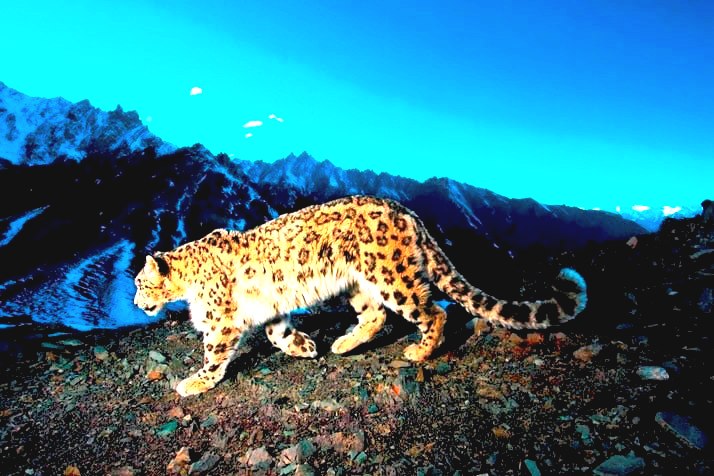
Snow Leopard: a moderately large cat native to the mountain ranges of Central Asia, mainly in the Pamir Mountains of Tajikistan (photograph by Steve Winter)
Part One: The Aircraft and the Operation
The Aircraft
This is the story about an aircraft named Snow Leopard, which was a Boeing 747SP that was leased by Tajik Air, the national airline of the Republic of Tajikistan, then a newly independent former Soviet Republic located in Central Asia. The aircraft was operated exclusively on the international routes of Tajik Air and gave that airline a presence in London, UK, Delhi, India and Karachi, Pakistan. The operation was controlled and managed by a management company in London, Tajik Air Limited. This is what made this operation unique. What also made it unique was that Snow Leopard was crewed by former pilots and flight attendants of Pan American World Airways, the former great airline that ceased operations in December, 1991.
The operation started with Snow Leopard’s departure from London for Dushanbe, Tajikistan in December 1993. It ended in February 1994 when the aircraft was repossessed by United Airlines, the aircraft’s owner and lessor. What happened during these three months are stories of adventure, bravery, comedy, intrigue, loyalty and teamwork. And they will be told in the following posts by those who were there, the pilots, flight attendants and the London management staff.
As background, the Boeing 747SP is a modified version of the Boeing 747 which was designed for ultra-long-range flights. The “SP” stands for “Special Performance”. Compared with its predecessor, the 747-100, the 747SP retains its wide-body four-engine layout, along with its double-deck design, but has a shortened fuselage, larger vertical stabilizer, and simplified trailing edge flaps. The weight saved by the shortened fuselage permits longer range and increased speed relative to other 747 configurations.
Known during development as the short-body 747SB, the 747SP was designed to meet a 1973 joint request from Pan Am and Iran Air, who were looking for a high-capacity airliner with sufficient range to cover Pan Am’s New York–Middle Eastern routes and Iran Air’s planned Tehran–New York route. The aircraft also was intended to provide Boeing with a mid-size wide-body airliner to compete with the DC-10 and L-1011.
The 747SP first entered service with Pan Am in 1976. The aircraft was later acquired by VIP and government customers, but sales did not meet the expected 200 units, and production ultimately totaled 45 aircraft.
While in service, the 747SP set several aeronautical performance records, including three record-setting round-the-world flights, two operated by Pan Am and the third by United.
From Captain Sherman Carr, one of the former Pan Am pilots who flew Snow Leopard:
“The airplane that was to be used for this operation was a Boeing 747SP. * * * The plane was originally developed for Pan Am to be able to operate non-stop from the U.S. to Hong Kong and be able to stay aloft for over 15 hours. It was actually a regular 747 with upstairs lounge seating but shortened by about 48 feet to make it lighter and additional fuel tanks for longer range. If it’s not loaded with full fuel for extended range flights, the aircraft actually scoots like a hot rod and will outperform any WWII or Korean conflict fighter aircraft and is a lot of fun to fly. It will roll or loop or do most of the maneuvers you see at airshows but of course this is not authorized so no pilot would ever tell you he had done those things. For Dushanbe, surrounded by mountains in all directions, it was the perfect choice due to its ability to climb quickly, safely and be on its way in a timely manner and still carry about 260 people with an extended first class.”
Snow Leopard, Manufacturer’s Serial Number 21649, Serial 373 was first delivered to Pan American World Airways on May 11, 1979 registered as N540PA and named Clipper White Falcon. It was renamed Clipper Flying Arrow on August 1, 1979 and later renamed Clipper Star of the Union on January 1, 1980. One year later, on January 1, 1981, the aircraft became China Clipper.
On February 12, 1986, as part of Pan Am’s sale of its Pacific Routes, N540PA was acquired by United Airlines. The registration was changed to N149UA on June 1, 1986. It was under this registration that the aircraft operated for Tajik Air, pictured below:
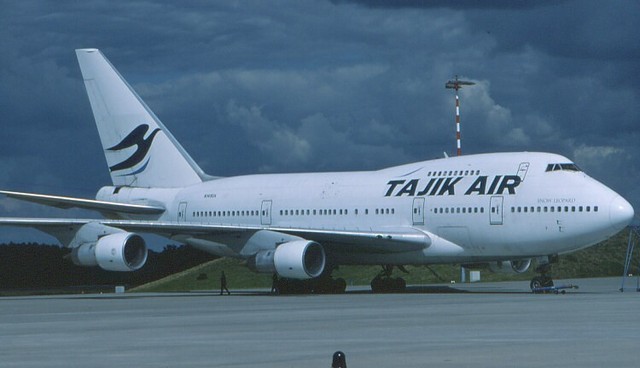
Snow Leopard
After the aircraft was repossessed by United Airlines, it was bought by the Brunei Government and re-registered as V8-JBB. It was then bought by the Government of Bahrain on December 24, 1998 and registered as A9C-HMH (below, left). Today Snow Leopard is owned by the Las Vegas Sands Corporation, registered as VQ-BMS (below, right, photo by Wong Chi Lam). She is still in operation.
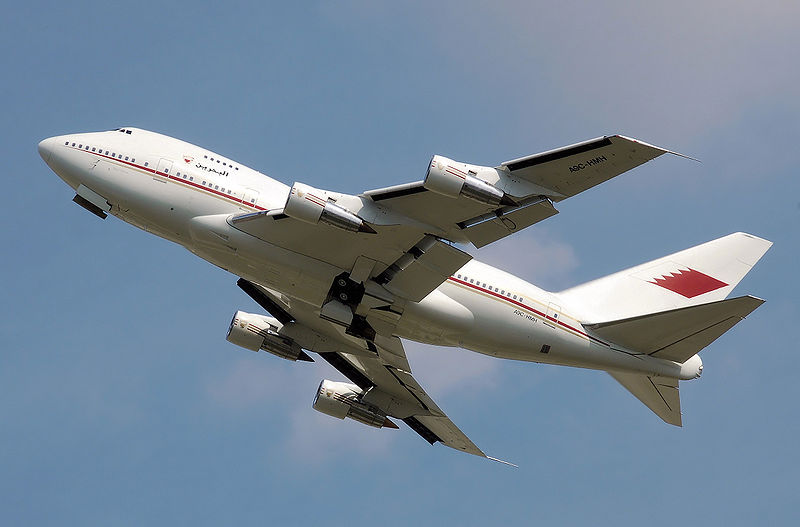
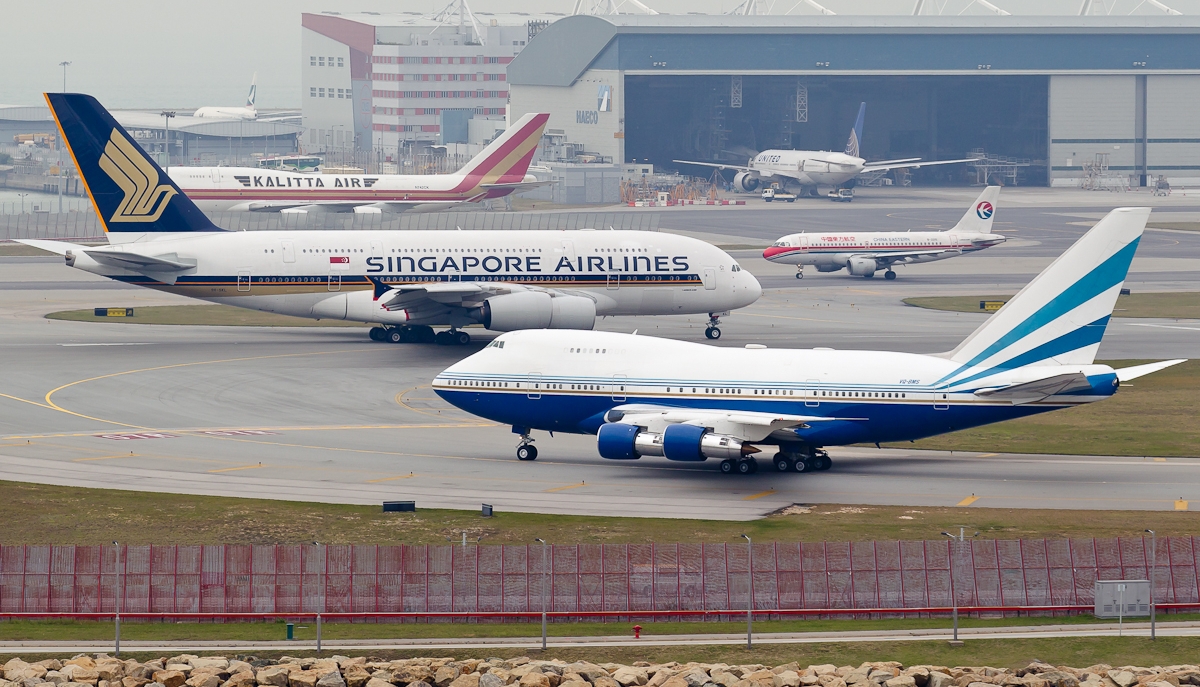
The Operation
Starting a new service in any market requires a great deal of research and planning. There must be a suitable aircraft. Government approvals must be in place. Airport access, slots (if required), ground handling services and airport facilities (check-in desks, etc) must be obtained. On the commercial side, the new service needs to be marketed, publicized and tickets sold. Other details include setting up the ticket and operations offices, arranging catering, publishing an In-Flight magazine and printing safety information cards, timetables, paper tickets, baggage tickets, promotional materials and stationary.
For Tajik Air, however, there was one very important requirement missing: an operating base in London and sufficient infrastructure to crew and maintain a Boeing 747SP aircraft. That presented a huge problem as the civil aviation structure of Tajkistan was completely inexperienced in intercontinental operations. In fact, Tajik Air was created by the breaking-up of the Soviet Union and the then national carrier Aeroflot’s leaving of some old Russian-built aircraft (mostly TU-154s) for use by Tajik Air as the new national air carrier of Tajikistan. Setting up a London base would seem impossible to achieve given the limited resources of Tajikistan. However, through the foresight and creativeness of a few airline experts in London, the requirement was met.
To establish the necessary infrastructure so that Tajik Air could operate flights to/from London, a third-party UK management company, Tajik Air Limited, was formed. Its purpose was to operate international flights on behalf of Tajik Air. The company would obtain and maintain the aircraft and crew, organize the marketing and selling of the flights and essentially operate the flights. This would be accomplished using Tajikistan’s Air Operator’s Certificate and Tajik Air’s call-sign and airline code. Tajikistan committed to funding the new service and also obtaining the required government permissions for the operation.
How would this operation be viable and profitable? The route of primary interest to Tajik Air was the London (Heathrow) (“LHR”)-Dushanbe (“DYU”) sector. Operating that sector as an Origin-Destination route presented problems in that there was little, if any, traffic between the two points. The question was how to fill an aircraft with 260 seats? The answer: Offer service between LHR and points beyond DYU. This was to be accomplished using rights under the Sixth Freedom of the Air.
The Freedoms of the Air, established by the Chicago Conference of 1944, are a set of commercial aviation rights granting a country’s airlines the privilege of entering and landing in another country’s airspace. The table below illustrates these Freedoms of the Air:
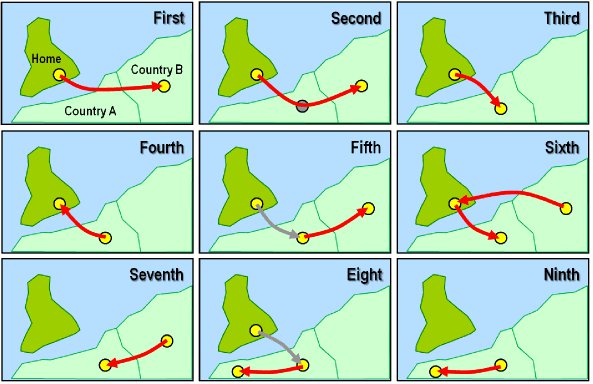
In the case of Tajik Air, the Third and Fourth Freedoms were the operative. The former gives the “Home” (Tajikistan) country the rights to carry commercial traffic (passengers/cargo/mail, etc) to another country; the latter gives the “Home” country the rights to carry commercial traffic from that other country to home. These rights are generally agreed-to between the “Home” country and the other country in the form of a Bilateral Agreement or an Air Services Agreement. By using Third and Fourth Freedom rights, a Sixth Freedom operation can be created. It is similar to a hub operation with the home country being in the middle of the operation between two different countries.
For Tajik Air, the beyond points selected were Delhi, India (“DEL”) and Karachi, Pakistan (“KHI”) due to the large number of Indians and Pakistanis living in the UK. The schedule would work like this: Tajik Air departs from LHR with a planeload of passengers on a Fourth Freedom flight to DYU. Upon arrival in DYU, those few passengers destined for DYU disembark and the rest stay on board. The flight then departs DYU with a new flight number on a Third Freedom flight for DEL or KHI. Upon turning around in DEL/KHI, with a new planeload of passengers, the flight becomes a Fourth Freedom to DYU and from DYU, with another flight number, Third Freedom to LHR. By operating this schedule, Tajik Air could fill the seats of Snow Leopard, and compete in a highly competitive market by offering good service with low fares. In order to operate this schedule, Bilateral or Air Services agreements were required for scheduled traffic between Tajikistan and India/Pakistan in addition to the UK.
The published timetable shown below illustrates this operation. Baggage tags are also shown.
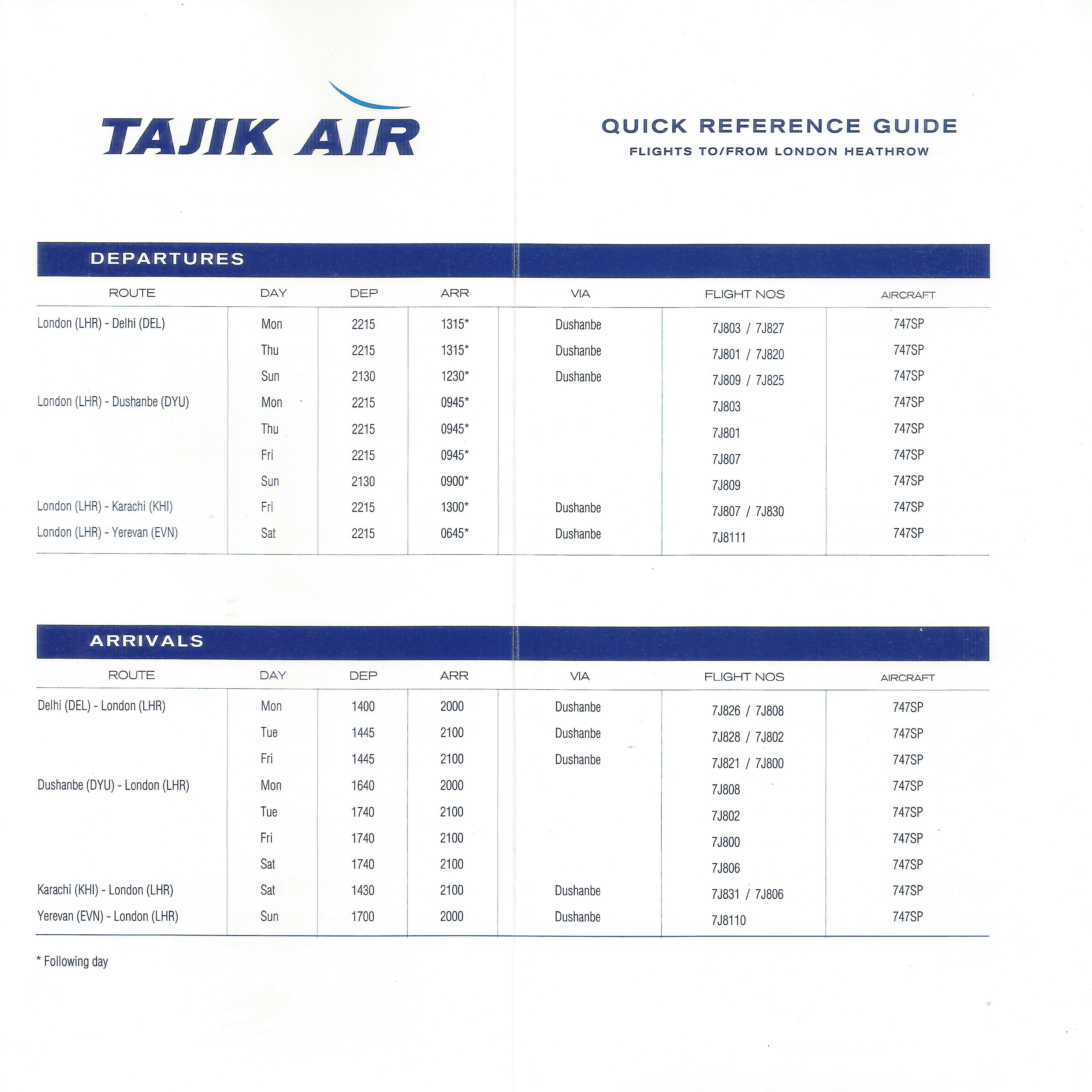

As outlined above, there were other details necessary for the operation. For the aircraft, copies of the In-Flight magazine and emergency information cards were printed and are illustrated below:
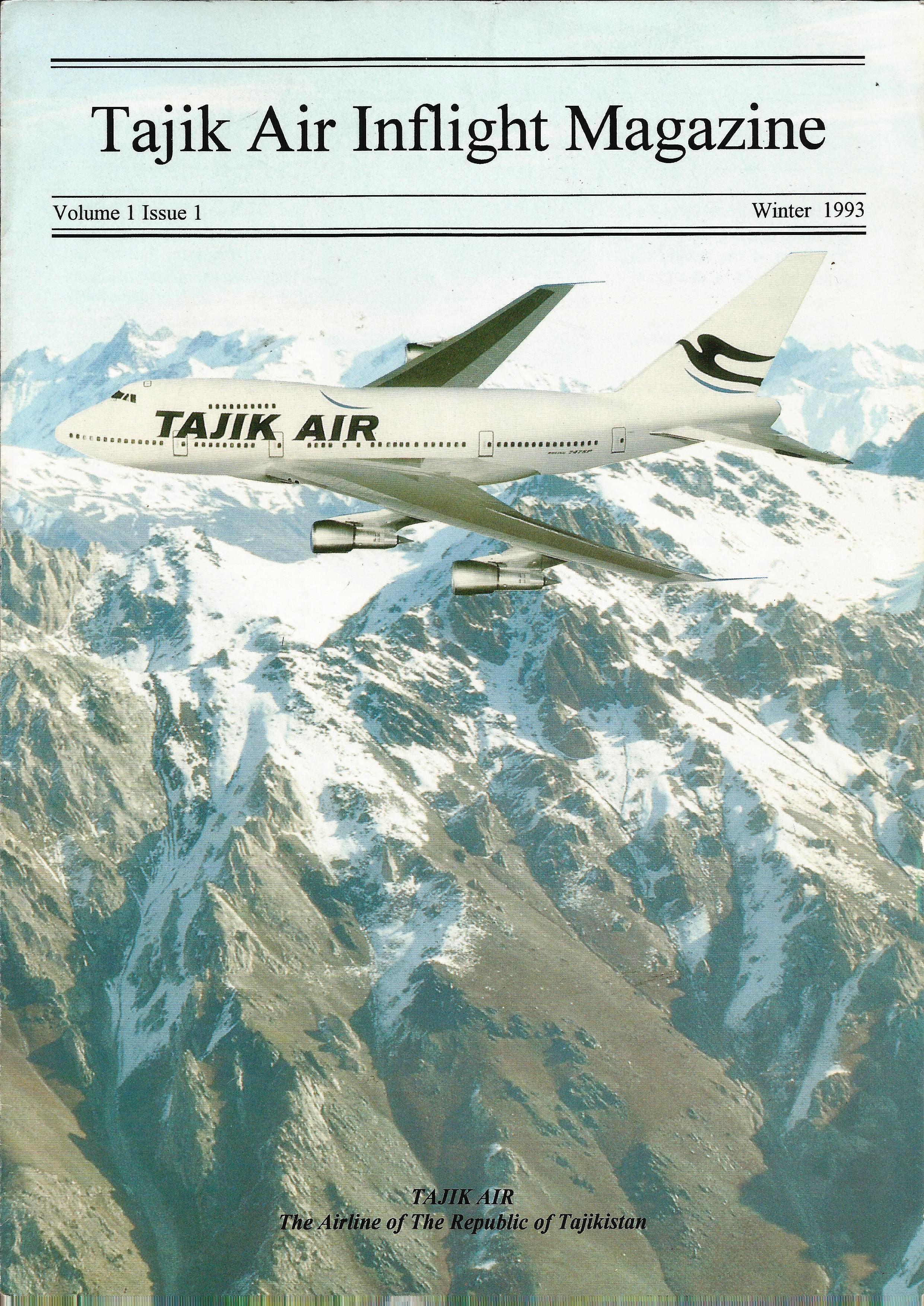
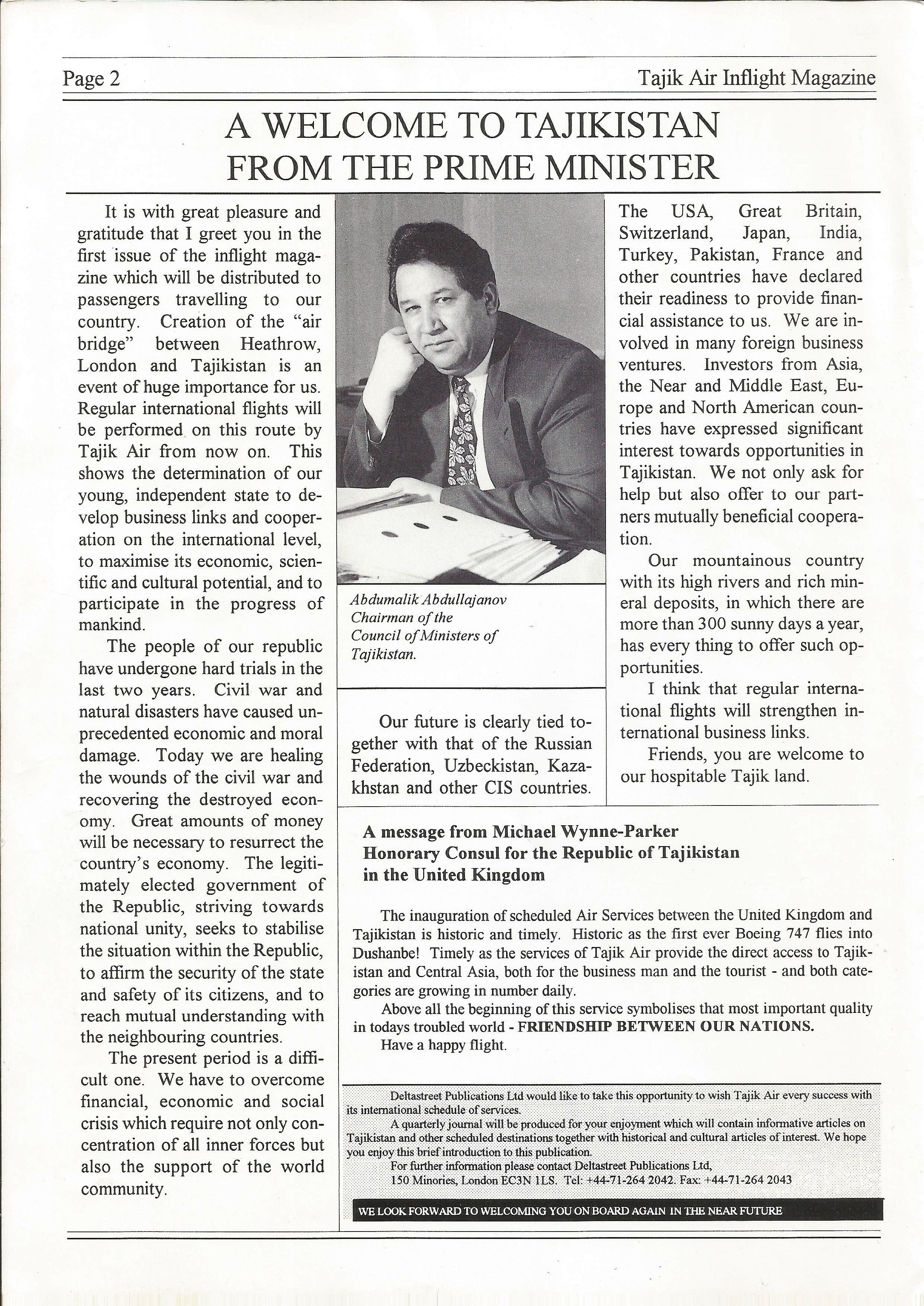
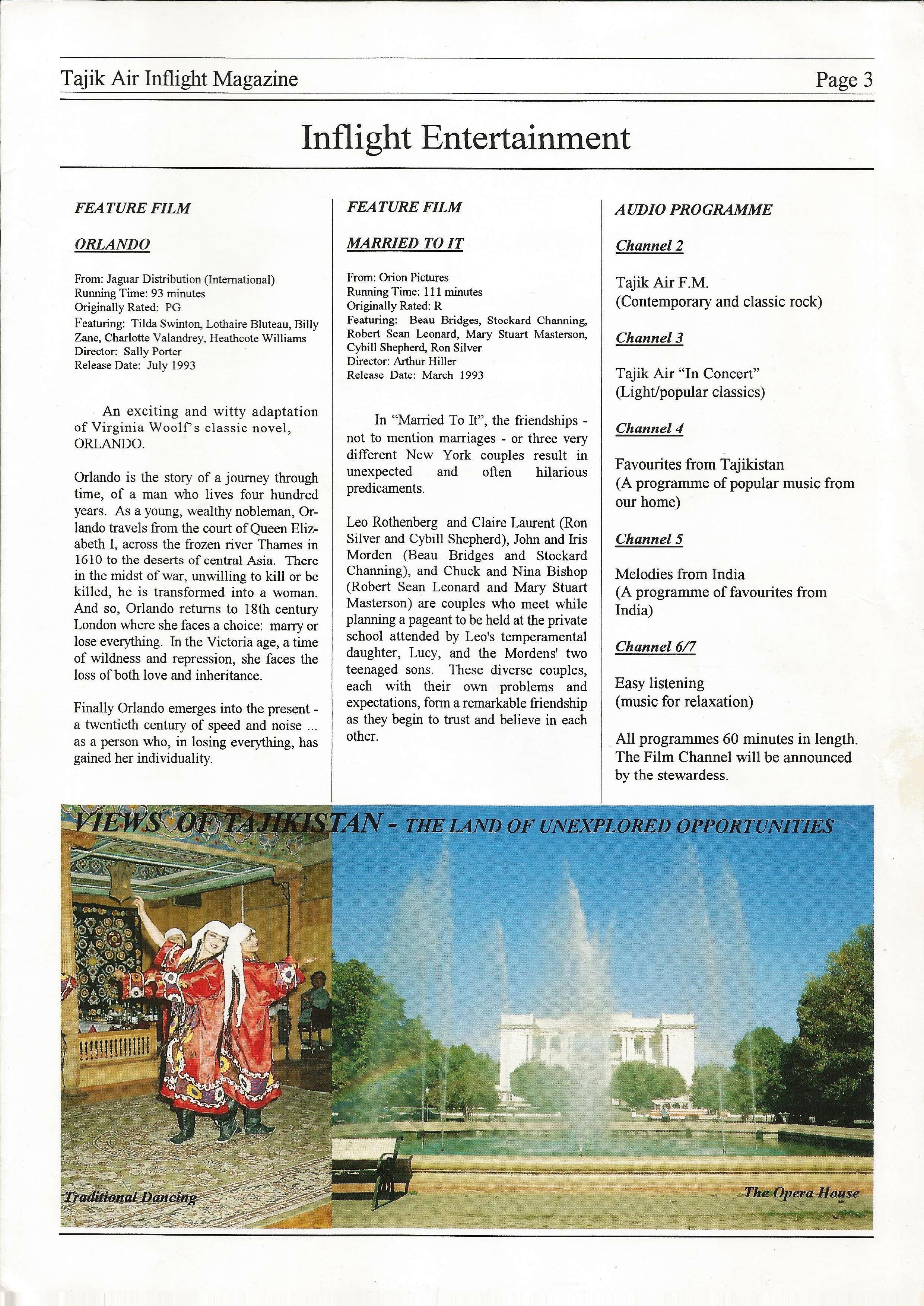
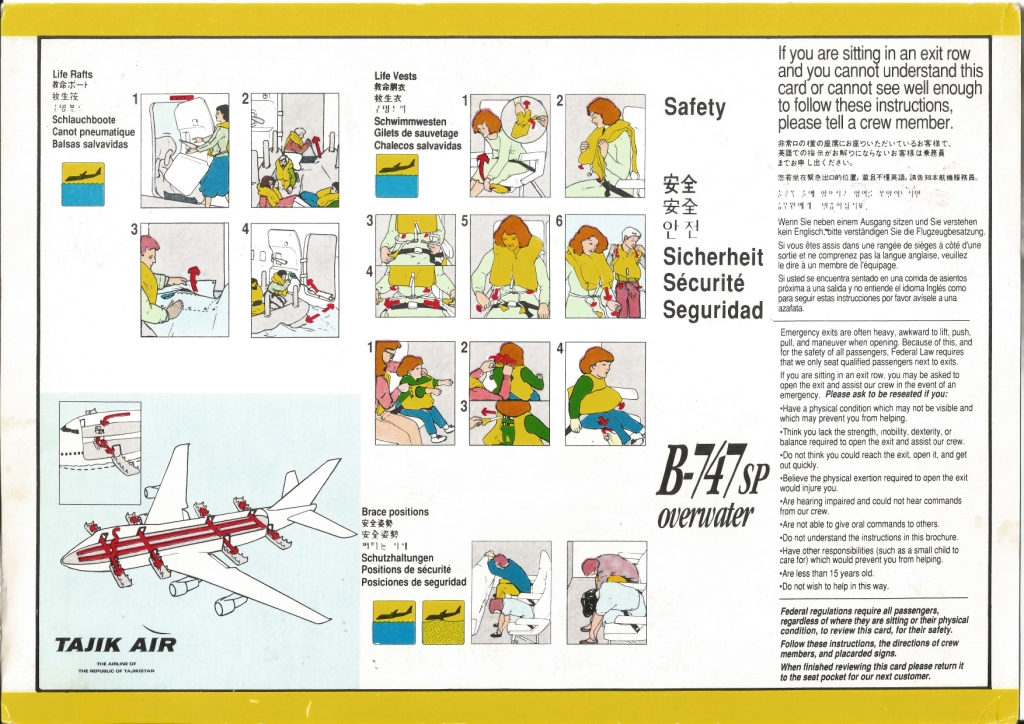
Additionally, as part of the pre-launch publicity, an article was put in a magazine for business travelers about the new service:
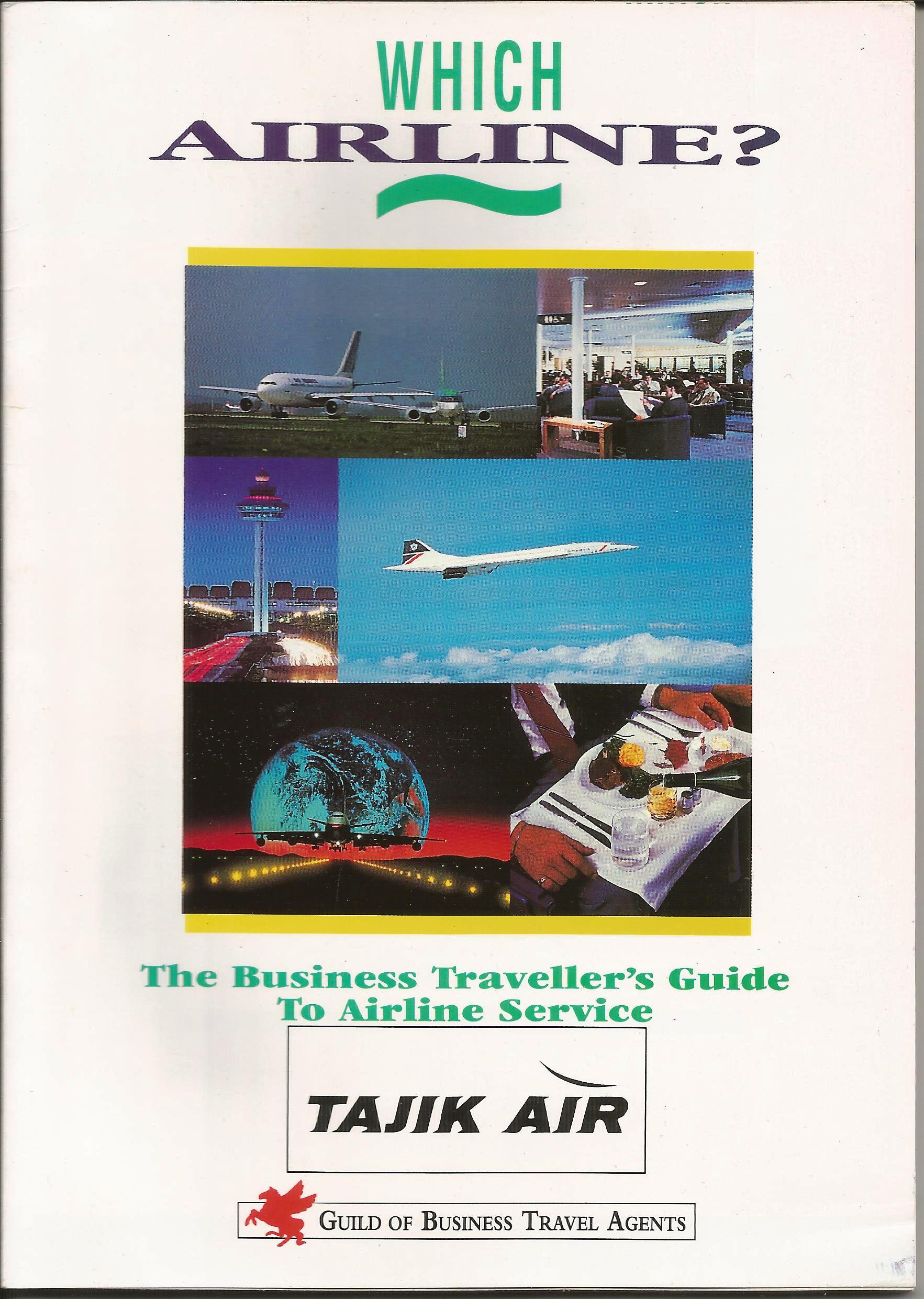

For ticket sales, an office was set up in Kensington, London and a general sales agent was appointed in Karachi and Delhi. In addition a large poster was printed for display at the ticketing offices with an image of Snow Leopard in the air:
The next steps in the launch of Tajik Air’s new service to London involved recruiting and training flight crews and taking delivery of the aircraft. This will be coming in Part Two of the Story of Snow Leopard.
End of Part One
6 August 2013 Leave a comment
Part Four: The Suez Canal
Our transit of the Suez Canal began at 0100 hours (1:00 a.m.). By daybreak, the convoy was well underway and I had the opportunity to see the sights on both sides of the canal.
From my newsletter of November 1990:
“After Cairo I got an opportunity to transit the Suez Canal on a merchant ship. This was a fascinating experience primarily because of the importance of the role of the Suez Canal in world commerce and its role in history. It is the only fast way to get between Europe and the Middle East/Far East by sea. On one side is the Sinai Desert and the other side is developed land, much of which is used by the Egyptian military. During the transit I saw many remnants of the Egypt-Israel wars, including blown up and abandoned buildings, abandoned airbases and abandoned vehicles.
“Ships transiting the canal are formed into convoys and are guided and controlled by the Egyptians from the time they arrive in Port Said (the Mediterranean entrance to the canal also known as “Port Marlboro”) to the time they are released at Port Suez (at the top of the Gulf of Suez). These people include immigration, health, customs and canal officials, vendors, agents and their assistants, electricians (for the canal floodlight) and mooring laborers (the “boatmen”). They can hold up or expedite a canal transit at will. Additionally, when the ship is moored in Port Said awaiting transit, “bumboats” containing vendors selling souvenirs surround the ship, trying to get on board.
“For the ship’s master, the object is to get through the canal as quickly as possible. And, one of the best means of getting expeditiously through the transit is to prevent the occurrence of any reason to delay the transit. This is accomplished by giving the canal officials and others a “present”, which is usually a carton of Marlboro cigarettes (in the red box). The giving of “presents” is usually preceded by someone saying, “Do you have my present, Captain?” There is a saying among those who have transited the canal: “Give ’em a carton of Marlboros and things move fast”. Otherwise a document may be lost, or something could be “discovered” wrong with the ship that could slow down the transit.
“On the ship I was on, the Suez Canal Authority suggested that the ship’s trim was not in line with canal standards. The problem was resolved when the master passed out the cartons of Marlboros (the Egyptians want only Marlboros, reds, in the box; anything else, especially Kools, would make them unhappy). On my ship, the master gave out a total of about thirty cartons, which is about average. Why all the cigarettes? Cigarettes, especially Marlboros, are like currency. And incomes of some of these people (especially laborers and vendors) are so low that selling cigarettes to Marlboro-hungry Egyptians is a lucrative source of income. (While in Cairo, it seemed everyone who was smoking was smoking Marlboros (reds, in the box).) Just before we got underway, a crewman on the pilot boat bringing the Suez pilot was yelling at our ship, “Captain, Captain, seegarets pleeze, seegarets for food!”
Besides cigarettes the Egyptians usually manage to get American-made toiletries and similar goods from the masters of the ships transiting the canal. In addition, interestingly enough, the canal pilot can also get a special “present” of a bottle of liquor, usually top end. Ships that regularly transit the canal have a bonded storage containing these goods. It is also interesting to note that the cigarettes given out are marked “For shipboard use only” on the box.
The canal is only wide enough for one-way traffic. At Great Bitter Lake, about two-thirds the way down, both the southbound and northbound convoys rendezvous. Once the southbound convoy has exited the canal, the northbound proceeds on to Port Said. The southbound convoy proceeds to, and ends at, Port Suez, where the Egyptian pilot and the boatmen disembark the ship. The ships in the convoy then break up, heading into the Gulf of Suez and eventually the Red Sea.
Below: Views from the bridge of the Ashley Lykes.


Below: Sinai (east) side of the canal. “Road to Nowhere” in left picture; military facility in the right. Note the Mosque, lower left corner.


Below: West side of the canal. Left picture shows crater created by a blast. Note the unfinished structures in the right picture.


Below: Contrast the east side (left) and west side (right) of the canal. Note the Mosque in left picture.


Below: Goods on display for sale brought on board by the boatmen (left). On the right, the Suez pilot.


Below: Ships at anchor awaiting the southbound convoy in Great Bitter Lake (left). At right, a Mosque in Port Suez.


Below: The convoy breaking up as it enters the Gulf of Suez (left). At right is a map of the canal.


From my newsletter:
“A few more observations about life in Egypt: Traffic is not regulated as in the States. Signals are only advisory. During rush hour (which seems to be all day), traffic police try to control the cars, with mild success – sometimes the cars obey. Additionally, it is not unusual to see mule drawn carts in the middle of city streets.
“I also got the impression that drivers, when given driving lessons, were taught first on the use of the horn, and how to get the most out of it. Horns were heard at all hours, even when there was no need for them. The message given by a horn is “get out of the way”. And when someone does not get out of the way an accident results. And when an accident occurs, it is not resolved in the usual way by exchanging insurance company names. Not in Egypt. First fault has to be determined. And this is accomplished by shouting matches between the two parties involved. But it is not only two people shouting to each other. The shouting is so loud, a crowd gathers, picks sides, and joins the debate. I actually witnessed this in an accident between a bus and a taxicab. To their credit, the passengers did not get involved, just the drivers and the onlookers.”
I found visiting Cairo and transiting the Suez Canal a fascinating and most memorable experience; something to be remembered for a long time. I do not think much has changed vis-a-vis the Suez Canal transit based on recent Google searches. However, I did observe, and this is back in 1990, that Egypt’s history was pivotal in the development of the world’s civilizations. The country is rich in resources and tradition, and should be a great place to visit. However, things need to be fixed, and while not commenting on the current political situation, I do hope it is resolved soon, so that Egypt can eventually become economically and politically healthy and people can visit and enjoy what Egypt has to offer.
End of Part Four
End of my Egypt Adventure
5 August 2013 Leave a comment
Part Three: Port Said
Part Three of my Egypt Adventure began on the third day when I left Cairo for Port Said and my transit of the Suez Canal aboard the Ashley Lykes. I was picked up by two representatives from the ship’s Port Said agents whose sole purpose was to get me to Port Said, processed through immigration and on board the ship. The trip took me through the Egyptian countryside, passing through several towns and villages. We made a couple of stops where one of the agents delivered packages of what appeared to contain American-made toiletries and similar goods, and cartons of cigarettes to various shops. When we finally arrived in Port Said, I was ushered to the offices of the shipping agent, where I was to remain for about four hours until I was to be taken to the ship.
Below are photos of one of the roads en-route to Port Said, a town where we stopped with the goods and scenes of downtown Port Said:


Below is a picture of the entrance to the office of the shipping agency of my ship (left) and a picture of my handlers (right).


Below: Port Said’s waterfront (left) and the Suez Canal Authority headquarters (right).


After leaving the agent’s office, we went directly to Egyptian immigration to process me out of the country. When we arrived there was a huge line in the waiting hall but somehow we bi-passed that and went to the office of one of the more senior immigration officials. He dutifully studied my passport, gave it the appropriate stamps and cleared me to depart. As we left, the agent shook hands with the immigration official and I noticed that part of the handshake included a wad of cash. The cash was what is known as “baksheesh”.
After boarding a launch, we proceeded to the ship, going through a maze of anchored ships of various sizes and shapes, including a Greek frigate, a Cypriot cruise ship, a multitude of tankers and other cargo ships.
Below: The Greek frigate Elli and Cypriot cruise ship Princesa Marissa at anchor off Port Said’s waterfront.


Below: A tanker at anchor and a local harbor ferry.


Below: S.S. Ashley Lykes at anchor. Note the bumboats lingering by the gangway. The master raised the gangway to keep vendors from boarding his ship.


Once on board the Ashley Lykes, I was greeted by the master who escorted me to his cabin where he added my name to the crew roster as an engineering officer(!). He told me that the immigration people might be coming on board before departure and therefore I had to be accounted for. He put the crew roster on a table in the reception area of his cabin and placed on top of it a carton of Marlboro cigarettes, “to keep them happy”, he said.
The next day, at 0100 hours, we got underway for our transit of the Suez Canal. In Part Four, my trip down the Suez Canal. Watch this Space!
End of Part Three


 JPB TRANS CONSULTING, LLC
Recent Comments